Case Reports
. 2020 Oct-Dec;13(4):312-316.
doi: 10.4103/JETS.JETS_70_20. Epub 2020 Dec 7.

Memory T-Waves, a Rare Cause of T-Wave Inversion in the Emergency Department

Affiliations
Case Reports

Memory T-Waves, a Rare Cause of T-Wave Inversion in the Emergency Department

R Gunaseelan et al. J Emerg Trauma Shock. 2020 Oct-Dec.

Abstract

One of the rare causes of diffuse T-wave inversion (TWI) in electrocardiogram (ECG) is memory T-waves. This should be considered among the differentials of diffuse TWI in ECG of patients presenting to the emergency department (ED), especially when they have previous episodes of ventricular tachycardia (VT) or pacemaker implantation or Wolff-Parkinson-White syndrome. These TWIs are benign and do not require any treatment. However, it is of paramount importance for the emergency physician to differentiate it from ischemia-related T-wave changes. In the following case series, we report three cases of memory T-waves. Two of the cases had TWI in leads II, III, aVF, and V3 to V6 following reversion of VT. The other patient, with a VVI (Left ventricle paced, Left ventricle sensed, Inhibition to sensing) pacemaker, had memory T-waves in the ECG taken during normal sinus rhythm. In all the three patients, we considered memory T-waves to be the possible cause of TWI. The electrocardiographic diagnostic criteria for memory T-waves are positive T in lead aVL and positive/isoelectric T in the lead I; and precordial TWI >inferior TWI. These criteria are 92% sensitive and 100% specific. In the following case series, we also provide an algorithmic approach for patients with suspected memory T-waves in their 12-lead ECG when they present to the ED.

Keywords: Chatterjee phenomenon; T-wave inversion; memory T-waves; postpacing T-wave inversion; posttachycardia T-wave inversion.


Conflict of interest statement

There are no conflicts of interest.

Figures
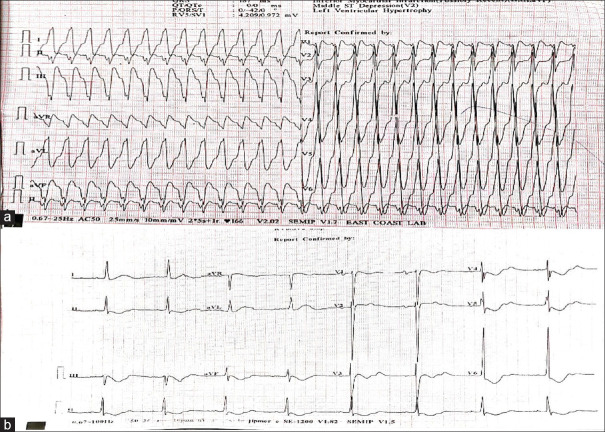
Figure 1
Figure 1
(a) 12-lead electrocardiogram of the patient showing regular wide complex tachycardia. (b) Electrocardiogram of the same patient postcardioversion showing positive T-wave in leads I and aVL and negative T-wave in leads II, III, aVF, and V3 to V6 with precordial T-wave inversion more than T-wave inversion in inferior leads suggestive of memory T-waves
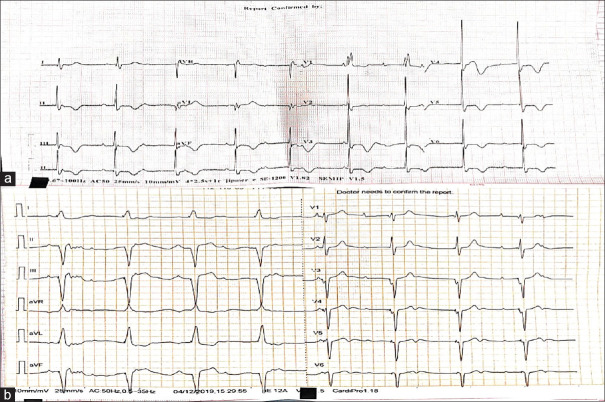
Figure 2
Figure 2
(a) 12-lead electrocardiogram of the patient showing regular intermediate QRS complex tachycardia with right bundle branch morphology with left axis deviation and AV dissociation suggestive of fascicular ventricular tachycardia. (b) Electrocardiogram of the same patient postcardioversion showing positive T-wave in leads I and aVL and negative T-wave in leads II, III, aVF, and V4 to V6 with precordial T-wave inversion more than T-wave inversion in inferior leads suggestive of memory T-waves
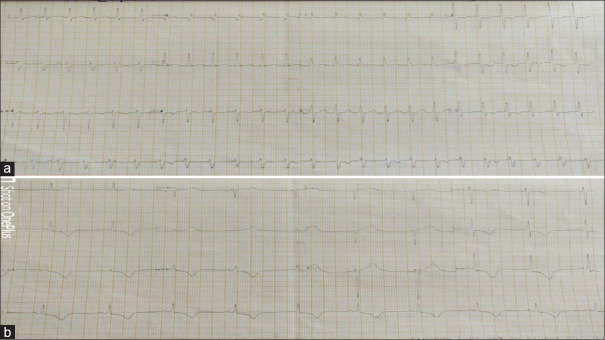
Figure 3
Figure 3
(a) 12-lead electrocardiogram of the patient with a pacemaker in situ showing positive T-wave in leads I and aVL and negative T-wave in leads II, III, aVF, and V4 to V6 with precordial T-wave inversion more than T-wave inversion in inferior leads suggestive of memory T-waves. (b) 12-lead electrocardiogram of the same patient showing regular wide complex rhythm at a rate of 50 beats/min with pacer spikes suggestive of pacemaker rhythm. (Note: The lower rate of pacemaker is set at 50 beats/min to prolong the life of pacemaker)
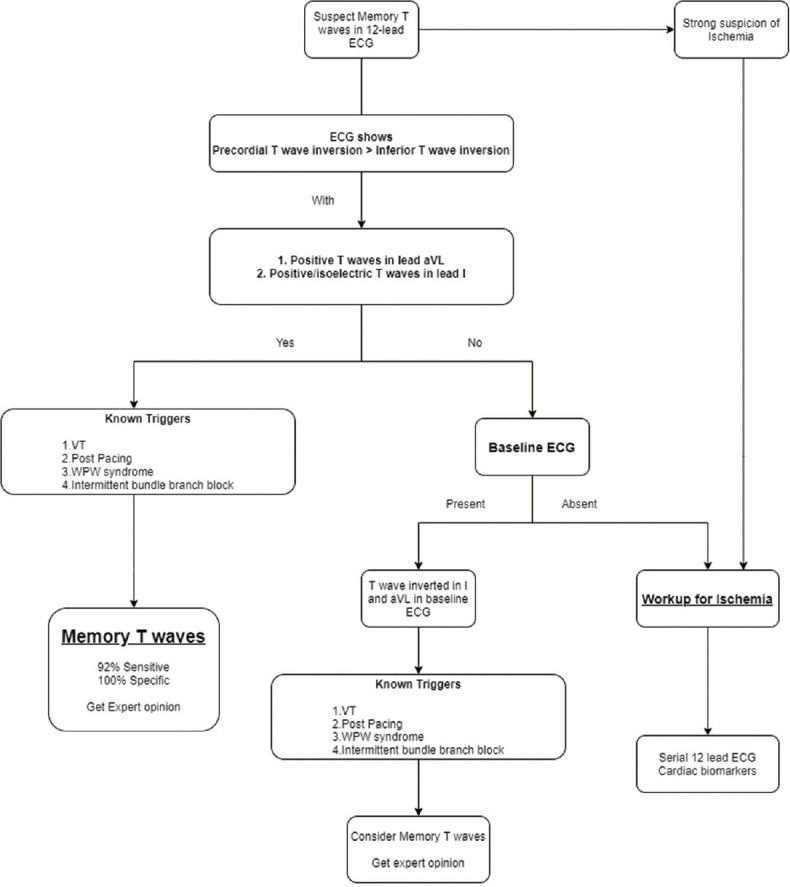
Figure 4
Figure 4
Algorithm for differentiating memory T-waves from ischemia related T-wave changes

References

    1. Chatterjee K, Harris A, Davies G, Leatham A. Electrocardiographic changes subsequent to artificial ventricular depolarization. Br Heart J. 1969;31:770–9. - PMC - PubMed
    1. Rosenbaum MB, Blanco HH, Elizari MV, Lázzari JO, Davidenko JM. Electrotonic modulation of the T wave and cardiac memory. Am J Cardiol. 1982;50:213–22. - PubMed
    1. Jeyaraj D, Ashwath M, Rosenbaum DS. Pathophysiology and clinical implications of cardiac memory. Pacing Clin Electrophysiol. 2010;33:346–52. - PMC - PubMed
    1. Sucu MM, Davutoglu V. Cardiac memory T-wave changes after ventricular tachycardia in pregnancy. Am J Emerg Med. 2008;26:968:e1–3. - PubMed
    1. Waks JW, Steinhaus DA, Shvilkin A, Kramer DB. Post-pacemaker T-wave Inversions: Cardiac memory. Am J Med. 2016;129:170–2. - PMC - PubMed

Publication types