. 2021 Mar;33(3):033328.
doi: 10.1063/5.0043934. Epub 2021 Mar 29.

Computer simulation of the SARS-CoV-2 contamination risk in a large dental clinic

Affiliations

Computer simulation of the SARS-CoV-2 contamination risk in a large dental clinic

Jonathan Komperda et al. Phys Fluids (1994). 2021 Mar.

Abstract

COVID-19, caused by the SARS-CoV-2 (severe acute respiratory syndrome coronavirus 2) virus, has been rapidly spreading worldwide since December 2019, causing a public health crisis. Recent studies showed SARS-CoV-2's ability to infect humans via airborne routes. These motivated the study of aerosol and airborne droplet transmission in a variety of settings. This study performs a large-scale numerical simulation of a real-world dentistry clinic that contains aerosol-generating procedures. The simulation tracks the dispersion of evaporating droplets emitted during ultrasonic dental scaling procedures. The simulation considers 25 patient treatment cubicles in an open plan dentistry clinic. The droplets are modeled as having a volatile (evaporating) and nonvolatile fraction composed of virions, saliva, and impurities from the irrigant water supply. The simulated clinic's boundary and flow conditions are validated against experimental measurements of the real clinic. The results evaluate the behavior of large droplets and aerosols. We investigate droplet residence time and travel distance for different droplet diameters, surface contamination due to droplet settling and deposition, airborne aerosol mass concentration, and the quantity of droplets that escape through ventilation. The simulation results raise concerns due to the aerosols' long residence times (averaging up to 7.31 min) and travel distances (averaging up to 24.45 m) that exceed social distancing guidelines. Finally, the results show that contamination extends beyond the immediate patient treatment areas, requiring additional surface disinfection in the clinic. The results presented in this research may be used to establish safer dental clinic operating procedures, especially if paired with future supplementary material concerning the aerosol viral load generated by ultrasonic scaling and the viral load thresholds required to infect humans.


Figures

FIG. 1.
FIG. 1.
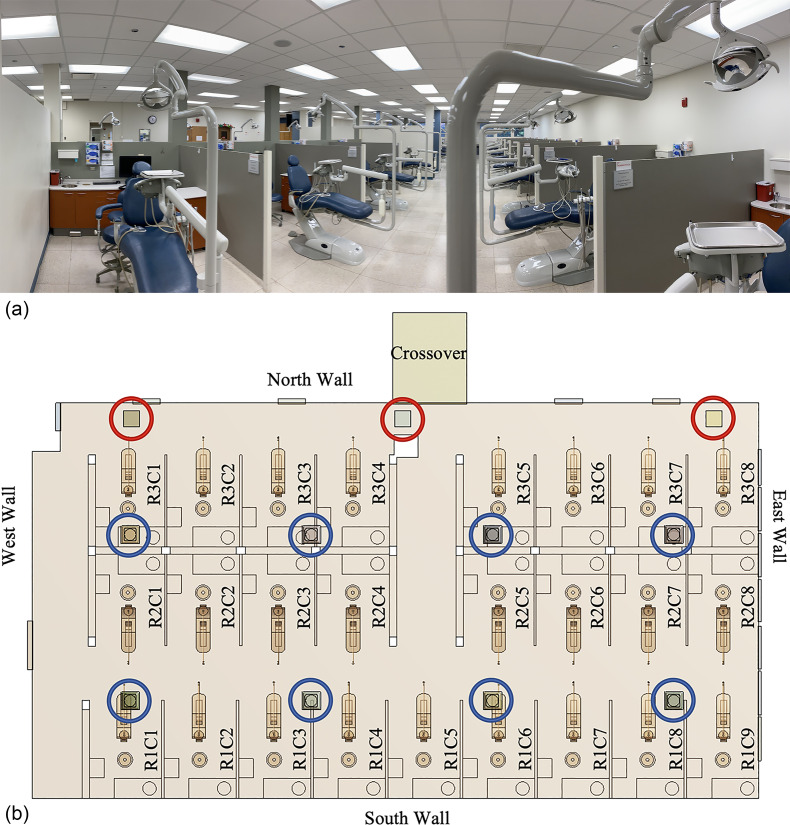
(a) Dentistry clinic and (b) layout of the dentistry room. Red and blue circles locate the ventilation outlets and inlets, respectively. Labels within the patient cubicles denote the cubicle number.
FIG. 2.
FIG. 2.
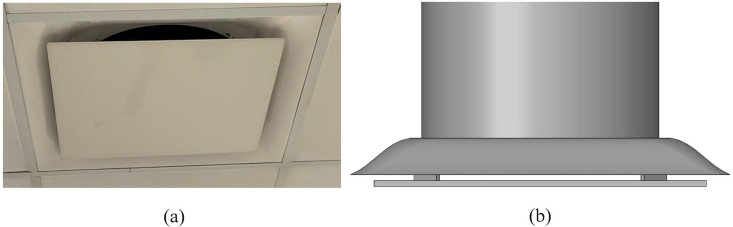
(a) Inlet vent mounted on the ceiling of the clinic and (b) CAD model of inlet vent.
FIG. 3.
FIG. 3.
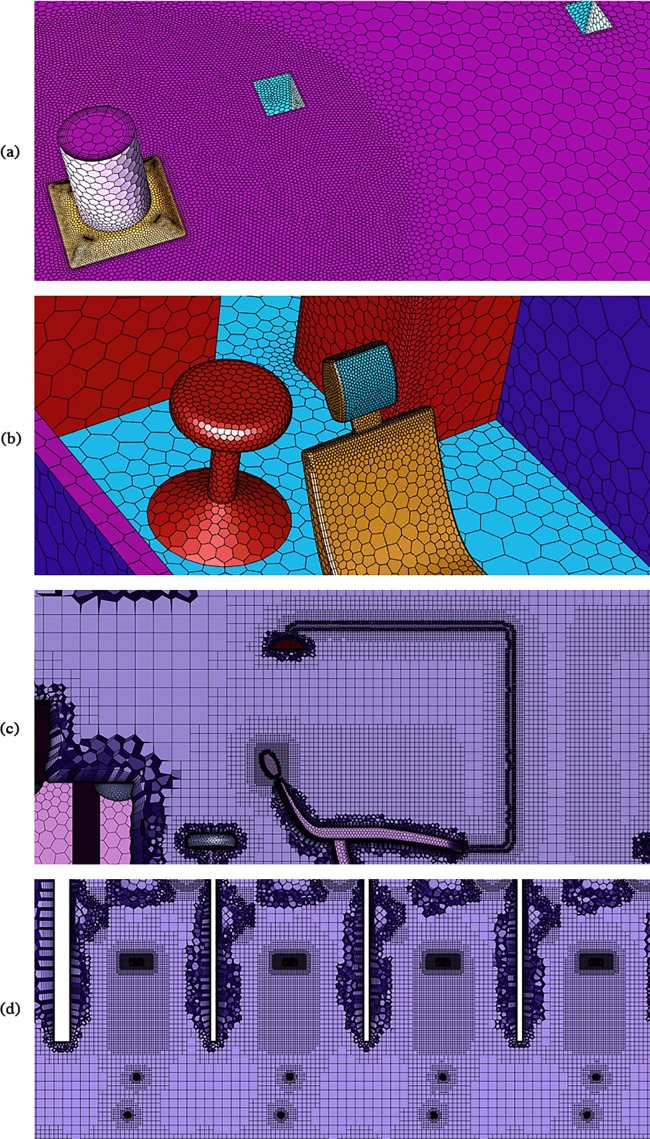
(a) Details of the numerical mesh near high-velocity inlets, (b) curvature refinement for dental unit, (c) side view of mesh refinement near the dental unit, and (d) top view of mesh refinement in the immediate vicinity of the patient chair.
FIG. 4.
FIG. 4.
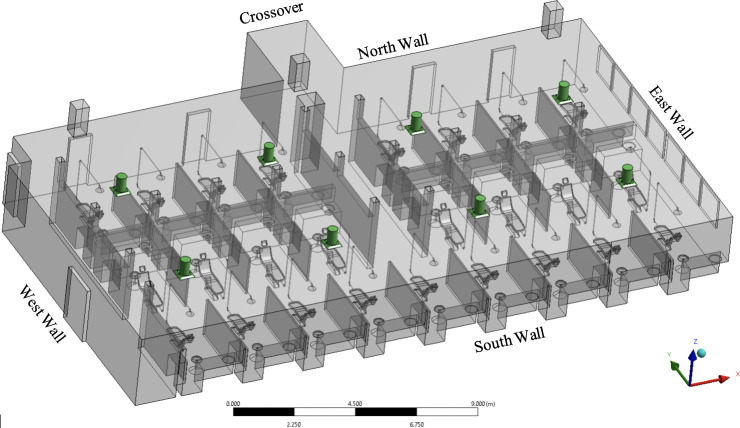
CAD model of the dentistry clinic. Conditioned air inlet vents are colored green.
FIG. 5.
FIG. 5.
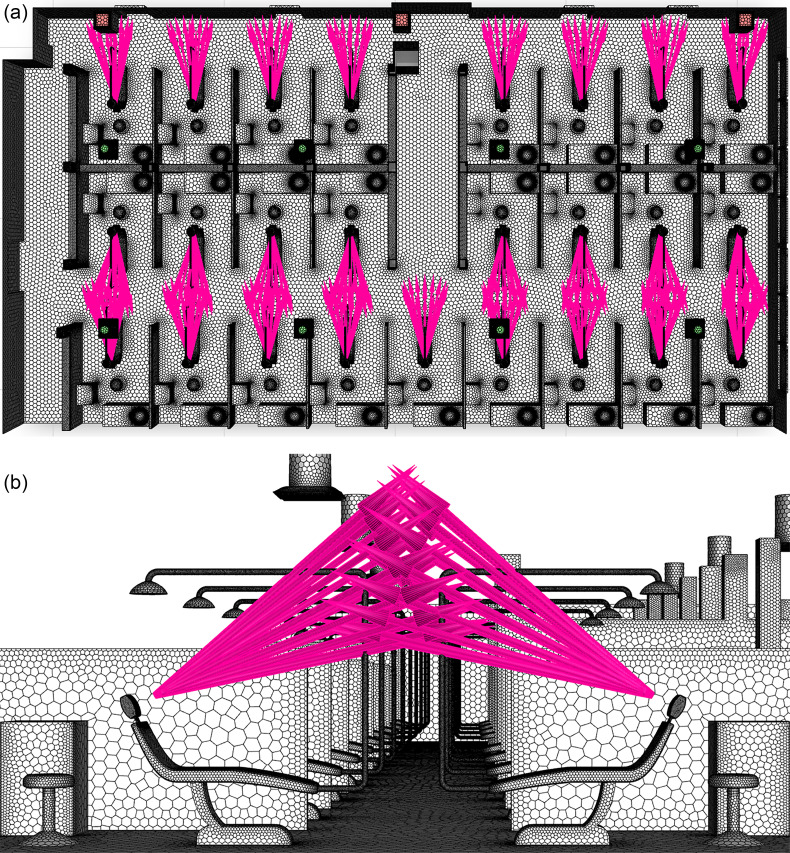
(a) Top view of droplet injection locations in the dentistry clinic and (b) side view of the injection away from the headrest location.
FIG. 6.
FIG. 6.
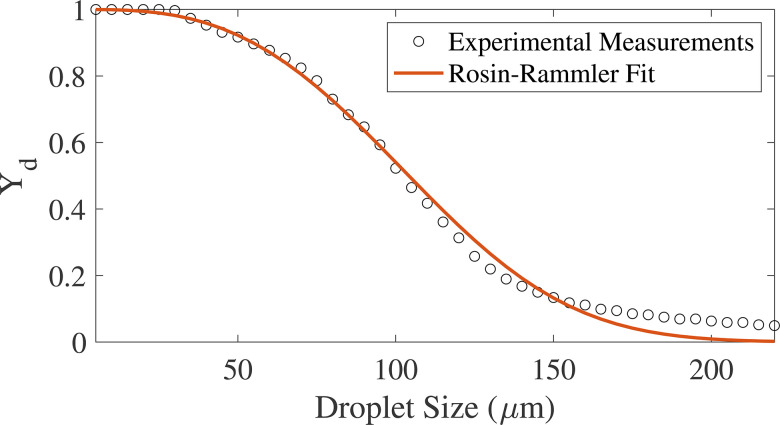
Experimental droplet size distribution of ejecta from patient's mouth compared to the Rosin–Rammler distribution used in DPM simulations.
FIG. 7.
FIG. 7.
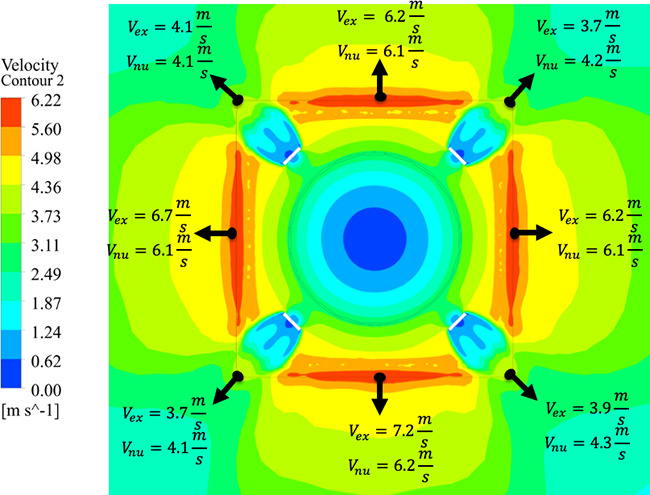
Comparison of the experimental measurements and numerical predictions for velocity exiting the vent in the clinic. Experimental measurements are Vex and numerical results are Vnu.
FIG. 8.
FIG. 8.
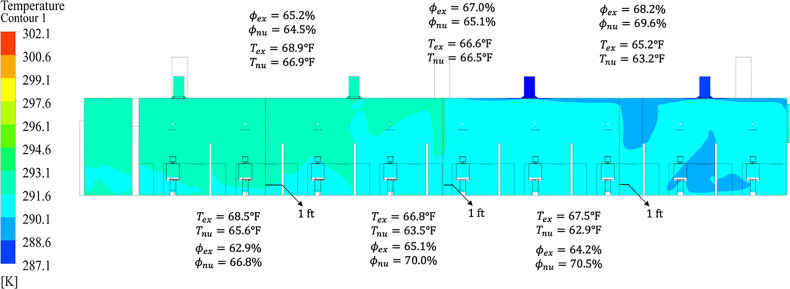
Comparison of experimental measurements and numerical predictions for temperature (T) and humidity (ϕ) at six locations in the clinic. Upper predictions are taken 1 in. below the drop ceiling and the bottom values are taken one foot from the floor.
FIG. 9.
FIG. 9.
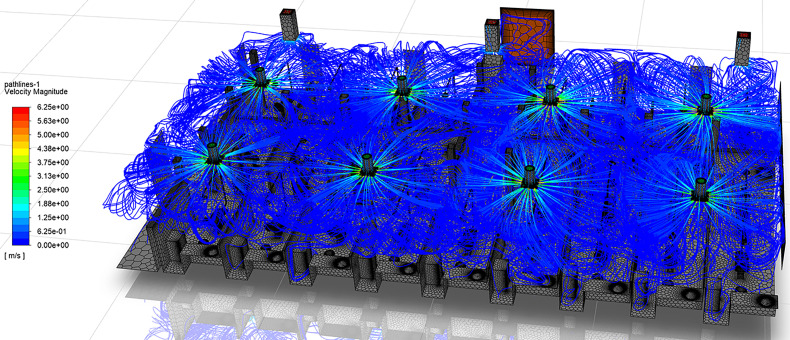
Streamlines colored by velocity magnitude in the dentistry clinic.
FIG. 10.
FIG. 10.
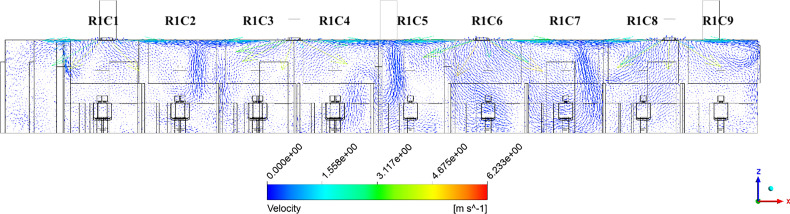
Velocity vectors along the vertical plane of the south vents in the clinic.
FIG. 11.
FIG. 11.
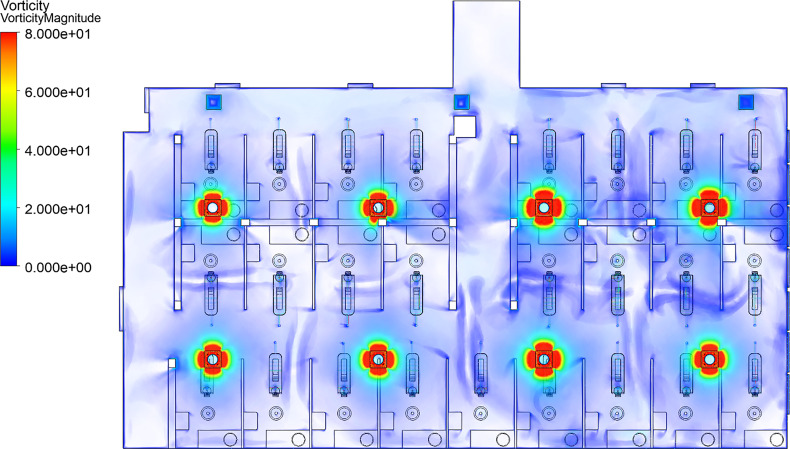
Vorticity magnitude in the dentistry clinic. Vorticity scale is limited to 80 [1/s].
FIG. 12.
FIG. 12.
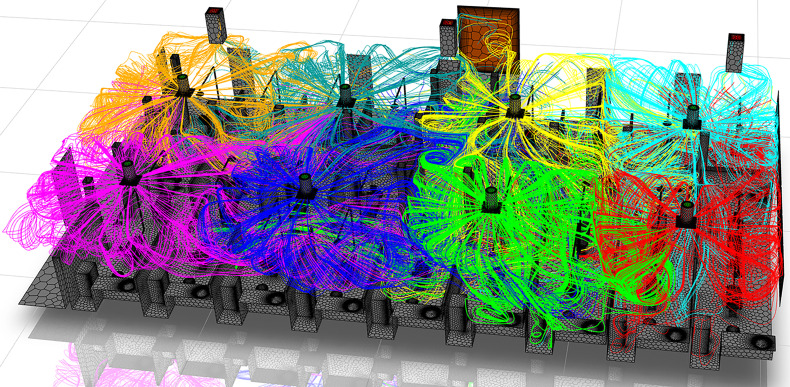
Streamlines colored by originating vent. Each color represents air jets entering the room from a specific vent.
FIG. 13.
FIG. 13.
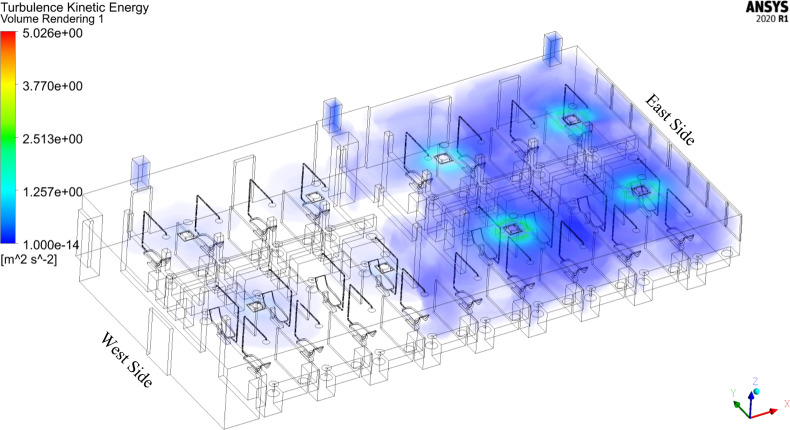
Turbulent kinetic energy in the dentistry clinic.
FIG. 14.
FIG. 14.
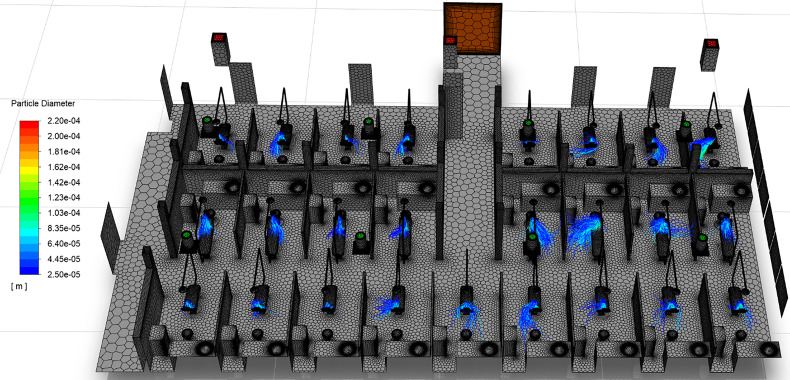
Transport of droplets over 25 μm in diameter. Particle paths are colored by droplet diameter.
FIG. 15.
FIG. 15.
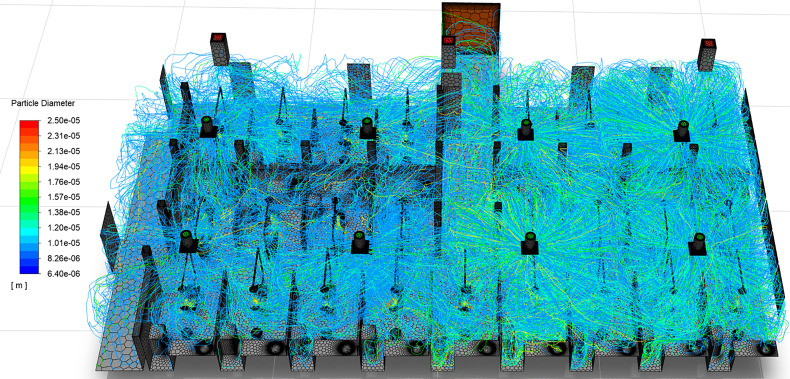
Transport of droplets under 25 μm in diameter. Particle paths are colored by droplet diameter.
FIG. 16.
FIG. 16.
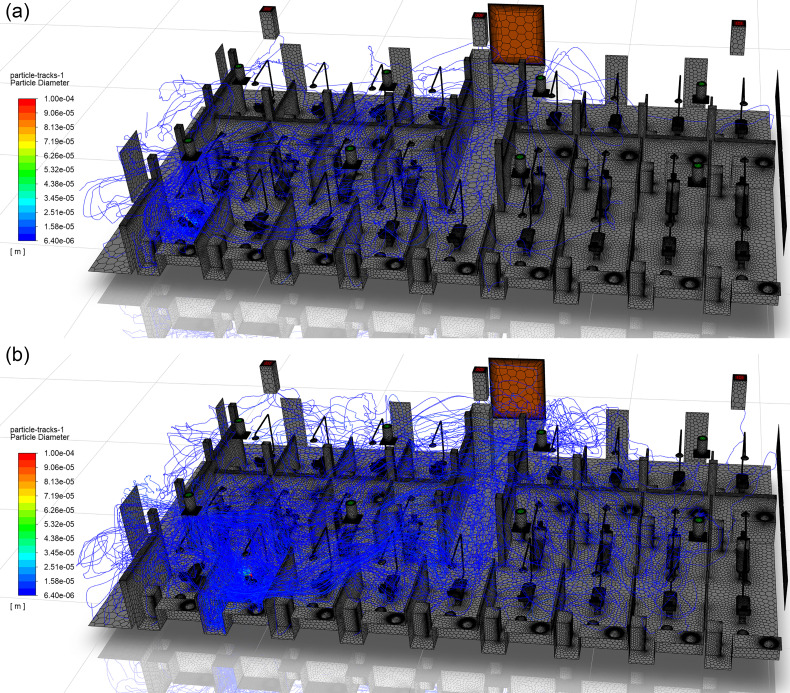
Comparison of the droplet distribution in the clinic resulting from ultrasonic scaling procedures performed in chairs (a) R1C1 and (b) R1C2.
FIG. 17.
FIG. 17.
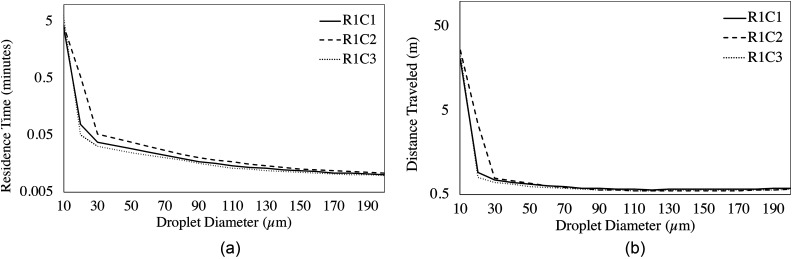
The average (a) residence time and (b) distance traveled as a function of droplet diameter for chairs R1C1, R1C2, and R1C3.
FIG. 18.
FIG. 18.
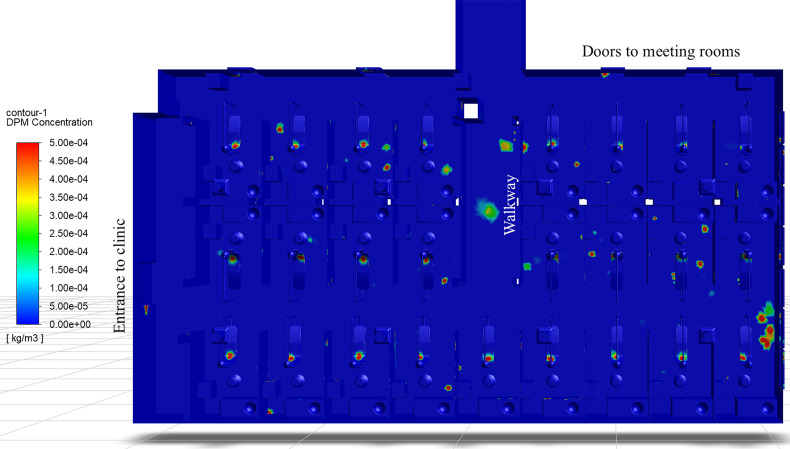
Surface concentration of droplet mass in the dentistry clinic as viewed from above.
FIG. 19.
FIG. 19.
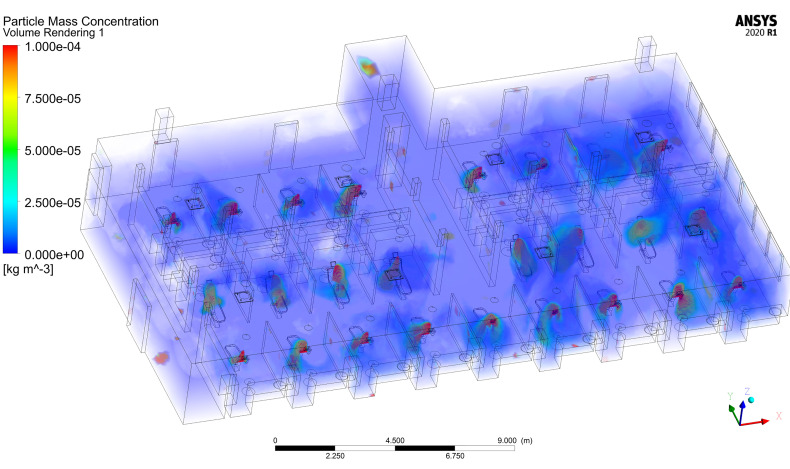
Volume rendering of airborne droplet concentration in the dentistry clinic simulation.

References

    1. Abuhegazy, M. , Talaat, K. , Anderoglu, O. , and Poroseva, S. , “ Numerical investigation of aerosol transport in a classroom with relevance to COVID-19,” Phys. Fluids 32, 103311 (2020). 10.1063/5.0029118 - DOI - PMC - PubMed
    1. Akhtar, J. , Garcia, A. L. , Saenz, L. , Kuravi, S. , Shu, F. , and Kota, K. , “ Can face masks offer protection from airborne sneeze and cough droplets in close-up, face-to-face human interactions? - A quantitative study,” Phys. Fluids 32, 127112 (2020). 10.1063/5.0035072 - DOI - PMC - PubMed
    1. ANSYS (2020). “ ANSYS fluent—CFD software,” ANSYS, http://www.ansys.com/products/fluids/ansys-fluent.
    1. Ansys Academic Research Mechanical and CFD, “ Choosing the pressure interpolation scheme,” in ANSYS Fluent Theory Guide ( ANSYS, Inc., Canonsburg, PA, 2020a), R.2.
    1. Ansys Academic Research Mechanical and CFD, “ Coupled algorithm,” in ANSYS Fluent Theory Guide ( ANSYS, Inc., Canonsburg, PA, 2020b), R.2.

LinkOut - more resources