


Current Landscape of Nutrition Within Prehabilitation Oncology Research: A Scoping Review
- PMID: 33898499
- PMCID: PMC8062858
- DOI: 10.3389/fnut.2021.644723
Current Landscape of Nutrition Within Prehabilitation Oncology Research: A Scoping Review
Abstract
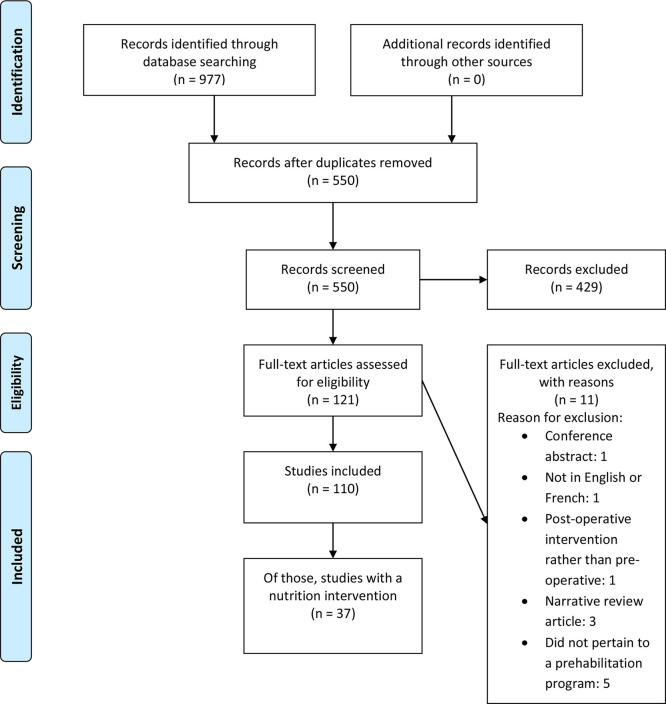
Background: Prehabilitation aims to improve functional capacity prior to cancer treatment to achieve better psychosocial and clinical outcomes. Prehabilitation interventions vary considerably in design and delivery. In order to identify gaps in knowledge and facilitate the design of future studies, we undertook a scoping review of prehabilitation studies to map the range of work on prehabilitation being carried out in any cancer type and with a particular focus on diet or nutrition interventions. Objectives: Firstly, to describe the type of prehabilitation programs currently being conducted. Secondly, to describe the extent to which prehabilitation studies involved aspects of nutrition, including assessment, interventions, implementation, and outcomes. Eligibility Criteria: Any study of quantitative or qualitative design that employed a formal prehabilitation program before cancer treatment ("prehabilitation" listed in keywords, title, or abstract). Sources of Evidence: Search was conducted in July 2020 using MEDLINE, PubMed, EMBASE, EMCARE, CINAHL, and AMED. Charting Methods: Quantitative data were reported as frequencies. Qualitative nutrition data were charted using a framework analysis that reflects the Nutrition Care Process Model: assessment, intervention, and monitoring/evaluation of the nutrition intervention. Results: Five hundred fifty unique articles were identified: 110 studies met inclusion criteria of a formal prehabilitation study in oncology. prehabilitation studies were mostly cohort studies (41%) or randomized-controlled trials (38%) of multimodal (49%), or exercise-only (44%) interventions that were applied before surgery (94%). Nutrition assessment was inconsistently applied across these studies, and often conducted without validated tools (46%). Of the 110 studies, 37 (34%) included a nutrition treatment component. Half of these studies provided the goal for the nutrition component of their prehabilitation program; of these goals, less than half referenced accepted nutrition guidelines in surgery or oncology. Nutrition interventions largely consisted of counseling with dietary supplementation. The nutrition intervention was indiscernible in 24% of studies. Two-thirds of studies did not monitor the nutrition intervention nor evaluate nutrition outcomes. Conclusion: Prehabilitation literature lacks standardized and validated nutritional assessment, is frequently conducted without evidence-based nutrition interventions, and is typically implemented without monitoring the nutrition intervention or evaluating the intervention's contribution to outcomes. We suggest that the development of a core outcome set could improve the quality of the studies, enable pooling of evidence, and address some of the research gaps identified.
Keywords: oncological nutrition; pre-operative; pre-surgery; prehabilitation; surgical nutrition.
Copyright © 2021 Gillis, Davies, Carli, Wischmeyer, Wootton, Jackson, Riedel, Marino, Levett and West.
Conflict of interest statement
The authors declare that the research was conducted in the absence of any commercial or financial relationships that could be construed as a potential conflict of interest.
References
-
- Carli F, Silver JK, Feldman LS, McKee A, Gilman S, Gillis C, et al. . Surgical prehabilitation in patients with cancer: state-of-the-science and recommendations for future research from a panel of subject matter experts. Phys Med Rehabil Clin North Am. (2017) 28:49–64. 10.1016/j.pmr.2016.09.002 - DOI - PubMed
-
- Gillis C, Fenton TR, Gramlich L, Sajobi TT, Culos-Reed SN, Bousquet-Dion G, et al. . Older frail prehabilitated patients who cannot attain a 400 m 6-min walking distance before colorectal surgery suffer more postoperative complications. Eur J Surg Oncol. (2020) 47:871–81. 10.1016/j.ejso.2020.09.041 - DOI - PubMed
-
- Chen BP, Awasthi R, Sweet SN, Minnella EM, Bergdahl A, Santa Mina D, et al. . Four-week prehabilitation program is sufficient to modify exercise behaviors and improve preoperative functional walking capacity in patients with colorectal cancer. Support Care Cancer. (2017) 25:33–40. 10.1007/s00520-016-3379-8 - DOI - PubMed
Publication types
LinkOut - more resources
Full Text Sources
Other Literature Sources
Miscellaneous
