. 2021 Jul 2;105(1):52-63.
doi: 10.1093/biolre/ioab075.

Importance of WNT-dependent signaling for derivation and maintenance of primed pluripotent bovine embryonic stem cells†

Affiliations

Importance of WNT-dependent signaling for derivation and maintenance of primed pluripotent bovine embryonic stem cells†

Yao Xiao et al. Biol Reprod. .

Abstract

The WNT signaling system plays an important but paradoxical role in the regulation of pluripotency. In the cow, IWR-1, which inhibits canonical WNT activation and has WNT-independent actions, promotes the derivation of primed pluripotent embryonic stem cells from the blastocyst. Here, we describe a series of experiments to determine whether derivation of embryonic stem cells could be generated by replacing IWR-1 with other inhibitors of WNT signaling. Results confirm the importance of inhibition of canonical WNT signaling for the establishment of pluripotent embryonic stem cells in cattle and indicate that the actions of IWR-1 can be mimicked by the WNT secretion inhibitor IWP2 but not by the tankyrase inhibitor XAV939 or WNT inhibitory protein dickkopf 1. The role of Janus kinase-mediated signaling pathways for the maintenance of pluripotency of embryonic stem cells was also evaluated. Maintenance of pluripotency of embryonic stem cells lines was blocked by a broad inhibitor of Janus kinase, even though the cells did not express phosphorylated signal transducer and activator of transcription 3 (pSTAT3). Further studies with blastocysts indicated that IWR-1 blocks the activation of pSTAT3. A likely explanation is that IWR-1 blocks differentiation of embryonic stem cells into a pSTAT3+ lineage. In conclusion, results presented here indicate the importance of inhibition of WNT signaling for the derivation of pluripotent bovine embryonic stem cells, the role of Janus kinase signaling for maintenance of pluripotency, and the participation of IWR-1 in the inhibition of activation of STAT3.

Keywords: JAK/STAT; WNT; bovine; embryonic stem cells; pluripotency.


Figures

Figure 1
Figure 1
The WNT inhibitor DKK1 was not able to replace IWR-1 for the establishment of bovine ESC. (A) Experimental design. Zona-free blastocysts were seeded onto MEF with the culture medium consisting of base medium mTeSR, FGF2 and with additional treatments of 2.5 μM IWR-1, 100 ng/ml recombinant human DKK1, or vehicle. Outgrowths were passaged on day 7 and the subculture was performed at least five times before the immunolabeling of cells grown in glass slide chambers. The total number of blastocysts analyzed is given in (B). Blastocysts were produced in four embryo production replicates. (B) Efficiency of derivation of cell lines. There was no significant difference among treatments. Subsequent observations were carried out on the number of cell lines indicated. (C) Morphological characteristics of cells at passages 5~6 on week 5. (D, E) Immunolabeling for SOX2 and CTNNB1 after 5–6 weeks of treatment. Scale bar = 100 μm.
Figure 2
Figure 2
Derivation of pluripotent bESC could not be achieved by treatment with the WNT and tankyrase inhibitor XAV939 but could by with an inhibitor of WNT secretion. (A) Experimental design. Zona-free blastocysts were seeded onto MEF cells with the culture medium consisting of base medium mTeSR, FGF2 and with additional treatments of 2.5 μM IWR-1, 2.0 μM XAV939, or 2.0 μM IWP2. Outgrowths were passaged on day 7 and the subculture was performed at least five times before the immunolabeling of cells grown in glass slide chambers. The total number of blastocysts analyzed is given in (B). Blastocysts were produced in two embryo production replicates. (B) Efficiency of derivation of cell lines. There was no significant difference among treatments. Subsequent observations were carried out on the number of cell lines indicated. (C) Morphological characteristics of cells at passages 5~6 on week 5. (D, E) Immunolabeling for SOX2 and CTNNB1 after 5–6 weeks of treatment. Scale bar = 100 μm.
Figure 3
Figure 3
IWR-1 suppresses STAT3 phosphorylation in established ESC. (A) Experimental design. A total of three bESC cell lines were each treated with 2.5 μM IWR, 2.5 μM IWR + 2 μM JAK inhibitor I or vehicle. Treatment was initiated at either passage 5 (cell line V2-1), 12 (S8W1), or 14 (S9W4). Cells were grown in glass slide chambers with MEF for immunolabeling. (B) Morphological characteristics of cells after 6 weeks of treatment. (C, D) Immunolabeling for SOX2 and pSTAT3Tyr705 at week 7 of culture. The arrow and arrowhead denote a pSTAT3+ and negative cell, respectively. Scale bars = 100 μm in B and C and 50 μm in D.
Figure 4
Figure 4
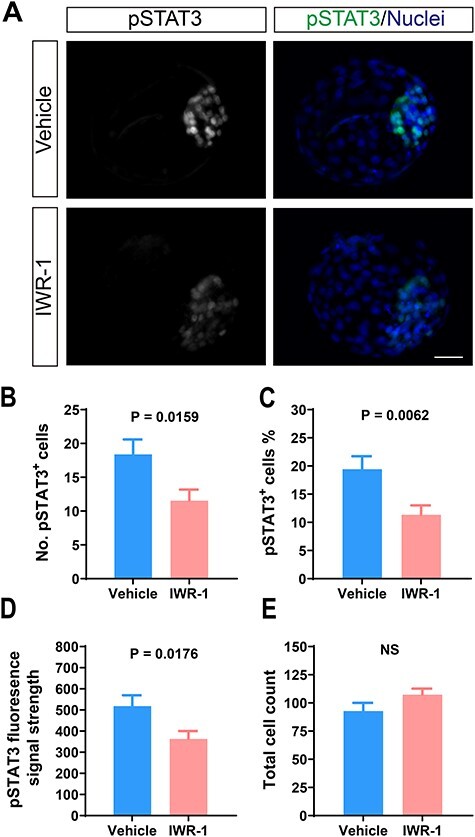
Treatment of bovine embryos with 2.5 μM IWR-1 from days 4–7.5 after fertilization reduced pSTAT3+ cell population in bovine blastocysts. (A) Immunolabeling of pSTAT3Tyr705. Scale bar = 50 μm. (B–E) Quantification of number of pSTAT3+ cells (B), percent of cells that were pSTAT3+ (C), pSTAT3Tyr705 immunofluorescent intensity (D), and total cell number (E). The number of observations was n = 39 for IWR-1 and n = 21 for vehicle from four embryo production replicates. Levels of significance are indicated in each graph. NS = non-significant.

References

    1. Buehr M, Meek S, Blair K, Yang J, Ure J, Silva J, McLay R, Hall J, Ying QL, Smith A.. Capture of authentic embryonic stem cells from rat blastocysts. Cell 2008; 135:1287–1298. doi: 10.1016/j.cell.2008.12.007. - DOI - PubMed
    1. Mulas C, Kalkan T, Meyenn F, Leitch HG, Nichols J, Smith A. Defined conditions for propagation and manipulation of mouse embryonic stem cells. Development 2019; 146:dev173146. doi: 10.1242/dev.173146. - DOI - PMC - PubMed
    1. Ying QL, Wray J, Nichols J, Batlle-Morera L, Doble B, Woodgett J, Cohen P, Smith A.. The ground state of embryonic stem cell self-renewal. Nature 2008; 453:519–523. doi: 10.1038/nature06968. - DOI - PMC - PubMed
    1. Gafni O, Weinberger L, Mansour AA, Manor YS, Chomsky E, Ben-Yosef D, Kalma Y, Viukov S, Maza I, Zviran A, Rais Y, Shipony Z et al. . Derivation of novel human ground state naive pluripotent stem cells. Nature 2013; 504:282–286. doi: 10.1038/nature12745. - DOI - PubMed
    1. Furusawa T, Ohkoshi K, Kimura K, Matsuyama S, Akagi S, Kaneda M, Ikeda M, Hosoe M, Kizaki K, Tokunaga T.. Characteristics of bovine inner cell mass-derived cell lines and their fate in chimeric conceptuses. Biol Reprod 2013; 89:28. doi: 10.1095/biolreprod.112.106641. - DOI - PubMed

Publication types