


Antiarrhythmic drugs in patients with early persistent atrial fibrillation and heart failure: results of the RACE 3 study
- PMID: 33899093
- PMCID: PMC8427339
- DOI: 10.1093/europace/euab062
Antiarrhythmic drugs in patients with early persistent atrial fibrillation and heart failure: results of the RACE 3 study
Abstract
Aims: Maintaining sinus rhythm in patients with persistent atrial fibrillation (AF) is challenging. We explored the efficacy of class I and III antiarrhythmic drugs (AADs) in patients with persistent AF and mild to moderate heart failure (HF).
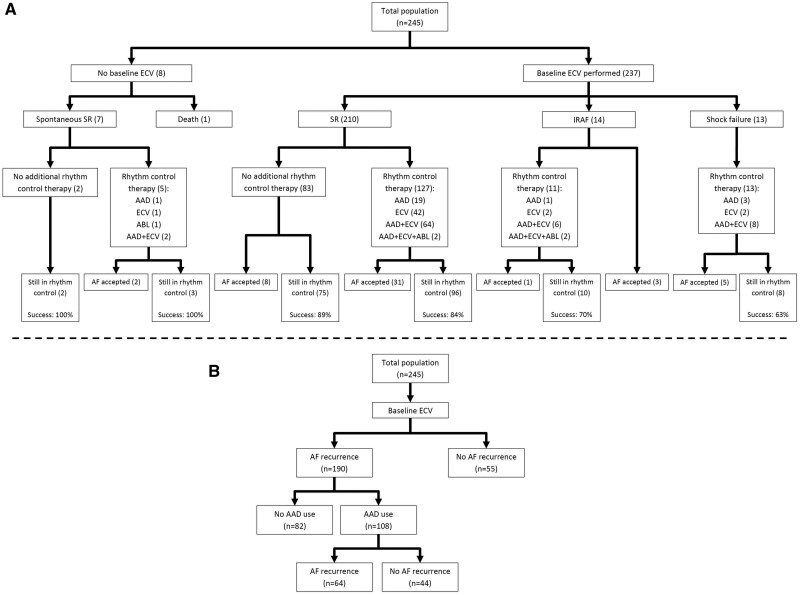
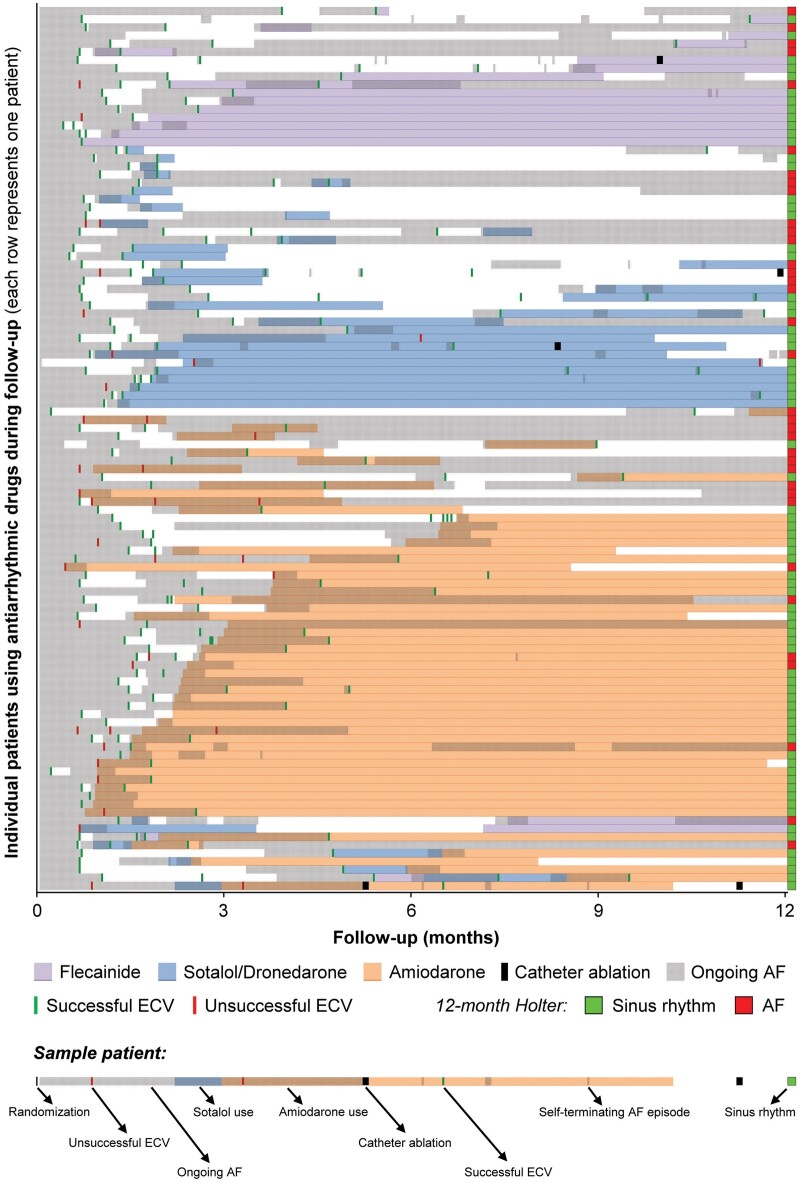
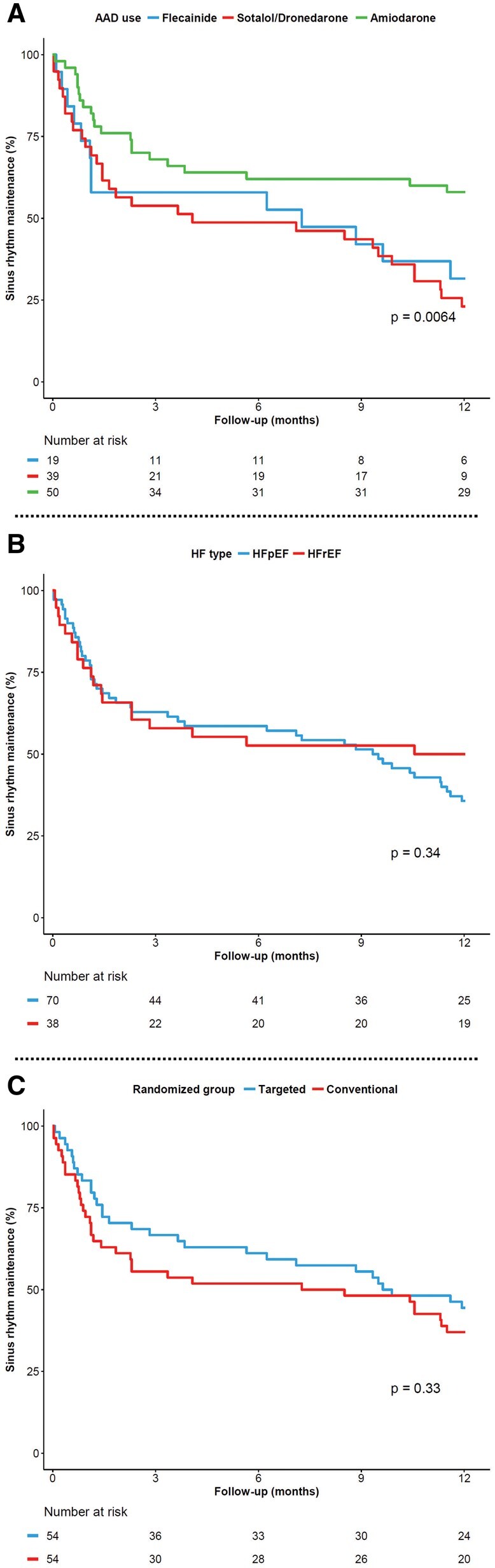
Methods and results: In the RACE 3 trial, patients with early persistent symptomatic AF and short history of mild to moderate HF with preserved or reduced left ventricular ejection fraction (LVEF) were randomized to targeted or conventional therapy. Both groups received AF and HF guideline-driven treatment. Additionally, the targeted-group received mineralocorticoid receptor antagonists, statins, angiotensin-converting enzyme inhibitors and/or receptor blockers, and cardiac rehabilitation. Class I and III AADs could be instituted in case of symptomatic recurrent AF. Eventually, pulmonary vein isolation could be performed. Primary endpoint was sinus rhythm on 7-day Holter after 1-year. Included were 245 patients, age 65 ± 9 years, 193 (79%) men, AF history was 3 (2-6) months, HF history 2 (1-4) months, 72 (29.4%) had HF with reduced LVEF. After baseline electrical cardioversion (ECV), 190 (77.6%) had AF recurrences; 108 (56.8%) received class I/III AADs; 19 (17.6%) flecainide, 36 (33.3%) sotalol, 3 (2.8%) dronedarone, 50 (46.3%) amiodarone. At 1-year 73 of 108 (68.0%) patients were in sinus rhythm, 44 (40.7%) without new AF recurrences. Maintenance of sinus rhythm was significantly better with amiodarone [n = 29/50 (58%)] compared with flecainide [n = 6/19 (32%)] and sotalol/dronedarone [n = 9/39 (23%)], P = 0.0064. Adverse events occurred in 27 (25.0%) patients, were all minor and reversible.
Conclusion: In stable HF patients with early persistent AF, AAD treatment was effective in nearly half of patients, with no serious adverse effects reported.
Keywords: Antiarrhythmic drugs; Atrial fibrillation; Early persistent atrial fibrillation; Heart failure; Rhythm control.
© The Author(s) 2021. Published by Oxford University Press on behalf of the European Society of Cardiology.
Figures
References
-
- Anter E, Jessup M, Callans DJ.. Atrial fibrillation and heart failure: treatment considerations for a dual epidemic. Circulation 2009;119:2516–25. - PubMed
-
- Marrouche NF, Brachmann J, Andresen D, Siebels J, Boersma L, Jordaens L, CASTLE-AF Investigators et al. Catheter ablation for atrial fibrillation with heart failure. N Engl J Med 2018;378:417–27. - PubMed
-
- HindricksG, , PotparaT, , DagresN, , ArbeloE, , BaxJJ, , Blomstrom-Lundqvist C. et al. ESC Guidelines for the diagnosis and management of atrial fibrillation developed in collaboration with the European Association for Cardio-Thoracic Surgery (EACTS). Eur Heart J 2021;42:373–498. - PubMed
-
- Rienstra M, Hobbelt AH, Alings M, Tijssen JGP, Smit MD, Brugemann J, for the RACE 3 Investigators et al. Targeted therapy of underlying conditions improves sinus rhythm maintenance in patients with persistent atrial fibrillation: results of the RACE 3 trial. Eur Heart J 2018;39:2987–96. - PubMed
-
- De With RR, Rienstra M, Smit MD, Weijs B, Zwartkruis VW, Hobbelt AH. et al. Targeted therapy of underlying conditions improves quality of life in patients with persistent atrial fibrillation: results of the RACE 3 study. Europace 2019;21:563–71. - PubMed
Publication types
MeSH terms
Substances
LinkOut - more resources
Full Text Sources
Other Literature Sources
Medical
Research Materials
Miscellaneous
