


Dietary intake of advanced glycation endproducts and risk of hepatobiliary cancers: A multinational cohort study
- PMID: 33899229
- PMCID: PMC8360042
- DOI: 10.1002/ijc.33612
Dietary intake of advanced glycation endproducts and risk of hepatobiliary cancers: A multinational cohort study
Abstract
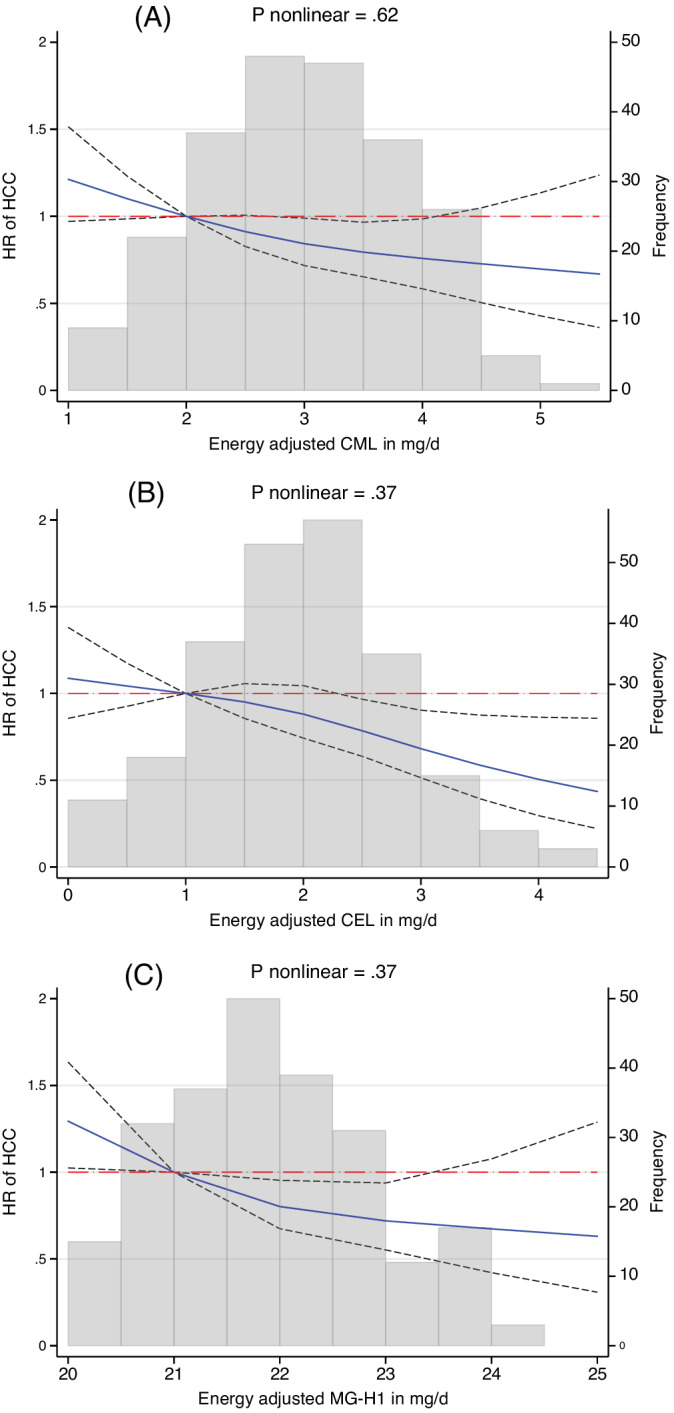
Advanced glycation endproducts (AGEs) may contribute to liver carcinogenesis because of their proinflammatory and prooxidative properties. Diet is a major source of AGEs, but there is sparse human evidence on the role of AGEs intake in liver cancer etiology. We examined the association between dietary AGEs and the risk of hepatobiliary cancers in the European Prospective Investigation into Cancer and Nutrition prospective cohort (n = 450 111). Dietary intake of three AGEs, Nε -[carboxymethyl]lysine (CML), Nε -[1-carboxyethyl]lysine (CEL) and Nδ -[5-hydro-5-methyl-4-imidazolon-2-yl]-ornithine (MG-H1), was estimated using country-specific dietary questionnaires linked to an AGEs database. Cause-specific hazard ratios (HR) and their 95% confidence intervals (CI) for associations between dietary AGEs and risk of hepatocellular carcinoma (HCC), gallbladder and biliary tract cancers were estimated using multivariable Cox proportional hazard regression. After a median follow-up time of 14.9 years, 255 cases of HCC, 100 cases of gallbladder cancer and 173 biliary tract cancers were ascertained. Higher intakes of dietary AGEs were inversely associated with the risk of HCC (per 1 SD increment, HR-CML = 0.87, 95% CI: 0.76-0.99, HR-CEL = 0.84, 95% CI: 0.74-0.96 and HR-MH-G1 = 0.84, 95% CI: 0.74-0.97). In contrast, positive associations were observed with risk of gallbladder cancer (per 1 SD, HR-CML = 1.28, 95% CI: 1.05-1.56, HR-CEL = 1.17; 95% CI: 0.96-1.40, HR-MH-G1 = 1.27, 95% CI: 1.06-1.54). No associations were observed for cancers of the intra and extrahepatic bile ducts. Our findings suggest that higher intakes of dietary AGEs are inversely associated with the risk of HCC and positively associated with the risk of gallbladder cancer.
Keywords: EPIC study; advanced glycation endproducts; bile duct cancers; gallbladder cancer; hepatocellular carcinoma.
© 2021 The Authors. International Journal of Cancer published by John Wiley & Sons Ltd on behalf of UICC.
Conflict of interest statement
None of the authors declared a conflict of interest. Where authors are identified as personnel of the International Agency for Research on Cancer/WHO, the authors alone are responsible for the views expressed in this article and they do not necessarily represent the decisions, policy or views of the International Agency for Research on Cancer/WHO.
Figures
References
-
- International Agency for Research on Cancer . GLOBOCAN 2018. Estimated age‐standardized incidence rates (world) in 2018, worldwide, both sexes, all ages, vol. 2019. Lyon, France; 2019.
-
- Bray F, Ferlay J, Soerjomataram I, Siegel RL, Torre LA, Jemal A. Global cancer statistics 2018: GLOBOCAN estimates of incidence and mortality worldwide for 36 cancers in 185 countries. CA Cancer J Clin. 2018;68:394‐424. - PubMed
-
- Center MM, Jemal A. International trends in liver cancer incidence rates. Cancer Epidemiol Biomarkers Prev. 2011;20:2362‐2368. - PubMed
Grants and funding
LinkOut - more resources
Full Text Sources
Other Literature Sources
