Systemic analysis of the expression levels and prognosis of breast cancer-related cadherins
- PMID: 33899544
- PMCID: PMC8719037
- DOI: 10.1177/15353702211010417
Systemic analysis of the expression levels and prognosis of breast cancer-related cadherins
Abstract
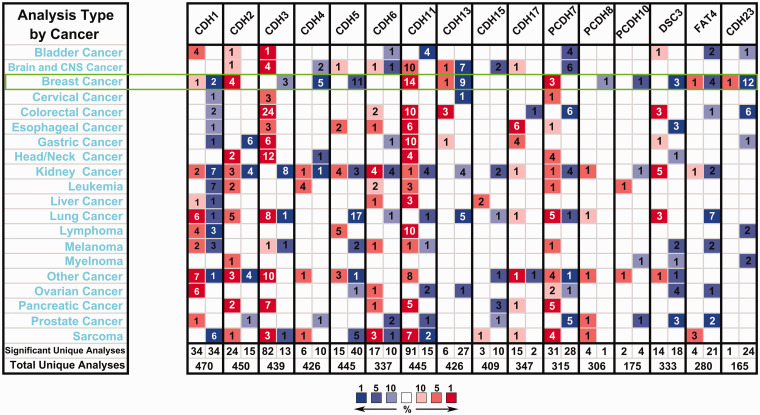
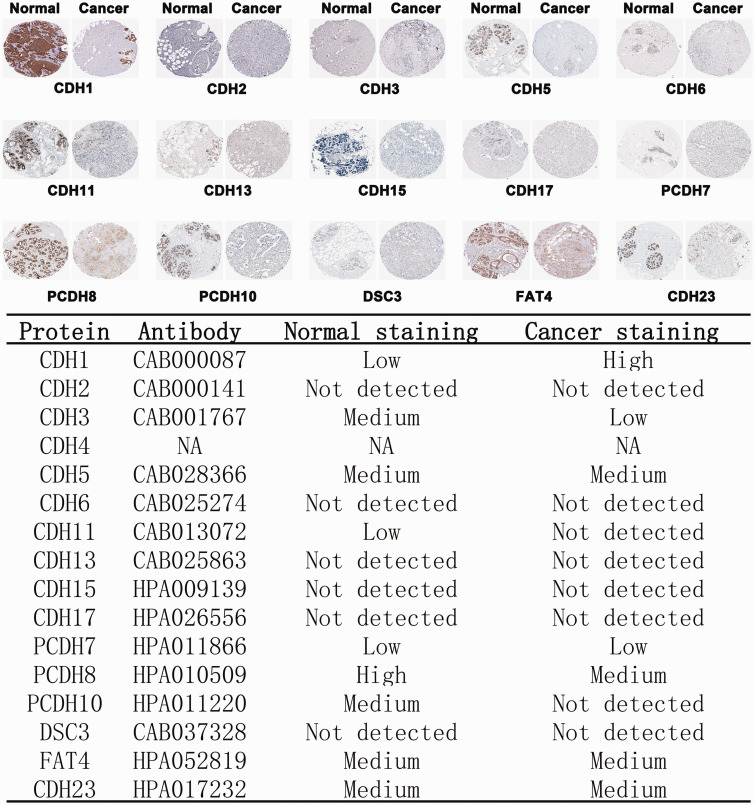
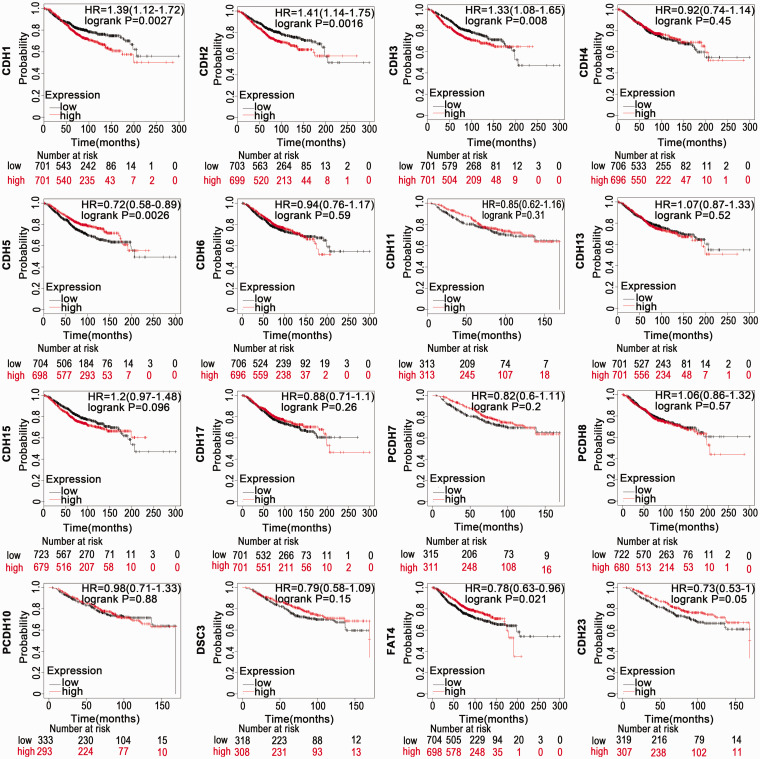
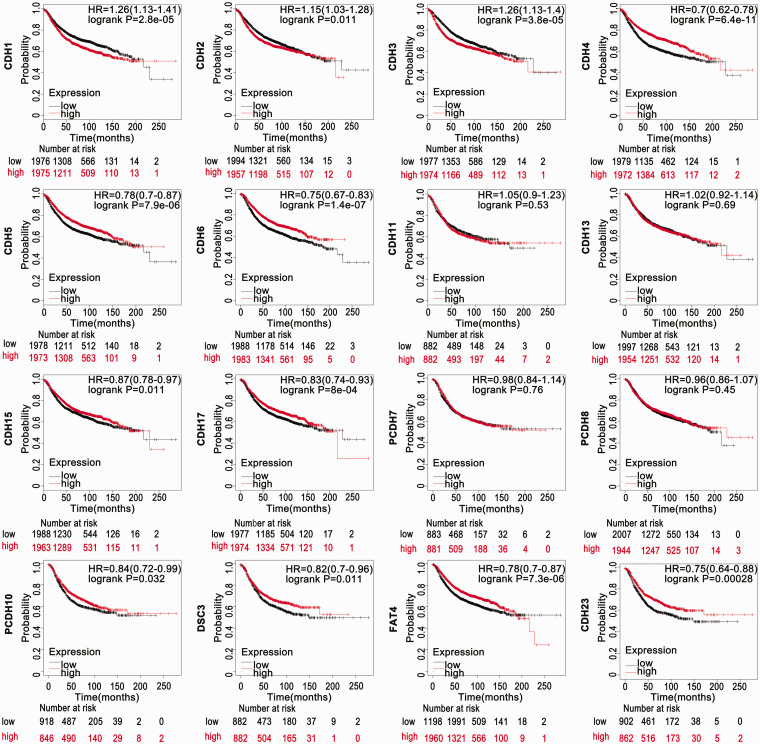
Cadherins form connection between cells, facilitate communication, and serve as essential agents in the progression of multiple cancers. Over 100 cadherins have been identified and they are mainly divided into four groups: classical cadherins (CDHs), protocadherins (PCDHs), desmosomal (DSC), and cadherin-related proteins. Accumulating evidence has indicated that several members of the cadherins are involved in breast cancer development. Nevertheless, the expression profiles and corresponding prognostic outcomes of these breast cancer-related cadherins are yet to be analyzed. Here, we examined the expression levels and prognostic potential of these breast cancer-related cadherins from the specific databases viz. oncomine, gene expression profiling interactive analysis, human protein atlas, UALCAN, Kaplan-Meier Plotter, and cBioPortal. We found that the CDH2/11 levels were higher in breast cancer tissues, compared to healthy breast tissues, whereas with CDH3-5, PCDH8/10, and DSC3, the levels were lower in the former than in the latter. Additionally, for CDH1/6/13/17/23, PCDH7, and FAT4, trancript level alterations between breast cancer and healthy tissues varied across different databases. The CDH1 protein levels were elevated in breast cancer tissues versus healthy breast tissues, whereas the protein levels of CDH3/11 and PCDH8/10 were reduced in breast cancer, compared to healthy breast tissues. For CDH15 and CDH23, the expression levels paralleled tumor stage. Survival analysis, using the Kaplan-Meier Plotter database, demonstrated that elevated CDH1-3 levels correlated with diminished relapse-free survival in breast cancer patients. Alternately, enhanced CDH4-6/15/17/23, PCDH10, DSC3, and FAT4 levels estimated a rise in relapse-free survival of breast cancer patients. These data suggest CDH1-3 to be a promising target for breast cancer precision therapy and CDH4-6/15/17/23, PCDH10, DSC3, and FAT4 to be novel biomarkers for breast cancer prognosis.
Keywords: Breast cancer; bioinformatics; biomarkers; cadherin; expression.
Conflict of interest statement
Figures





References
-
- Siegel RL, Miller KD, Jemal A. Cancer statistics, 2020. CA Cancer J Clin 2020; 70:7–30 - PubMed
-
- Cardoso F, Harbeck N, Fallowfield L, Kyriakides S, Senkus E. Locally recurrent or metastatic breast cancer: ESMO clinical practice guidelines for diagnosis, treatment and follow-up. Ann Oncol 2012; 23:vii11–9 - PubMed
-
- Uhlén M, Fagerberg L, Hallström BM, Lindskog C, Oksvold P, Mardinoglu A, Sivertsson Å, Kampf C, Sjöstedt E, Asplund A, Olsson I, Edlund K, Lundberg E, Navani S, Szigyarto CA, Odeberg J, Djureinovic D, Takanen JO, Hober S, Alm T, Edqvist PH, Berling H, Tegel H, Mulder J, Rockberg J, Nilsson P, Schwenk JM, Hamsten M, von Feilitzen K, Forsberg M, Persson L, Johansson F, Zwahlen M, von Heijne G, Nielsen J, Pontén F. Proteomics. Tissue-based map of the human proteome. Science 2015; 347:1260419. - PubMed
Publication types
MeSH terms
Substances
LinkOut - more resources
Full Text Sources
Medical
Research Materials
Miscellaneous