. 2021 May;27(5):1438-1445.
doi: 10.3201/eid2705.204756.

Global Trends in Norovirus Genotype Distribution among Children with Acute Gastroenteritis

Global Trends in Norovirus Genotype Distribution among Children with Acute Gastroenteritis

Jennifer L Cannon et al. Emerg Infect Dis. 2021 May.

Abstract

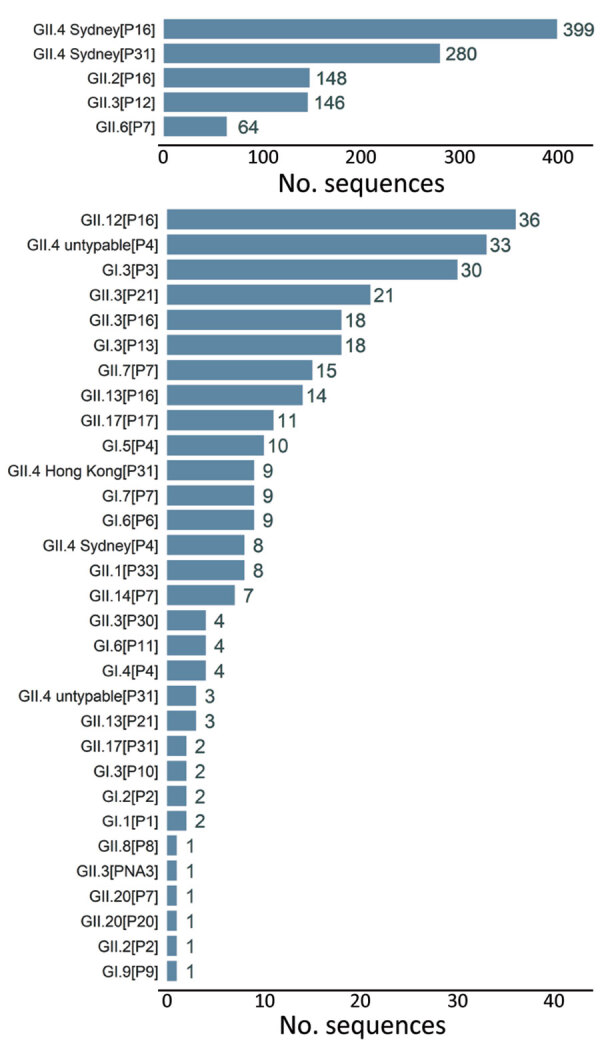
Noroviruses are a leading cause of acute gastroenteritis (AGE) among adults and children worldwide. NoroSurv is a global network for norovirus strain surveillance among children <5 years of age with AGE. Participants in 16 countries across 6 continents used standardized protocols for dual typing (genotype and polymerase type) and uploaded 1,325 dual-typed sequences to the NoroSurv web portal during 2016-2020. More than 50% of submitted sequences were GII.4 Sydney[P16] or GII.4 Sydney[P31] strains. Other common strains included GII.2[P16], GII.3[P12], GII.6[P7], and GI.3[P3] viruses. In total, 22 genotypes and 36 dual types, including GII.3 and GII.20 viruses with rarely reported polymerase types, were detected, reflecting high strain diversity. Surveillance data captured in NoroSurv enables the monitoring of trends in norovirus strains associated childhood AGE throughout the world on a near real-time basis.

Keywords: NoroSurv; P-types; acute gastroenteritis; capsids; children; dual typing; enteric infections; food safety; gastroenteritis; genotypes; norovirus; polymerase; surveillance; vaccines; viruses.


Figures
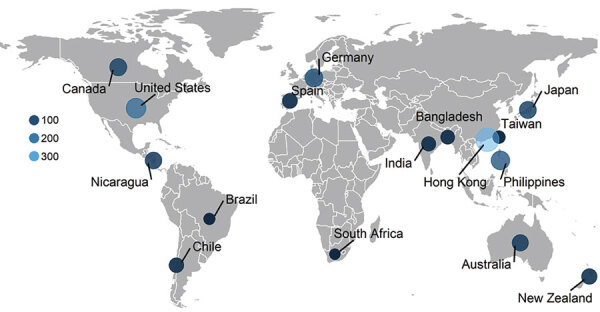
Figure 1
Figure 1
Countries participating in NoroSurv, December 2016–August 2020. Shades of blue and size of circles indicate the number of genetic sequences included from each country.
Figure 2
Figure 2
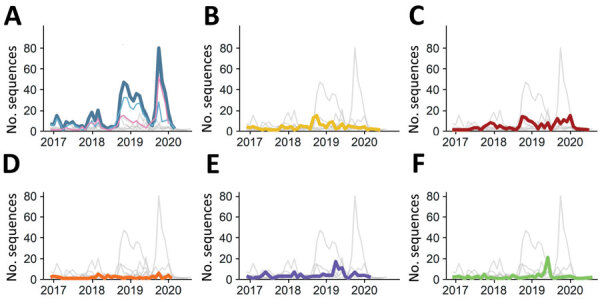
Global genotype distribution of norovirus sequences catalogued in NoroSurv during September 2016–August 2020. A) Dark blue line indicates all GII.4 Sydney viruses; light blue indicates GII.4 Sydney[P16] and pink indicates GII.4 Sydney[P31]); B) yellow indicates GII.2 viruses; C) red indicates GII.3 viruses; D) orange indicates GII.6 viruses; E) purple indicates other GII viruses; F) green indicates GI viruses. Gray lines overlay the distributions of other pictured genotypes to enable comparisons.
Figure 3
Figure 3
Distribution of dual typed sequences in NoroSurv, 2016–2020. Numbers to the right of bars indicate the number of sequences detected for each dual type.

References

    1. Ahmed SM, Hall AJ, Robinson AE, Verhoef L, Premkumar P, Parashar UD, et al. Global prevalence of norovirus in cases of gastroenteritis: a systematic review and meta-analysis. Lancet Infect Dis. 2014;14:725–30. 10.1016/S1473-3099(14)70767-4 - DOI - PMC - PubMed
    1. Pires SM, Fischer-Walker CL, Lanata CF, Devleesschauwer B, Hall AJ, Kirk MD, et al. Aetiology-specific estimates of the global and regional incidence and mortality of diarrhoeal diseases commonly transmitted through food. PLoS One. 2015;10:e0142927. 10.1371/journal.pone.0142927 - DOI - PMC - PubMed
    1. Cannon JL, Lopman BA, Payne DC, Vinjé J. Birth cohort studies assessing norovirus infection and immunity in young children: a review. Clin Infect Dis. 2019;69:357–65. 10.1093/cid/ciy985 - DOI - PMC - PubMed
    1. Chhabra P, Rouhani S, Browne H, Peñataro Yori P, Siguas Salas M, Paredes Olortegui M, et al. Homotypic and heterotypic protection and risk of re-infection following natural norovirus infection in a highly endemic setting. Clin Infect Dis. 2021;72:222–9. 10.1093/cid/ciaa019 - DOI - PMC - PubMed
    1. Shioda K, Kambhampati A, Hall AJ, Lopman BA. Global age distribution of pediatric norovirus cases. Vaccine. 2015;33:4065–8. 10.1016/j.vaccine.2015.05.051 - DOI - PMC - PubMed