Review
. 2021 May;105(9):3533-3557.
doi: 10.1007/s00253-021-11289-9. Epub 2021 Apr 26.

Sporulation in solventogenic and acetogenic clostridia

Affiliations
Review

Sporulation in solventogenic and acetogenic clostridia

Mamou Diallo et al. Appl Microbiol Biotechnol. 2021 May.

Abstract

The Clostridium genus harbors compelling organisms for biotechnological production processes; while acetogenic clostridia can fix C1-compounds to produce acetate and ethanol, solventogenic clostridia can utilize a wide range of carbon sources to produce commercially valuable carboxylic acids, alcohols, and ketones by fermentation. Despite their potential, the conversion by these bacteria of carbohydrates or C1 compounds to alcohols is not cost-effective enough to result in economically viable processes. Engineering solventogenic clostridia by impairing sporulation is one of the investigated approaches to improve solvent productivity. Sporulation is a cell differentiation process triggered in bacteria in response to exposure to environmental stressors. The generated spores are metabolically inactive but resistant to harsh conditions (UV, chemicals, heat, oxygen). In Firmicutes, sporulation has been mainly studied in bacilli and pathogenic clostridia, and our knowledge of sporulation in solvent-producing or acetogenic clostridia is limited. Still, sporulation is an integral part of the cellular physiology of clostridia; thus, understanding the regulation of sporulation and its connection to solvent production may give clues to improve the performance of solventogenic clostridia. This review aims to provide an overview of the triggers, characteristics, and regulatory mechanism of sporulation in solventogenic clostridia. Those are further compared to the current knowledge on sporulation in the industrially relevant acetogenic clostridia. Finally, the potential applications of spores for process improvement are discussed.Key Points• The regulatory network governing sporulation initiation varies in solventogenic clostridia.• Media composition and cell density are the main triggers of sporulation.• Spores can be used to improve the fermentation process.

Keywords: ABE production; Acetogens; Quorum sensing; Sigma factors; Solventogenic clostridia; Sporulation.


Conflict of interest statement

The authors declare no competing interests.

Figures
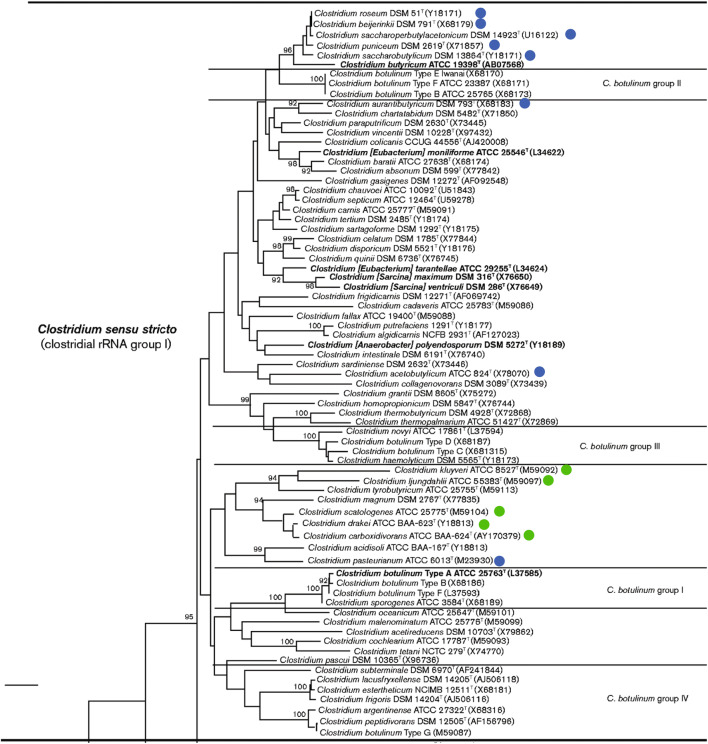
Fig. 1
Fig. 1
Phylogenetic tree of the Clostridium sensu stricto group, amended from (Lawson and Rainey 2016) with permission of the Microbiology Society. The tree was reconstructed using the neighbor-joining method based on the pairwise comparison of approximately 1340  nt. Atopobium parvulum was used as the outgroup. Bootstrap values (> 90 %), expressed as a percentage of 1000 replications. Bar, 1 % sequence divergence. A blue disc next to the name of a The strains next to in the blue discs and purple boxes belong indicates that this strain belongs to the solventogenic group, while a green disk next to the name of a strain indicates that this strain belongs to the and the acetogenic clostridia
Fig. 2
Fig. 2
Morphological changes and molecular regulation of sporulation in C. acetobutylicum modified from (Al-Hinai et al. 2015). The regulation of the sporulation process is mainly realized by the modulation of the transcription in each compartment. Post-translational regulation enables the activation of Spo0A and sporulation-specific transcription factors (σF, σG, σE). The activation mechanism of σG has not been investigated in C. acetobutylicum. Inactive transcriptional regulators are in grey, and active transcriptional regulators are in orange. DPA, dipicolinic acid; Sasps, small acid-soluble proteins. Black arrows indicate post-translational regulations, blue arrows transcriptional regulation. Arrows with short dashes indicate interactions described only in C. acetobutylicum, arrows with long dashes observed only in C. beijerinckii, and full arrows indicate interactions described in C. acetobutylicum and other clostridia
Fig. 3
Fig. 3
Mutations and associated phenotypes of markerless spo0A- strains. Five conserved regions are indicated by colored boxes; R: signal receiver domain, Green box: conserved region with no known function, HTM : helix turn motif, σA: putative σA activator region, σH: putative σH activator region. The ability to sporulate, to form heat resistant spores, and to produce solvent is indicated next to the scheme of the spo0A mutation present in each mutant strain; - : indicate a decrease compared to the wild type phenotype; -- : indicate the abolition of the feature in the mutant compared to the wild type phenotype; / : indicate that this characteristic could not be evaluated ; ++ indicate an increase compared to the wild type phenotype and NA stands for no data available
Fig. 4
Fig. 4
Transcriptional and post-translational regulation of Spo0A in C. acetobutylicum, C. beijerinckii, C. saccharoperbutylacetonicum. Figure adapted from (Al-Hinai et al. 2015) with results from (Feng et al. ; Kotte et al. ; X. Xin et al. ; J.-Y. Xu et al. ; Y. Yang et al. 2020). Blue arrows transcriptional regulation and black arrows post-translational regulation. The interrogation marks indicate interactions remain to be proven experimentally
Fig. 5
Fig. 5
Morphology and composition of the clostridial endospore; a Transmission electron micrographs of mature endospores from three solventogenic clostridia. Depending on the species, the size of the cortex, as well as the location of the endospore in the mother cell, changes; b Possible location of the endospore in solventogenic clostridia; c Composition of the endospore. EX stands for exosporium
Fig. 6
Fig. 6
Simplified acetone-butanol-ethanol metabolic pathway in solventogenic clostridia. Some strains harbor a secondary alcohol dehydrogenase (s-adh) that enables the formation of isopropanol. In C. acetobutylicum, the acidogenic phase and solventogenic phase succeed each other during the fermentation. During exponential growth, the substrate is metabolized to form lactate, acetate, and butyrate during the acid phase. At stationary phase, the acids are reassimilated, and the culture produces ethanol, acetone (or isopropanol), and butanol. However, in other solventogenic species (C. beijerinckii for example), acidogenic and solventogenic phase occur concomitantly and solvent production starts during the exponential phase. The enzymes involved in the metabolic pathway are in grey boxes: pta, phosphotransacetylase; ack, acetate kinase; thl, thiolase; hbd, 3-hydroxybutyryl-CoA-dehydrogenase; crt, crotonase; bcd, butyryl-CoA-dehydrogenase; ctfA/B, CoA-transferase; buk, butyrate kinase; ptb, phosphotransbutyrylase; adh, aldehyde/alcohol dehydrogenase; edh, ethanol dehydrogenase; adc, acetoacetate decarboxylase; s-adh, secondary alcohol dehydrogenase; ald, butyraldehyde dehydrogenase; bdh, butanol dehydrogenase and -P stands for phosphate. As indicated by its title, this figure represents a simplified ABE pathway; indeed, studies have shown a diversity in the structure and number of enzymes involved depending on the solventogenic species
Fig. 7
Fig. 7
Triggers of sporulation in solventogenic clostridia and the signal transduction systems involved in sporulation regulation; TCS, two-component system family; RRNPP, Rgg/Rap/ NprR/PlcR/PrgX quorum system family; ROS, reactive oxygen species-dependent mechanisms

References

    1. Abd-Alla MH, Zohri ANA, El-Enany AWE, Ali SM. Conversion of food processing wastes to biofuel using clostridia. Anaerobe. 2017;48:135–143. doi: 10.1016/j.anaerobe.2017.08.011. - DOI - PubMed
    1. Abrini J, Naveau H, Nyns E-J. Clostridium autoethanogenum, sp. nov., an anaerobic bacterium that produces ethanol from carbon monoxide. Arch Microbiol. 1994;161(4):345–351. doi: 10.1007/BF00303591. - DOI
    1. Aframian N, Eldar A. A bacterial tower of babel: quorum-sensing signaling diversity and its evolution. Annu Rev Microbiol. 2020;74(1):annurev-micro-012220-063740. doi: 10.1146/annurev-micro-012220-063740. - DOI - PMC - PubMed
    1. Aklujkar M, Leang C, Shrestha PM, Shrestha M, Lovley DR. Transcriptomic profiles of Clostridium ljungdahlii during lithotrophic growth with syngas or H2 and CO2 compared to organotrophic growth with fructose. Sci Rep. 2017;7(1):13135. doi: 10.1038/s41598-017-12712-w. - DOI - PMC - PubMed
    1. Al-Hinai MA, Jones SW, Papoutsakis ET. σK of Clostridium acetobutylicum is the first known sporulation-specific sigma factor with two developmentally separated roles, one early and one late in sporulation. J Bacteriol. 2014;196(2):287–299. doi: 10.1128/JB.01103-13. - DOI - PMC - PubMed
