. 2021 Apr 26;15(4):e0009381.
doi: 10.1371/journal.pntd.0009381. eCollection 2021 Apr.

Metagenomic sequencing reveals viral abundance and diversity in mosquitoes from the Shaanxi-Gansu-Ningxia region, China

Affiliations

Metagenomic sequencing reveals viral abundance and diversity in mosquitoes from the Shaanxi-Gansu-Ningxia region, China

Xiaozhou He et al. PLoS Negl Trop Dis. .

Abstract

Background: Mosquitoes host and transmit numerous arthropod-borne viruses (arboviruses) that cause disease in both humans and animals. Effective surveillance of virome profiles in mosquitoes is vital to the prevention and control of mosquito-borne diseases in northwestern China, where epidemics occur frequently.

Methods: Mosquitoes were collected in the Shaanxi-Gansu-Ningxia region (Shaanxi Province, Gansu Province, and Ningxia Hui Autonomous Region) of China from June to August 2019. Morphological methods were used for taxonomic identification of mosquito species. High-throughput sequencing and metagenomic analysis were used to characterize mosquito viromes.

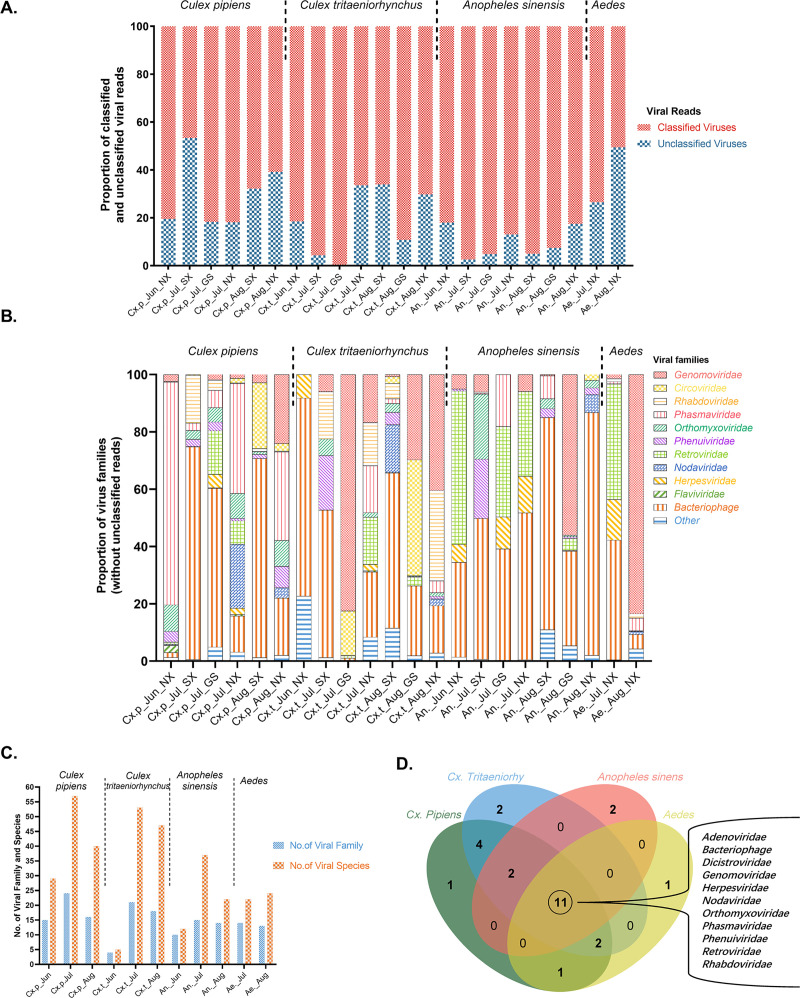
Results: A total of 22,959 mosquitoes were collected, including Culex pipiens (45.7%), Culex tritaeniorhynchus (40.6%), Anopheles sinensis (8.4%), Aedes (5.2%), and Armigeres subalbatus (0.1%). In total, 3,014,183 (0.95% of clean reads) viral sequences were identified and assigned to 116 viral species (including pathogens such as Japanese encephalitis virus and Getah virus) in 31 viral families, including Flaviviridae, Togaviridae, Phasmaviridae, Phenuiviridae, and some unclassified viruses. Mosquitoes collected in July (86 species in 26 families) showed greater viral diversity than those from June and August. Culex pipiens (69 species in 25 families) and Culex tritaeniorhynchus (73 species in 24 families) carried more viral species than Anopheles sinensis (50 species in 19 families) or Aedes (38 species in 20 families) mosquitoes.

Conclusion: Viral diversity and abundance were affected by mosquito species and collection time. The present study elucidates the virome compositions of various mosquito species in northwestern China, improving the understanding of virus transmission dynamics for comparison with those of disease outbreaks.


Conflict of interest statement

The authors have declared that no competing interests exist.

Figures
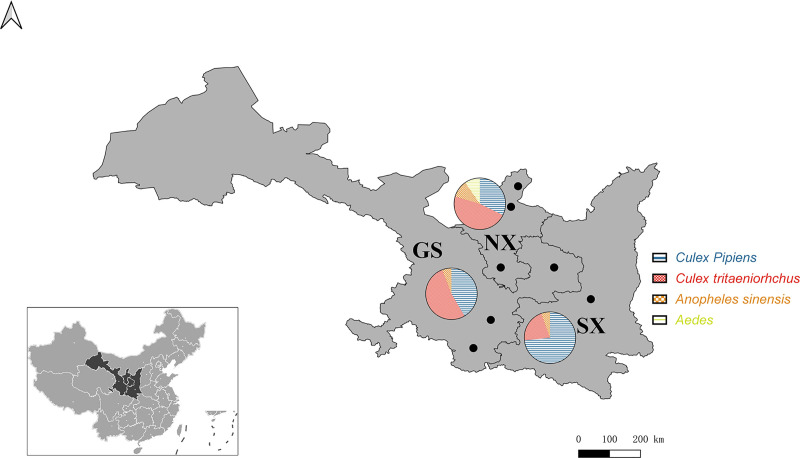
Fig 1
Fig 1. Map of mosquito collection sites.
The Shanxi-Gansu-Ningxia region is labeled in light gray and cities where the collection sites were located are indicated with black dots. The pie charts on the map show the composition of mosquito species collected in each province, with each color representing a mosquito species. The location of the Shaanxi-Gansu-Ningxia region is shown in dark gray on the map of China in the lower left of corner (GS: Gansu Province, SX: Shaanxi Province, NX: Ningxia Hui Autonomous Region). The base layer of this modified map originated from National Earth System Science Data Center, National Science & Technology Infrastructure of China (http://www.geodata.cn).
Fig 2
Fig 2. Virome of mosquitoes in the Shaanxi-Gansu-Ningxia region.
A. Proportions of classified and unclassified viral reads. Each bar represents a mosquito pool, as described in Table 1. B. Proportions of viral families among the classified viral reads. Each bar represents a mosquito pool, as described in Table 1. Read percentages lower than 0.1% are grouped as Others. C. Number of viral families and species among mosquitoes sorted by mosquito species and collection month. D. Venn diagram showing viral families found in the four mosquito groups. The four mosquito groups are presented in separate areas of the diagram. The numbers are representative of viral families found in mosquitos of each genus.
Fig 3
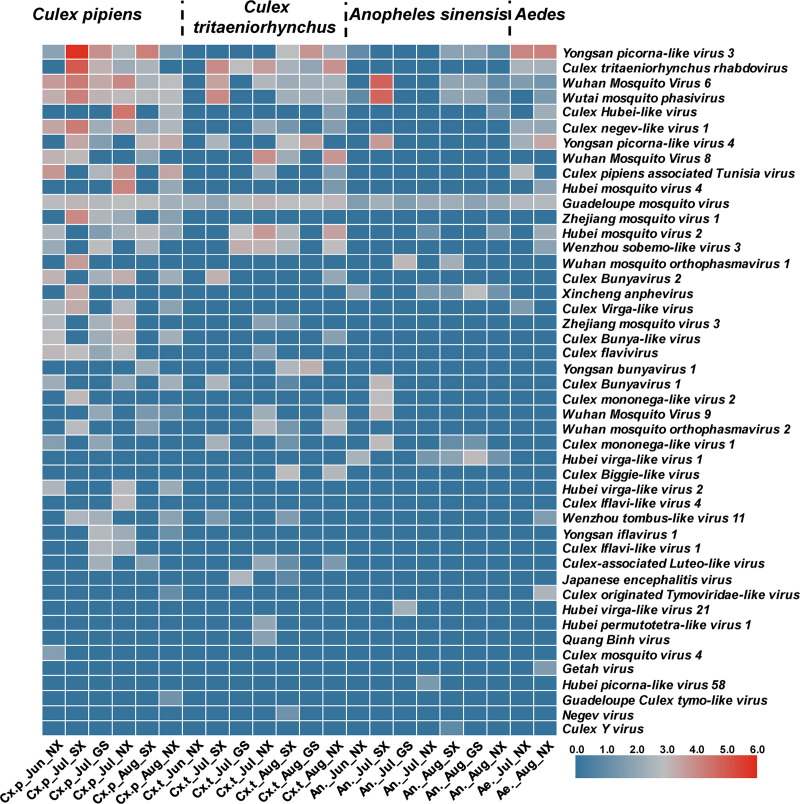
Fig 3. Heatmap showing sequence reads of selected mosquito-borne viruses in each pool.
The names of the 46 viral species are listed in the right column. Mosquito species are shown at the top. Pool information is provided in the bottom row. The colors represent the base-10 logarithm of sequence read number, from blue (low read number) to red (high read number).

References

    1. Xia H, Wang Y, Atoni E, Zhang B, Yuan Z. Mosquito-Associated Viruses in China. Virol Sin. 2018;1(33):5–20 10.1007/s12250-018-0002-9 - DOI - PMC - PubMed
    1. Liang G, Li X, Gao X, Fu S, Wang H, Li M, et al. Arboviruses and their related infections in China: A comprehensive field and laboratory investigation over the last 3 decades. Rev Med Virol. 2018;1(28) 10.1002/rmv.1959 - DOI - PubMed
    1. Aragao CF, Pinheiro V, Nunes NJ, Silva E, Pereira G, Nascimento B, et al. Natural Infection of Aedes aegypti by Chikungunya and Dengue type 2 Virus in a Transition Area of North-Northeast Brazil. Viruses. 2019;12(11) 10.3390/v11121126 - DOI - PMC - PubMed
    1. Fu S, Song S, Li X, Xu Z, He Y, Li F, et al. Comparisons of Zika Viruses Isolated from Culex Quinquefasciatus and Armigeres Subalbatus Mosquitoes. Chinese Journal of Virology. 2019;03(35):385–395
    1. Shi C, Beller L, Deboutte W, Yinda KC, Delang L, Vega-Rua A, et al. Stable distinct core eukaryotic viromes in different mosquito species from Guadeloupe, using single mosquito viral metagenomics. Microbiome. 2019;1(7):121 10.1186/s40168-019-0734-2 - DOI - PMC - PubMed

Publication types