The Relationship Between Bone and Reproductive Hormones Beyond Estrogens and Androgens
- PMID: 33901271
- PMCID: PMC8599211
- DOI: 10.1210/endrev/bnab015
The Relationship Between Bone and Reproductive Hormones Beyond Estrogens and Androgens
Erratum in
-
Erratum to: "The Relationship Between Bone and Reproductive Hormones Beyond Estrogens and Androgens".Endocr Rev. 2021 Nov 16;42(6):872. doi: 10.1210/endrev/bnab024. Endocr Rev. 2021. PMID: 34595521 Free PMC article. No abstract available.
Abstract
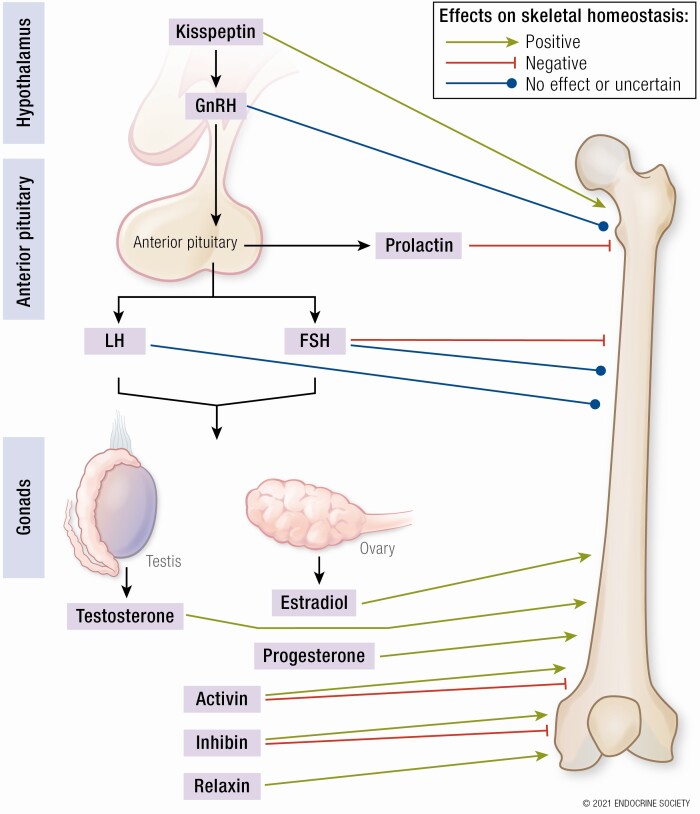
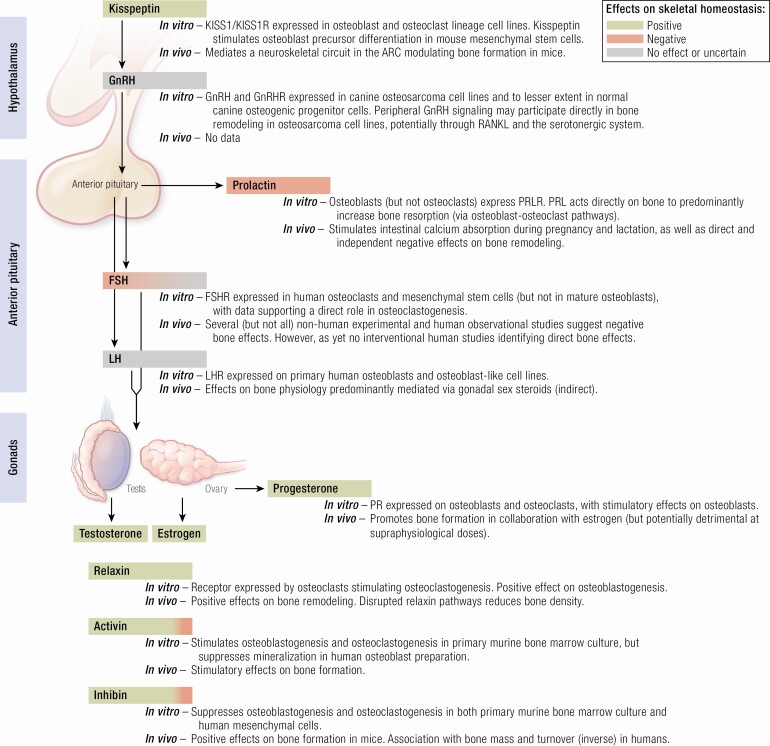
Reproductive hormones play a crucial role in the growth and maintenance of the mammalian skeleton. Indeed, the biological significance for this hormonal regulation of skeletal homeostasis is best illustrated by common clinical reproductive disorders, such as primary ovarian insufficiency, hypothalamic amenorrhea, congenital hypogonadotropic hypogonadism, and early menopause, which contribute to the clinical burden of low bone mineral density and increased risk for fragility fracture. Emerging evidence relating to traditional reproductive hormones and the recent discovery of newer reproductive neuropeptides and hormones has deepened our understanding of the interaction between bone and the reproductive system. In this review, we provide a contemporary summary of the literature examining the relationship between bone biology and reproductive signals that extend beyond estrogens and androgens, and include kisspeptin, gonadotropin-releasing hormone, follicle-stimulating hormone, luteinizing hormone, prolactin, progesterone, inhibin, activin, and relaxin. A comprehensive and up-to-date review of the recent basic and clinical research advances is essential given the prevalence of clinical reproductive disorders, the emerging roles of upstream reproductive hormones in bone physiology, as well as the urgent need to develop novel safe and effective therapies for bone fragility in a rapidly aging population.
Keywords: FSH; GnRH; LH; activin; bone; inhibin; kisspeptin; progesterone; prolactin; relaxin.
© The Author(s) 2021. Published by Oxford University Press on behalf of the Endocrine Society.
Figures
References
-
- Dwyer DS, Horton RY, Aamodt EJ. Role of the evolutionarily conserved starvation response in anorexia nervosa. Mol Psychiatry. 2011;16(6):595-603. - PubMed
-
- Takeda S, Elefteriou F, Levasseur R, et al. Leptin regulates bone formation via the sympathetic nervous system. Cell. 2002;111(3):305-317. - PubMed