Review
. 2021 Nov 1;13(11):a040014.
doi: 10.1101/cshperspect.a040014.

Uncovering How Auxin Optimizes Root Systems Architecture in Response to Environmental Stresses

Affiliations
Review

Uncovering How Auxin Optimizes Root Systems Architecture in Response to Environmental Stresses

Nicola Leftley et al. Cold Spring Harb Perspect Biol. .

Abstract

Since colonizing land, plants have developed mechanisms to tolerate a broad range of abiotic stresses that include flooding, drought, high salinity, and nutrient limitation. Roots play a key role acclimating plants to these as their developmental plasticity enables them to grow toward more favorable conditions and away from limiting or harmful stresses. The phytohormone auxin plays a key role translating these environmental signals into developmental outputs. This is achieved by modulating auxin levels and/or signaling, often through cross talk with other hormone signals like abscisic acid (ABA) or ethylene. In our review, we discuss how auxin controls root responses to water, osmotic and nutrient-related stresses, and describe how the synthesis, degradation, transport, and response of this key signaling hormone helps optimize root architecture to maximize resource acquisition while limiting the impact of abiotic stresses.


Figures

Figure 1.
Figure 1.
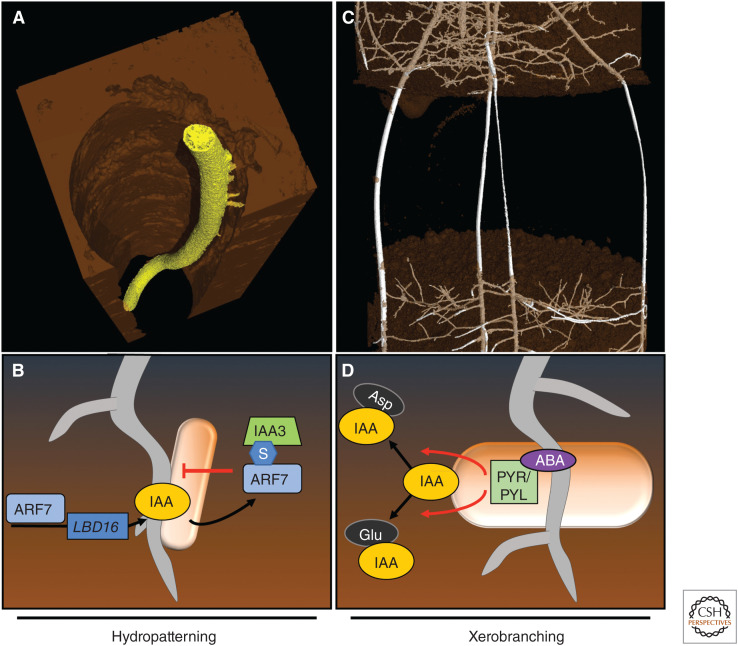
Auxin-regulated root-adaptive responses to water availability. (A) X-ray microCT image of a maize root growing down a macropore reveals lateral branches only form on the side in contact with soil employing the hydropatterning response. (B) Hydropatterning is regulated via the posttranslational modification of ARF7 by SUMO (blue hexagon “S”) in cells on the side of the root exposed to the air-filled macropore (denoted by bubble). SUMOylated ARF7 recruits the repressor Aux/IAA3, blocking auxin-dependent transcription and lateral root development. On the wet side of the root, ARF7 is not SUMOylated and therefore can activate LBD16 gene expression, leading to lateral root initiation. (C) X-ray microCT image of a barley root growing through an air-filled space, causing branching to cease until later reentering soil due to the xerobranching response. (D) A transient reduction in water uptake causes abscisic acid (ABA) to accumulate in root tip tissues during growth through the air space (denoted by bubble). ABA triggers its receptor PYR/PYL, which results in an increase of indole-3-acetic acid (IAA) conjugation to aspartate (Asp) and glutamate (Glu) by GH3 enzymes. This leads to a drop in free IAA levels, negatively affecting lateral root initiation.
Figure 2.
Figure 2.
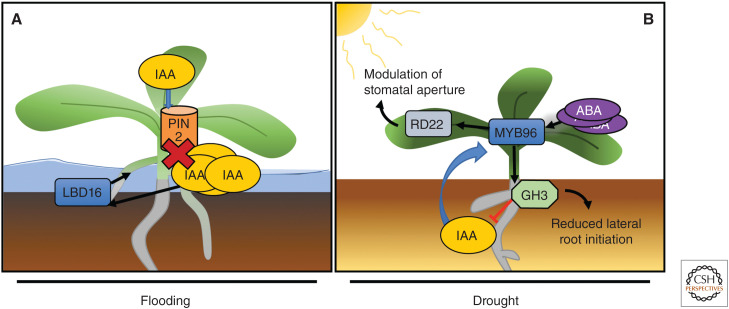
Systematic adaptive responses caused by flooding and drought stress. (A) During prolonged drought, exposure plants increase the initiation of adventitious roots as indicated in this simplified model. This initiation is induced by the inhibition of PIN2, decreasing auxin transport from shoot to root. The accumulation of indole-3-acetic acid (IAA) in the stem causes the induction of LBD16 (through auxin response factors [ARFs]) and the subsequent initiation of adventitious roots. (B) During long drought periods, plants accumulate abscisic acid (ABA) in leaf tissue. This accumulation leads to regulation of multiple genes of which one is the transcription factor MYB96. Through MYB96 induction, ABA regulates gene expression of RD22 and GH3. RD22 is important for drought responses in the shoot by modulating stomatal aperture. GH3 promotes conjugation of IAA in the root, thereby limiting auxin levels and restricting the initiation and development of lateral roots.
Figure 3.
Figure 3.
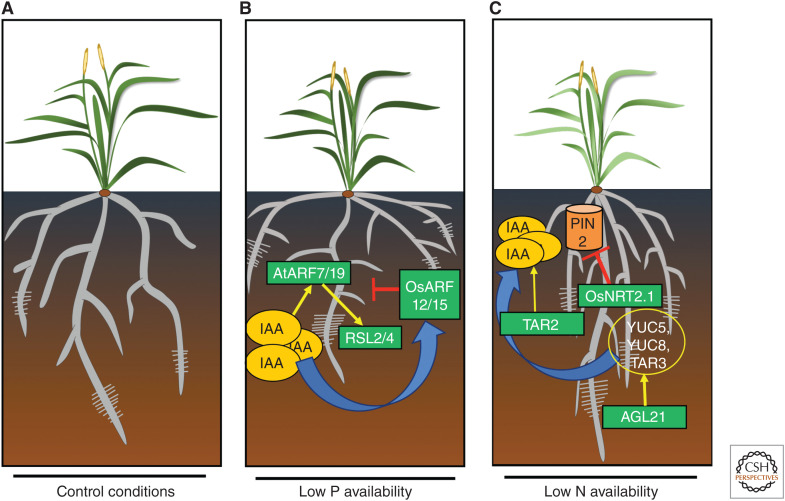
Phosphorus (P) and nitrogen (N) availability steer root system architecture. (A) Representative cartoon of a cereal root architecture. (B) Auxin response and levels are enhanced in P-deficient roots. The elevated auxin response causes the activation of ARF7 and ARF19 regulating the expression of RSL2 and RSL4 transcription factors, ultimately regulating the root hair elongation. OsARF12 and OsARF15 act as negative regulators of P homeostasis and regulate the branching density and root hair elongation in rice. (C) Root architecture of a low N (nitrogen) stressed plants showing enhanced forging capacity by elongating root hairs, longer branching, and steep root angle. Low N stress increases the IAA level via up-regulating expression of auxin biosynthetic genes. For example, TAR2 expression is increased under low N and results in higher IAA levels, which in turn reshapes the root architecture to favor maximum N uptake. AGL21 also positively regulates the expression YUC5, YUC8, and TAR3, which increases IAA synthesis rate under low N conditions. OsNRT2.1, which acts as an auxin influx facilitator, regulates lateral branching in rice by controlling PIN2 expression.

References

    1. Abas L, Benjamins R, Malenica N, Paciorek T, Wišniewska J, Moulinier-Anzola JC, Sieberer T, Friml J, Luschnig C. 2006. Intracellular trafficking and proteolysis of the Arabidopsis auxin-efflux facilitator PIN2 are involved in root gravitropism. Nat Cell Biol 8: 249–256. 10.1038/ncb1369 - DOI - PubMed
    1. Armstrong W. 1980. Aeration in higher plants. Adv Bot Res 7: 225–332. 10.1016/S0065-2296(08)60089-0 - DOI
    1. Babé A, Lavigne T, Séverin JP, Nagel KA, Walter A, Chaumont F, Batoko H, Beeckman T, Draye X. 2012. Repression of early lateral root initiation events by transient water deficit in barley and maize. Philos Trans R Soc B Biol Sci 367: 1534–1541. 10.1098/rstb.2011.0240 - DOI - PMC - PubMed
    1. Band LR, Wells DM, Larrieu A, Sun J, Middleton AM, French AP, Brunoud G, Sato EM, Wilson MH, Peŕet B, et al. 2012. Root gravitropism is regulated by a transient lateral auxin gradient controlled by a tipping-point mechanism. Proc Natl Acad Sci 109: 4668−4673. 10.1073/pnas.1201498109 - DOI - PMC - PubMed
    1. Banda J, Bellande K, von Wangenheim D, Goh T, Guyomarc'h S, Laplaze L, Bennett MJ. 2019. Lateral root formation in Arabidopsis: a well-ordered LRexit. Trends Plant Sci 24: 826–839. 10.1016/j.tplants.2019.06.015 - DOI - PubMed

Publication types

LinkOut - more resources