


Global and country-level estimates of human population at high altitude
- PMID: 33903258
- PMCID: PMC8106311
- DOI: 10.1073/pnas.2102463118
Global and country-level estimates of human population at high altitude
Abstract
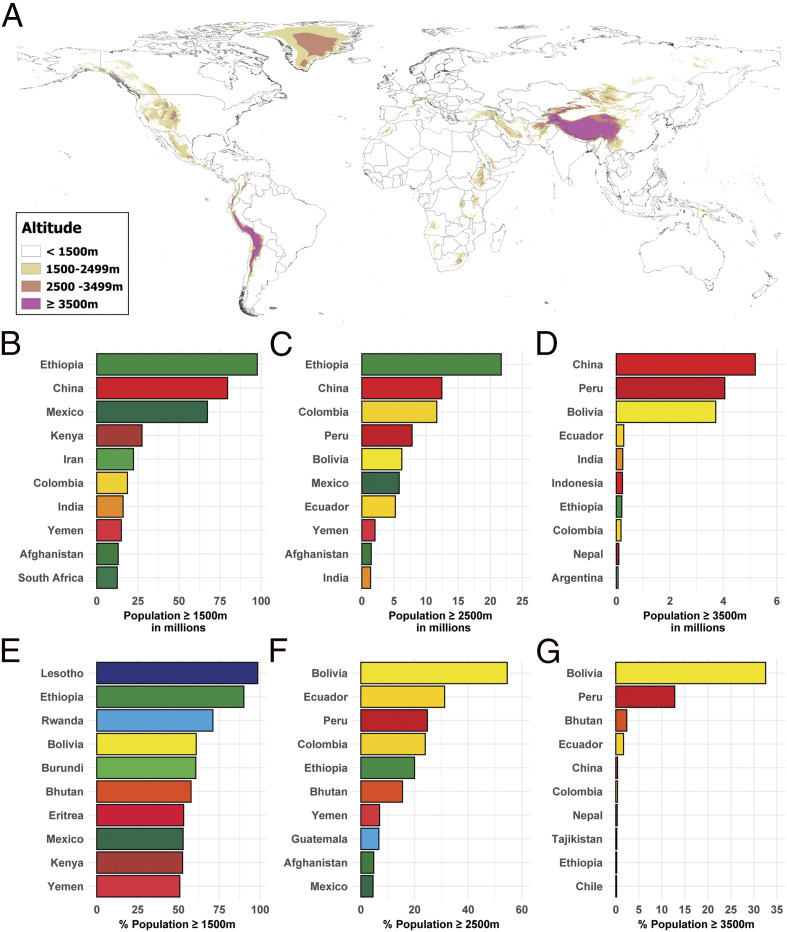
Estimates of the global population of humans living at high altitude vary widely, and such data at the country level are unavailable. Herein, we use a geographic information system (GIS)-based approach to quantify human population at 500-m elevation intervals for each country. Based on georeferenced data for population (LandScan Global 2019) and elevation (Global Multiresolution Terrain Elevation Data), 500.3 million humans live at ≥1,500 m, 81.6 million at ≥2,500 m, and 14.4 million at ≥3,500 m. Ethiopia has the largest absolute population at ≥1,500 m and ≥2,500 m, while China has the greatest at ≥3,500 m. Lesotho has the greatest percentage of its population above 1,500 m, while Bolivia has the greatest at ≥2,500 m and ≥3,500 m. High altitude presents a myriad of environmental stresses that provoke physiological responses and adaptation, and consequently impact disease prevalence and severity. While the majority of high-altitude physiology research is based upon lowlanders from western, educated, industrialized, rich, and democratic countries ascending to high altitude, the global population distribution of high-altitude residents encourages an increased emphasis on understanding high-altitude physiology, adaptation, epidemiology, and public health in the ∼500 million permanent high-altitude residents.
Keywords: geographic information system; global health; global population distribution; hypoxia; mountain.
Copyright © 2021 the Author(s). Published by PNAS.
Conflict of interest statement
The authors declare no competing interest.
Figures
References
-
- Romeo R., Grita F., Parisi F., Russo L., Vulnerability of Mountain Peoples to Food Insecurity: Updated Data and Analysis of Drivers (Food and Agriculture Organization, Rome, 2020).
-
- Hock R., et al., “High mountain areas” in IPCC Special Report on the Ocean and Cryosphere in a Changing Climate, Pörtner H.-O., et al., Eds. (Intergovernmental Panel on Climate Change, 2019), pp. 131−202.
-
- De Jong G. F., Demography and research with high altitude populations. Soc. Biol. 17, 114–119 (1970). - PubMed
-
- Baker P. T., “The adaptive fitness of high-altitude populations” in The Biology of High-Altitude Peoples, Baker P. T., Ed. (Cambridge University Press, Cambridge, United Kingdom, 1978), pp. 317–350.
Publication types
MeSH terms
LinkOut - more resources
Full Text Sources
Other Literature Sources
