Carotid stiffness, intima-media thickness and aortic augmentation index among adults with SARS-CoV-2
- PMID: 33904234
- PMCID: PMC8239784
- DOI: 10.1113/EP089481
Carotid stiffness, intima-media thickness and aortic augmentation index among adults with SARS-CoV-2
Abstract
New findings: What is the central question of this study? We sought to investigate whether carotid stiffness, carotid intima-media thickness and the aortic augmentation index are altered in young adults 3-4 weeks after contraction of severe acute respiratory syndrome coronavirus 2 (SARS-CoV-2) compared with young healthy adults. What is the main finding and its importance? We found that carotid stiffness, Young's modulus and the aortic augmentation index were greater in young adults who tested positive for SARS-CoV-2 compared with healthy young adults. These findings provide additional evidence for detrimental effects of SARS-CoV-2 on young adult vasculature, which might have implications for cardiovascular health.
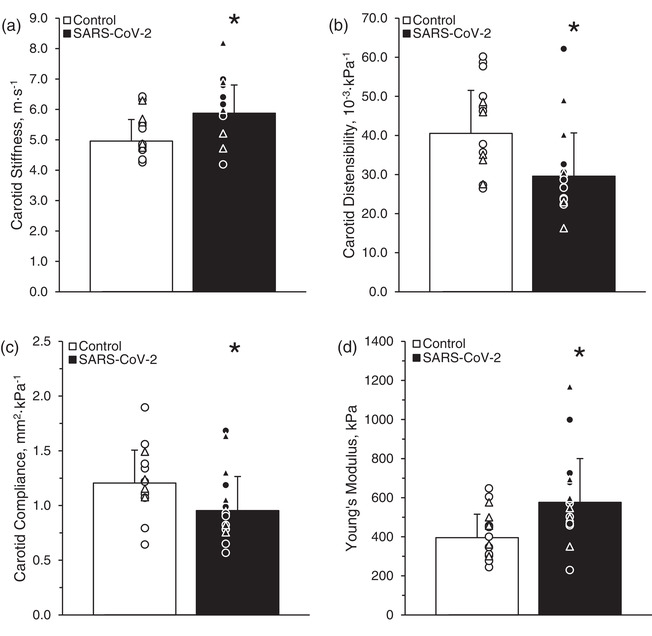
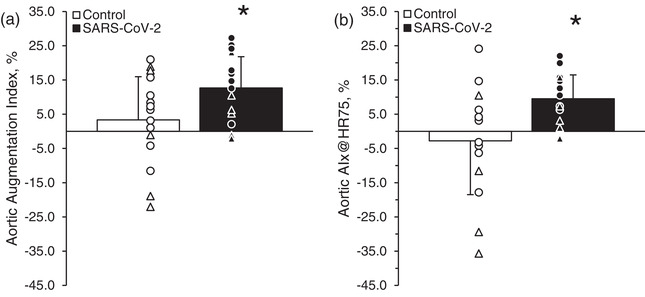
Abstract: Contracting severe acute respiratory syndrome coronavirus 2 (SARS-CoV-2) has been observed to cause decrements in vascular function of young adults. However, less is known about the impact of SARS-CoV-2 on arterial stiffness and structure, which might have additional implications for cardiovascular health. The purpose of this study was to assess the carotid artery stiffness and structure using ultrasound and the aortic augmentation index (AIx) using applanation tonometry in young adults after they tested positive for SARS-CoV-2. We hypothesized that carotid artery stiffness, carotid intima-media thickness (cIMT) and aortic AIx would be elevated in young adults with SARS-CoV-2 compared with healthy young adults. We evaluated 15 young adults (six male and nine female; 20 ± 1 years of age; body mass index, 24 ± 3 kg m-2 ) 3-4 weeks after a positive SARS-CoV-2 test result compared with young healthy adults (five male and 10 female; 23 ± 1 years of age; body mass index, 22 ± 2 kg m-2 ) who were evaluated before the coronavirus 2019 pandemic. Carotid stiffness, Young's modulus and cIMT were assessed using ultrasound, whereas aortic AIx and aortic AIx standardized to 75 beats min-1 (AIx@HR75) were assessed from carotid pulse wave analysis using SphygmoCor. Group differences were observed for carotid stiffness (control, 5 ± 1 m s-1 ; SARS-CoV-2, 6 ± 1 m s-1 ), Young's modulus (control, 396 ± 120 kPa; SARS-CoV-2, 576 ± 224 kPa), aortic AIx (control, 3 ± 13%; SARS-CoV-2, 13 ± 9%) and aortic AIx@HR75 (control, -3 ± 16%; SARS-CoV-2, 10 ± 7%; P < 0.05). However, cIMT was similar between groups (control, 0.42 ± 0.06 mm; SARS-CoV-2, 0.44 ± 0.08 mm; P > 0.05). This cross-sectional analysis revealed higher carotid artery stiffness and aortic stiffness among young adults with SARS-CoV-2. These results provide further evidence of cardiovascular impairments among young adults recovering from SARS-CoV-2 infection, which should be considered for cardiovascular complications associated with SARS-CoV-2.
Keywords: COVID-19; SARS-CoV-2; aortic augmentation index; carotid stiffness; intima-media thickness.
© 2021 The Authors. Experimental Physiology © 2021 The Physiological Society.
Conflict of interest statement
None declared.
Figures
References
-
- Bilginer, Y. , Ozaltin, F. , Basaran, C. , Duzova, A. , Besbas, N. , Topaloglu, R. , Ozen, S. , & Bakkaloglu, A. (2008). Evaluation of intima media thickness of the common and internal carotid arteries with inflammatory markers in familial Mediterranean fever as possible predictors for atherosclerosis. Rheumatology International, 28, 1211–1216. 10.1007/s00296-008-0605-9 - DOI - PubMed
-
- Bruno, R. M. , Cartoni, G. , Stea, F. , Armenia, S. , Bianchini, E. , Buralli, S. , Giannarelli, C. , Taddei, S. , & Ghiadoni, L. (2017). Carotid and aortic stiffness in essential hypertension and their relation with target organ damage: The CATOD study. Journal of Hypertension, 35, 310–318. 10.1097/HJH.0000000000001167 - DOI - PMC - PubMed
Publication types
MeSH terms
LinkOut - more resources
Full Text Sources
Other Literature Sources
Medical
Miscellaneous