. 2021 Jul 21;49(13):e75.
doi: 10.1093/nar/gkab274.

Argonaute integrated single-tube PCR system enables supersensitive detection of rare mutations

Affiliations

Argonaute integrated single-tube PCR system enables supersensitive detection of rare mutations

Qian Liu et al. Nucleic Acids Res. .

Abstract

Technological advances in rare DNA mutations detection have revolutionized the diagnosis and monitoring of tumors, but they are still limited by the lack of supersensitive and high-coverage procedures for identifying low-abundance mutations. Here, we describe a single-tube, multiplex PCR-based system, A-Star, that involves a hyperthermophilic Argonaute from Pyrococcus furiosus (PfAgo) for highly efficient detection of rare mutations beneficial from its compatibility with DNA polymerase. This novel technique uses a specific guide design strategy to allow PfAgo selective cleavage with single-nucleotide resolution at 94°C, thus mostly eliminating wild-type DNA in the denaturation step and efficiently amplifying rare mutant DNA during the PCR process. The integrated single-tube system achieved great efficiency for enriching rare mutations compared with a divided system separating the cleavage and amplification. Thus, A-Star enables easy detection and quantification of 0.01% rare mutations with ≥5500-fold increase in efficiency. The feasibility of A-Star was also demonstrated for detecting oncogenic mutations in solid tumor tissues and blood samples. Remarkably, A-Star achieved simultaneous detection of multiple oncogenes through a simple single-tube reaction by orthogonal guide-directed specific cleavage. This study demonstrates a supersensitive and rapid nucleic acid detection system with promising potential for both research and therapeutic applications.


Figures

Figure 1.
Figure 1.
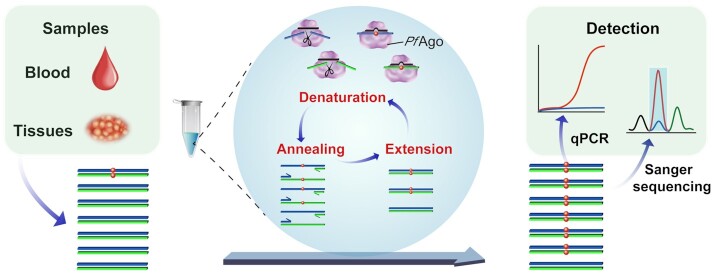
Schematic representation of the A-Star approach for rare mutation enrichment. Black lines represent gDNA and blue and green lines represent forward and reverse strands of target dsDNA, respectively. The coordinating-colored lines with arrows above or below the blue and green lines represent the forward and reverse primers. Red dots indicate the mutated nucleotides of SNV targets.
Figure 2.
Figure 2.
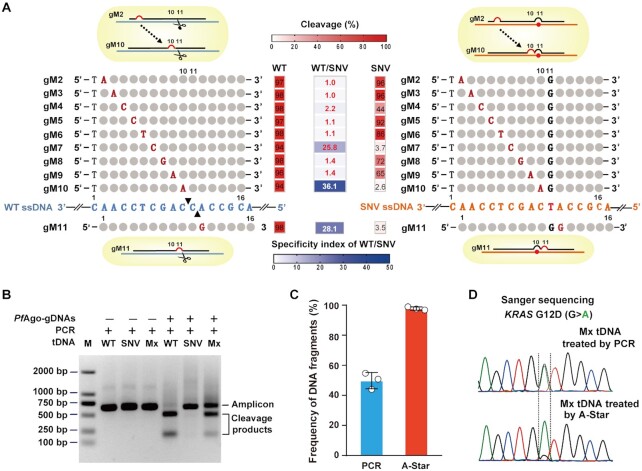
Discriminant DNA cleavage by designed gDNAs and suitability of PfAgo use in PCR in a single-tube reaction for SNV enrichment. (A) Schematic representation of designed gDNAs for KRAS G12D ssDNA cleavage and heat map analysis of the gel detection results for the designed mismatched gDNA directed cleavage on WT and SNV targets. Of the designed gDNAs, the introduced mismatched nucleotides are indicated by red capital letters, the nucleotides corresponding to the SNV site are indicated by black capital letters, and the remaining nucleotides pairing to the ssDNA target are represented by grey circles. The black triangles on the WT ssDNA represent the specific cleavage sites. The cleavage (red heatmaps) was quantified by measuring the electropherograms of the cleavage products with the ssDNA target of KRAS G12D WT or SNV directed by the mismatched gDNAs. The specificity index of WT/SNV (blue heatmap) is the ratio of the cleavage percentage (%) of WT to that of SNV directed by the mismatched gDNAs. (B) Gel electrophoresis analysis for the PfAgo-PCR coupled reaction to cleave WT sequences and enrich SNVs. Mx: a mixture of WT and SNV target at equal molar concentrations. (C) TaqMan qRT-PCR evaluation of the enrichment results tested with a mixture of WT and SNV targets at equal molar concentrations treated by PCR or PfAgo-PCR coupled reaction. Error bars represent standard deviations of the means, n = 3. (D) Sanger sequencing evaluation of the enrichment results tested with a mixture of WT and SNV targets at equal molar concentrations treated by PCR or PfAgo-PCR coupled reaction.
Figure 3.
Figure 3.
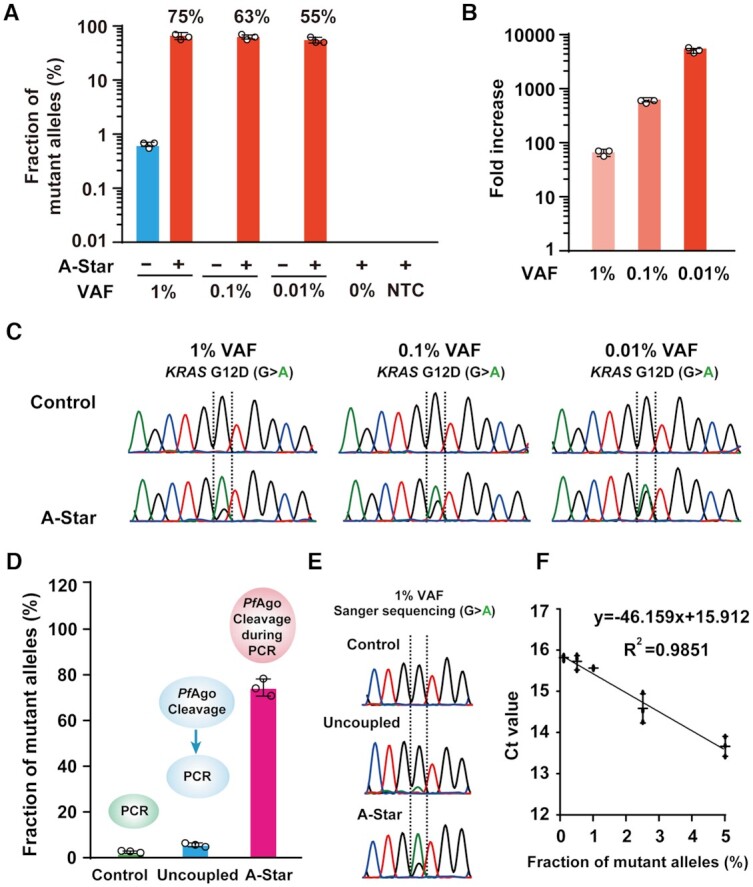
Detection sensitivity of A-Star for rare SNV enrichment. (A) Evaluation of enrichment efficiency of A-Star with KRAS G12D samples of varying VAFs by TaqMan qRT-PCR. (B) The values of fold increases were calculated from the data in (A). (C) Evaluation of enrichment efficiency of A-Star with KRAS G12D samples of varying VAFs by Sanger sequencing. (D, E) Comparison enrichment efficiency of A-Star with the uncoupled PfAgo-PCR tested with 1% VAF samples of KRAS G12D by TaqMan qRT-PCR (D) and Sanger sequencing (E). (F) Correlation of the threshold cycle (Ct) value and KRAS G12D samples of varying VAFs by TaqMan qRT-PCR. The no-template control (NTC) contained only water. Error bars represent the mean ± S.D., n = 3.
Figure 4.
Figure 4.
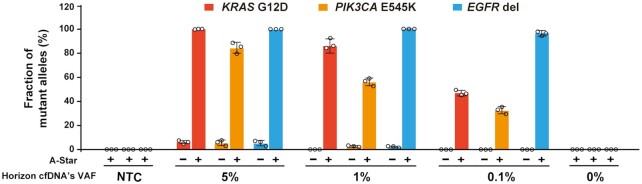
Evaluation of the A-Star enrichment results for KRAS G12D,PIK3CA E545K and EGFR del of Horizon cfDNA standard samples with different VAFs analyzed by TaqMan qRT-PCR. All controls were processed in the absence of a pair of gDNAs. NTC contained only water. Error bars represent standard deviations of the mean, n = 3.
Figure 5.
Figure 5.
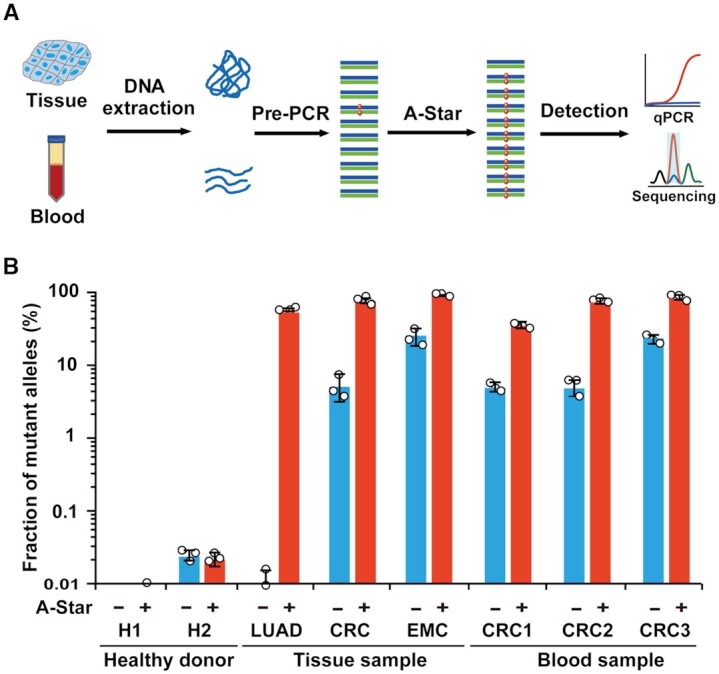
Analysis of A-Star with human clinical samples. (A) Flow chart of the A-Star procedure for the identification of cancer-associated SNVs in human samples. (B) Evaluation of A-Star by TaqMan qRT-PCR using clinical samples from diverse cancer types, as exemplified by KRAS G12D-containing samples from patients with lung adenocarcinoma (LUAD), colorectal cancer (CRC), or endometrial cancer (EMC). The control reactions did not contain gDNA pairs. Error bars represent standard deviations of the mean, n = 3.
Figure 6.
Figure 6.
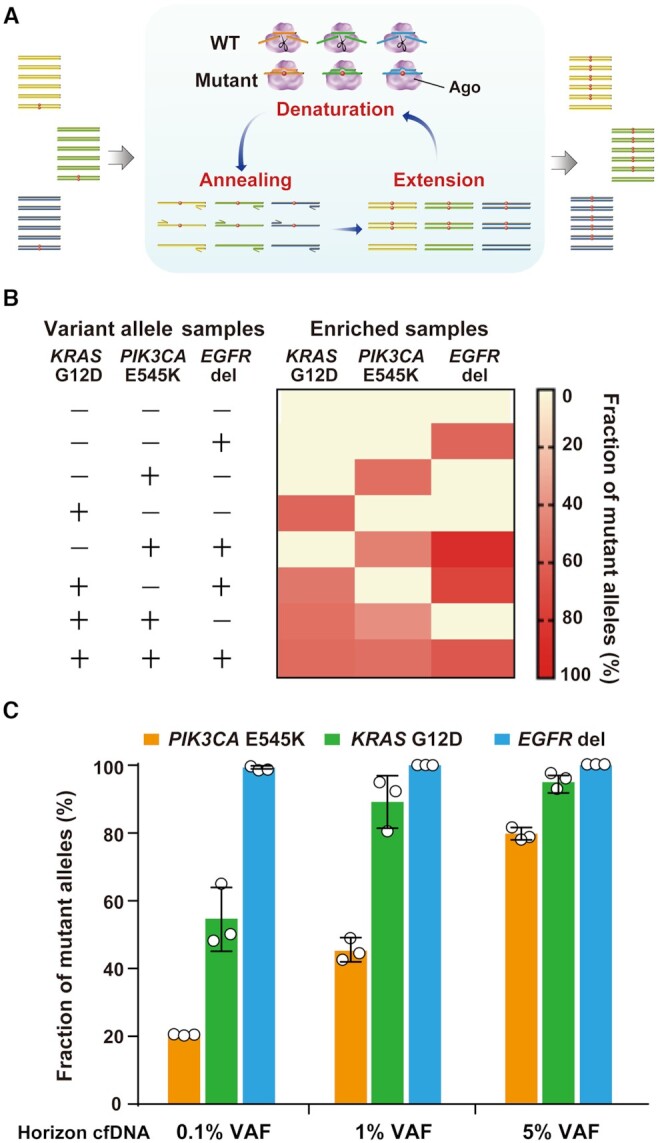
Multiplex detection by A-Star. (A) Schematic representation of multiplex mutation detection in a single-tube reaction containing multiple pairs of primers and gDNAs. (B) Triplex detection by A-Star of the 1% VAF samples of targets KRAS G12D, PIK3CA E545K and EGFR del. (C) A-Star triplex enrichment of KRAS G12D, PIK3CA E545K and EGFR del using standard cfDNA samples with different VAFs of 0.1%, 1% and 5%. The enrichment output was detected using TaqMan qRT-PCR. Error bars represent standard deviations of the mean, n = 3 for each variant.

References

    1. Bettegowda C., Sausen M., Leary R.J., Kinde I., Wang Y., Agrawal N., Bartlett B.R., Wang H., Luber B., Alani R.M.et al. .. Detection of circulating tumor DNA in early- and late-stage human malignancies. Sci. Transl. Med. 2014; 6:224ra224. - PMC - PubMed
    1. Abbosh C., Birkbak N.J., Wilson G.A., Jamal-Hanjani M., Constantin T., Salari R., Le Quesne J., Moore D.A., Veeriah S., Rosenthal R.et al. .. Phylogenetic ctDNA analysis depicts early-stage lung cancer evolution. Nature. 2017; 545:446–451. - PMC - PubMed
    1. Salk J.J., Schmitt M.W., Loeb L.A.. Enhancing the accuracy of next-generation sequencing for detecting rare and subclonal mutations. Nat. Rev. Genet. 2018; 19:269–285. - PMC - PubMed
    1. Milbury C.A., Li J., Makrigiorgos G.M.. PCR-based methods for the enrichment of minority alleles and mutations. Clin. Chem. 2009; 55:632–640. - PMC - PubMed
    1. Wu L.R., Chen S.X., Wu Y., Patel A.A., Zhang D.Y.. Multiplexed enrichment of rare DNA variants via sequence-selective and temperature-robust amplification. Nat Biomed Eng. 2017; 1:714–723. - PMC - PubMed

Publication types