Multicenter Study
. 2021 May:67:103348.
doi: 10.1016/j.ebiom.2021.103348. Epub 2021 Apr 25.

A comprehensive antigen production and characterisation study for easy-to-implement, specific and quantitative SARS-CoV-2 serotests

Affiliations
Multicenter Study

A comprehensive antigen production and characterisation study for easy-to-implement, specific and quantitative SARS-CoV-2 serotests

Miriam Klausberger et al. EBioMedicine. 2021 May.

Abstract

Background: Antibody tests are essential tools to investigate humoral immunity following SARS-CoV-2 infection or vaccination. While first-generation antibody tests have primarily provided qualitative results, accurate seroprevalence studies and tracking of antibody levels over time require highly specific, sensitive and quantitative test setups.

Methods: We have developed two quantitative, easy-to-implement SARS-CoV-2 antibody tests, based on the spike receptor binding domain and the nucleocapsid protein. Comprehensive evaluation of antigens from several biotechnological platforms enabled the identification of superior antigen designs for reliable serodiagnostic. Cut-off modelling based on unprecedented large and heterogeneous multicentric validation cohorts allowed us to define optimal thresholds for the tests' broad applications in different aspects of clinical use, such as seroprevalence studies and convalescent plasma donor qualification.

Findings: Both developed serotests individually performed similarly-well as fully-automated CE-marked test systems. Our described sensitivity-improved orthogonal test approach assures highest specificity (99.8%); thereby enabling robust serodiagnosis in low-prevalence settings with simple test formats. The inclusion of a calibrator permits accurate quantitative monitoring of antibody concentrations in samples collected at different time points during the acute and convalescent phase of COVID-19 and disclosed antibody level thresholds that correlate well with robust neutralization of authentic SARS-CoV-2 virus.

Interpretation: We demonstrate that antigen source and purity strongly impact serotest performance. Comprehensive biotechnology-assisted selection of antigens and in-depth characterisation of the assays allowed us to overcome limitations of simple ELISA-based antibody test formats based on chromometric reporters, to yield comparable assay performance as fully-automated platforms.

Funding: WWTF, Project No. COV20-016; BOKU, LBI/LBG.

Keywords: Antibody assay validation; Antigen purity; COVID-19; Dual-antigen testing; Kinetics of primary antibody response; SARS-CoV-2 neutralisation.


Conflict of interest statement

Declaration of Competing Interest Dr. Klausberger has nothing to disclose. Dr. Duerkop has nothing to disclose. Dr. Haslacher has nothing to disclose. Dr. Wozniak-Knopp has nothing to disclose. Dr. Cserjan-Puschmann has nothing to disclose. Dr. Perkmann has nothing to disclose. Dr. Lingg has nothing to disclose. Dr. Pereira Aguilar has nothing to disclose. Dr. Laurent has nothing to disclose. Dr. De Vos has nothing to disclose. Mag.rer.nat. Hofner has nothing to disclose. Dr. Holzer has nothing to disclose. Mrs. Stadler has nothing to disclose. Dipl.-Ing. Manhart has nothing to disclose. DI Vierlinger has nothing to disclose. Dr. Egger has nothing to disclose. Dipl. Ing. Milchram has nothing to disclose. Dr. Gludovacz has nothing to disclose. Dr. Marx has nothing to disclose. Dipl.-Ing. Köppl has nothing to disclose. Christopher Tauer, BSc has nothing to disclose. Jürgen Beck, MSc reports nothing to disclose. Daniel Maresch has nothing to disclose. Dr. Grünwald-Gruber has nothing to disclose. Mr. Strobl has nothing to disclose. Dr. Satzer has nothing to disclose. Dr. Stadlmayr has nothing to disclose. Ing. Vavra has nothing to disclose. Ms. Huber BSc has nothing to disclose. Dr. Wahrmann has nothing to disclose. Dr. Eskandary has nothing to disclose. Dr. Breyer has nothing to disclose. Dr. Sieghart has nothing to disclose. Dr. Quehenberger reports other from Roche Austria, personal fees from Takeda, outside the submitted work; . Dr. Leitner has nothing to disclose. Dr. Strassl has nothing to disclose. Dr. Egger has nothing to disclose. Dr. IRSARA has nothing to disclose. Dr. Griesmacher has nothing to disclose. Dr. Hoermann has nothing to disclose. Dr. Weiss has nothing to disclose. Dr. Bellmann-Weiler has nothing to disclose. Dr. Löffler-Ragg has nothing to disclose. Dr. Borth has nothing to disclose. Dr. Strasser has nothing to disclose. Dr. Jungbauer has nothing to disclose. Dr. Hahn has nothing to disclose. Dr. Mairhofer reports other from enGenes Biotech GmbH, outside the submitted work; In addition, Dr. Mairhofer has a patent PCT/EP2016/059597-Uncoupling growth and protein production issued. Dr. Hartmann has nothing to disclose. Dr. Binder reports grants from Vienna Business Agency, during the conduct of the study; and Employee of Technoclone Herstellung von Diagnostika und Arzneimitteln GmbH. Dr. Striedner reports other from enGenes GmbH, outside the submitted work; In addition, Dr. Striedner has a patent. US20180282737A1 issued to enGenes GmbH. Dr. Mach has nothing to disclose. Dr. Weinhaeusel has nothing to disclose. Dr. Dieplinger has nothing to disclose. Dr. Grebien has nothing to disclose. Dr. Gerner has nothing to disclose. Dr. Christoph Binder is board member of Technoclone GmbH. Dr. Grabherr has nothing to disclose.

Figures

Fig 1
Fig. 1
Comparative profiling of SARS CoV-2 antigens from different expression hosts for serodiagnosis. a-c, the canonical SARS-CoV-2 RBD expressed in five biotechnological platforms (HEK-6E, CHO-K1, CHO-S, Tnms42, N. benthamiana,left panel), an optimised RBD construct expressed in HEK cells (tRBD) as well as the NP produced in E. coli(right panel) were compared in terms of biotechnological parameters as well as seroreactivity to identify ideal candidates that may be sustainably produced for specific and sensitive SARS-CoV-2 serodiagnosis. (a) Pre-defined process and protein quality parameters include overall yield after purification, functional binding to the conformation-dependent mAb CR3022 (RBD) or a commercially available anti-NP antibody as verified by biolayer interferometry, as well as glycosylation analysis. Purified monomer (M), dimer (D), and NP full-length protein (FL)-content was determined by HP-SEC. b-c, Pre-validation of antigens for serodiagnosis with sera of healthy blood donors collected prior to 2018 (n = 210) and convalescent sera from a COVID cohort (n = 124; see methods for cohort description) with an automatable bead-based, multiplex Luminex serotest. (b) Receiver operating characteristic (ROC) curves of the assayed antigens with an indication of the area under the curve (AUC) and 95% confidence interval (CI), (c) Seroreactivity of the two cohorts at a final serum dilution of 1:1200. Blank-corrected values are shown. Shades indicate the calculated cut-off yielding a specificity (Sp) of 99.1% for comparison of antigen performance. P-values were calculated by Mann-Whitney U tests.
Fig 2
Fig. 2
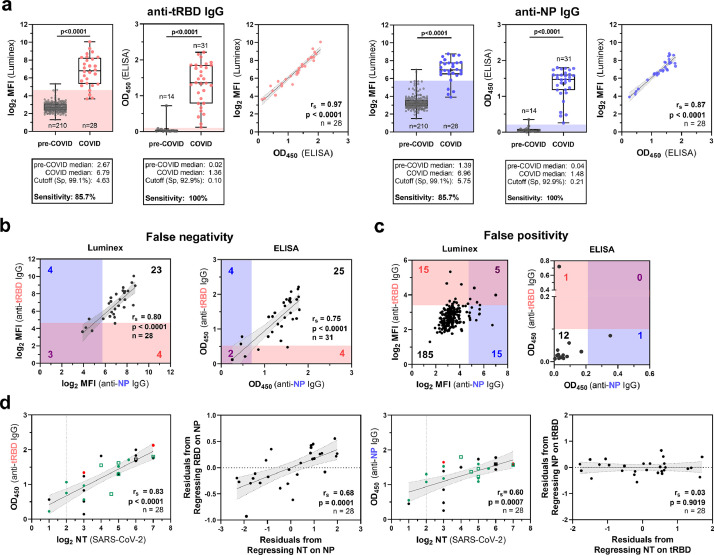
Convalescent sera from blood donors with mild to moderate courses of disease indicate an advantage of dual-antigen testing and a correlation of tRBD-specific antibodies with SARS-CoV-2 neutralization. a-d, A small set of convalescent sera (n = 28–31, part of the Medical University of Vienna COVID-19-cohort) with described courses of disease was used for in-depth analysis of the ELISA candidate antigens. Pre-COVID-19 sera included blood donor sera (n = 210 and n = 14) collected in pre-COVID-19 times (see methods for detailed cohort description). (a) Seroreactivity of HEK-tRBD and E. coli-derived NP as assessed by the Luminex platform and ELISA at serum dilutions of 1:1200 and 1:200, respectively, and the cross-platform correlation of the respective readouts. Data give the mean of blank-corrected values from three independent antigen production batches. Sensitivities with the respective test antigens at the indicated pre-defined specificities were calculated by AUC-analysis of ROC curves, P-values were calculated by Mann-Whitney U tests. b-c, Assessment of overlaps in (b) false-negative and (c) false-positive serum samples identified with both the tRBD or NP antigen in the Luminex and ELISA assay. The cut-offs were set to yield low sensitivity (87.1%, ELISA; 85.,7%, Luminex) or specificity (92.9%, both assays), respectively. Shades are coloured according to the respective antigens (NP: blue, tRBD: pink) and indicate the cut-offs. Numbers in blue and red give the total numbers of false-positives/false-negatives for NP or tRBD, respectively, while purple numbers give samples that are classified as false-positives/-negatives with both antigens. (d) Correlation and partial correlation analysis of ELISA anti-tRBD as well as anti-NP levels with neutralization titres obtained with authentic SARS-CoV-2 virus. Partial correlations take the effect of antibody levels towards the respective other antigen into account. Individual sera are color-coded according to the course of disease (green: asymptomatic and mild; black: moderate; red: severe). Solid lines indicate the linear regression and shades with dotted borders give the 95% CI. Full circles are for sera from individuals with a PCR-confirmed SARS-CoV-2 infection, open squares indicate asymptomatic close contacts. rs, Spearman's correlation factor.
Fig 3
Fig. 3
Performance validation of the Technozym NP and RBD tests. ROC-curve (AUC±95% confidence intervals) of (a) the Technozym RBD- and (b) the NP-ELISA on basis of a cohort of 1126 pre-COVID-19 and 244 COVID-19 serum samples. (c) Results from an adaptive orthogonal testing approach, where all samples yielding <3.000 U/mL in the tRBD ELISA were considered negative and samples with tRBD >35.000 U/mL positive. Samples with tRBD values between those borders were re-tested with the NP ELISA (blue shade). If NP>3.500 U/mL, positivity was confirmed, otherwise it was ruled out. Dashed lines indicate the cut-offs determined by the 99th percentile method (8.000 U/mL) and a reduced cut-off with increased sensitivity (5.000 U/mL, between 99th percentile- and Youden-index criteria) to display the increase in sensitivity gained by the orthogonal test system. (d) Differences in false-positive and -negative test results for different individual and combined test setups were compared by z-tests, total errors at an estimated 5% seroprevalence were compared by χ²-tests for proportions. PPV, positive predictive value, NPV, negative predictive value. * P<0.05, ** P<0.01, *** P<0.001, **** P<0.0001.
Fig 4
Fig. 4
Characterisation of cross-reactive IgG responses between SARS-CoV-2 and endemic hCoV strains in the specificity cohorts. (a) Seroreactivity of serum samples from the two specificity cohorts (AIT pre-COVID-19 cohort, n = 210 and MedUni Wien Biobank pre-COVID-19, n = 14) employed for pre-validation of the SARS-CoV-2 tRBD and NP antigens with the Luminex or ELISA assays respectively, was measured with the spike proteins of common-cold hCoVs HKU-1, OC43, 229E and NL63. Outliers were classified as observations that fall above the 75th percentile + 1.5 x IQR. Shades give the respective calculated cut-offs and are color-coded for NP (blue) or tRBD (pink). Values below the box-plots give the measured seropositivity in percent. (b) Relative IgG levels of NP (n = 17, blue boxes) and tRBD (n = 4, pink boxes) outliers towards the spike proteins of hCoV. White boxes give relative IgG levels of sera with readouts <25th percentile (n = 16 for NP, n = 5 for tRBD) to compare with outliers. Means within groups were compared by One-Way ANOVA followed by a Sidak test to correct for multiple comparisons. c) tRBD and NP-specific seroreactivity of the specificity cohort (n = 1126 MedUni Wien Biobank) used for clinical validation. Red crosses display sera from individuals with PCR-confirmed hCoV infection. Dashed lines indicate the cut-off of 5 U/mL.
Fig 5
Fig. 5
Time-resolved evaluation of NP, tRBD-specific and neutralizing antibodies in the acute and early convalescent phase after SARS-CoV-2 infection. a-b, A total of 104 plasma samples from 64 outpatients (16%) and hospitalised individuals (65% general ward, ICU 19%) were analyzed for anti-NP and anti-tRBD antibodies and neutralizing antibodies at the indicated time points. (a) Antibody levels were assessed with the Technozym ELISAs according to the suggested cut-off of 5.000 U/mL. Bars indicate the fraction of NP, tRBD-positive samples among the tested. Shades give the respective ELISA cut-offs (NP: blue, tRBD: pink). (b) Neutralization assays with authentic SARS-CoV-2 virus were performed within a serum dilution range of 1:4 – 1:512 (dashed lines). Values below or above these limits were assigned a titer of 1:2 or 1:1024 for correlation analysis, respectively. The red line indicates a NT of 1:160 that is recommended by the FDA for the screening of recovered COVID-19 patients for convalescent plasma therapy. All sera above this cut-off are color-coded in red. Geometric mean titers and 95% CI in the RBD ELISA are given for sera with a NT >1:160. rs, Spearman's correlation factor.

References

    1. Long Q.-.X., Liu B.-.Z., Deng H.-.J., Wu G.-.C., Deng K., Chen Y.-.K. Antibody responses to SARS-CoV-2 in patients with COVID-19. Nat Med. 2020;26(6):845–848. Jun. - PubMed
    1. Foundation for Innovative New Diagnostics (FIND). SARS-CoV-2 diagnostic pipeline. [cited 2021 Mar 11]; Available from: https://www.finddx.org/covid-19/pipeline/?avance=Commercialized&type=Man...
    1. Lisboa Bastos M., Tavaziva G., Abidi S.K., Campbell J.R., Haraoui L-P, Johnston J.C. Diagnostic accuracy of serological tests for covid-19: systematic review and meta-analysis. BMJ. 2020;1:m2516. Jul. - PMC - PubMed
    1. Amanat F., Stadlbauer D., Strohmeier S., Nguyen T.H.O., Chromikova V., McMahon M. A serological assay to detect SARS-CoV-2 seroconversion in humans. Nat Med. 2020;26(7):1033–1036. Jul. - PMC - PubMed
    1. Wu F., Zhao S., Yu B., Chen Y.-.M., Wang W., Song Z.-.G. A new coronavirus associated with human respiratory disease in China. Nature. 2020;579(7798):265–269. Mar. - PMC - PubMed

Publication types

MeSH terms

Substances