Effects of an active break and postural shift intervention on preventing neck and low-back pain among high-risk office workers: a 3-arm cluster-randomized controlled trial
- PMID: 33906239
- PMCID: PMC8091075
- DOI: 10.5271/sjweh.3949
Effects of an active break and postural shift intervention on preventing neck and low-back pain among high-risk office workers: a 3-arm cluster-randomized controlled trial
Abstract
Objective: This study evaluated the effects of the promotion of active breaks and postural shifts on new onset of neck and low-back pain during a 6-month follow-up among high-risk office workers.
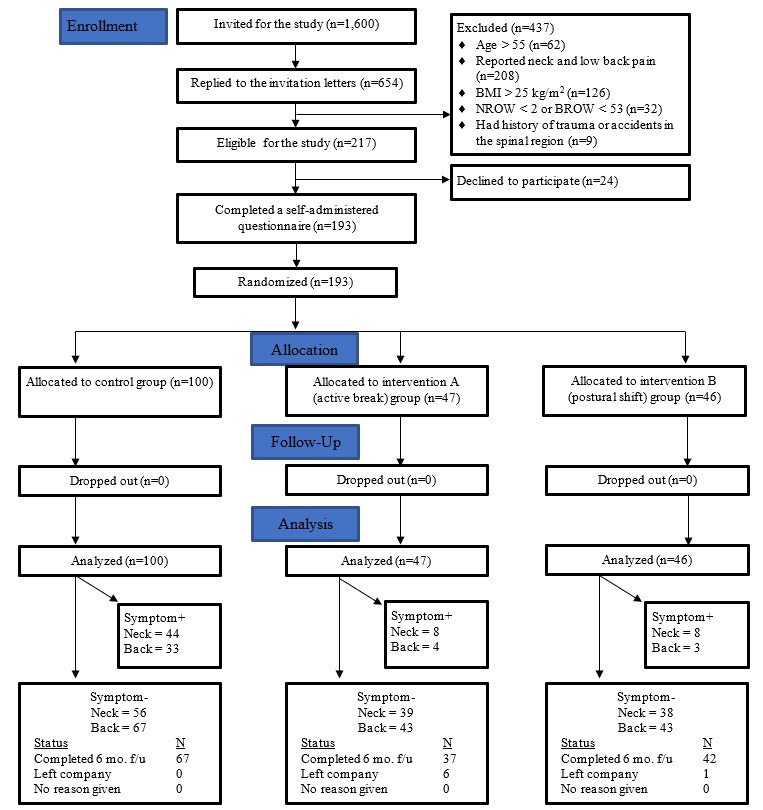
Methods: A 3-arm cluster-randomized controlled trial with 6-month follow-up was conducted among healthy but high-risk office workers. Participants were recruited from six organizations in Bangkok, Thailand (N=193) and randomly assigned at cluster level into active break intervention (N=47), postural shift intervention (N=46), and control (N=100) groups. Participants in the intervention groups received a custom-designed apparatus to facilitate designated active breaks and postural shifts during work. Participants in the control group received a placebo seat pad. The primary outcome measure was new onset of neck and low-back pain during 6-month follow-up. Analyses were performed using Cox proportional hazard models.
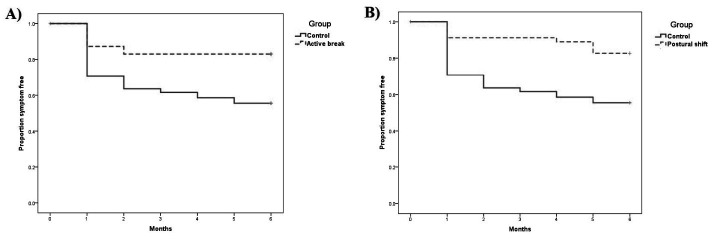
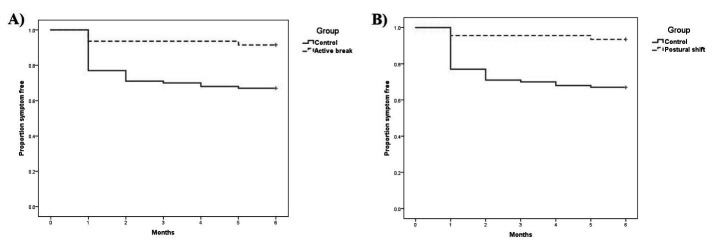
Results: One-hundred and eighty-six (96%) predominantly female participants were successfully followed up over six months. New onset of neck pain during the 6-month follow-up occurred in 17%, 17%, and 44% of the participants in the active break, postural shift, and control groups, respectively. For new onset of low-back pain, these percentages were 9%, 7%, and 33%, respectively. Hazard rate (HR) ratios after adjusting for biopsychosocial factors indicated a protective effect of the active break and postural shift interventions for neck pain [HRadj 0.45, 95% confidence interval (CI) 0.20-0.98 for active break and HRadj 0.41, 95% CI 0.18-0.94 for postural shift] and low-back pain (HRadj 0.34, 95% CI 0.12-0.98 for active break and HRadj 0.19, 95% CI 0.06-0.66 for postural shift).
Conclusion: Interventions to increase either active breaks or postural shifts reduced new onset of neck and low-back pain among high-risk office workers.
Conflict of interest statement
The authors declare no conflicts of interest.
Figures
References
-
- Ehsani F, Mosallanezhad Z, Vahedi G. The prevalence risk factors and consequences of neck pain in office employees. Middle East J Rehabil Health. 2017;4(2):e42031. https://doi.org/10.5812/mejrh.42031.
-
- Areerak K, van der Beek AJ, Janwantanakul P. A health behavior screening tool for non-specific neck pain in office workers:a 1-year prospective cohort study. J Occup Health. 2018 Sep;60(5):410–8. https://doi.org/10.1539/joh.2018-0001-FS. - PMC - PubMed
-
- Ayanniyi O, Ukpai BO, Adeniyi AF. Differences in prevalence of self-reported musculoskeletal symptoms among computer and non-computer users in a Nigerian population:a cross-sectional study. BMC Musculoskelet Disord. 2010 Aug;11(1):177. https://doi.org/10.1186/1471-2474-11-177. - PMC - PubMed
-
- Sitthipornvorakul E, Janwantanakul P, Lohsoonthorn V, Sitthipornvorakul E, Janwantanakul P, Lohsoonthorn V. The effect of daily walking steps on preventing neck and low back pain in sedentary workers:a 1-year prospective cohort study. Eur Spine J. 2015 Mar;24(3):417–24. - PubMed
-
- Hoy D, Bain C, Williams G, March L, Brooks P, Blyth F, et al. A systematic review of the global prevalence of low back pain. Arthritis Rheum. 2012 Jun;64(6):2028–37. https://doi.org/10.1002/art.34347. - PubMed
Publication types
MeSH terms
LinkOut - more resources
Full Text Sources
Other Literature Sources
Medical