


Genetic Causes of Cardiomyopathy in Children: First Results From the Pediatric Cardiomyopathy Genes Study
- PMID: 33906374
- PMCID: PMC8200745
- DOI: 10.1161/JAHA.120.017731
Genetic Causes of Cardiomyopathy in Children: First Results From the Pediatric Cardiomyopathy Genes Study
Erratum in
-
Correction to: Genetic Causes of Cardiomyopathy in Children: First Results From the Pediatric Cardiomyopathy Genes Study.J Am Heart Assoc. 2021 Jun;10(11):e020840. doi: 10.1161/JAHA.121.020840. Epub 2021 May 19. J Am Heart Assoc. 2021. PMID: 34008414 Free PMC article. No abstract available.
Abstract
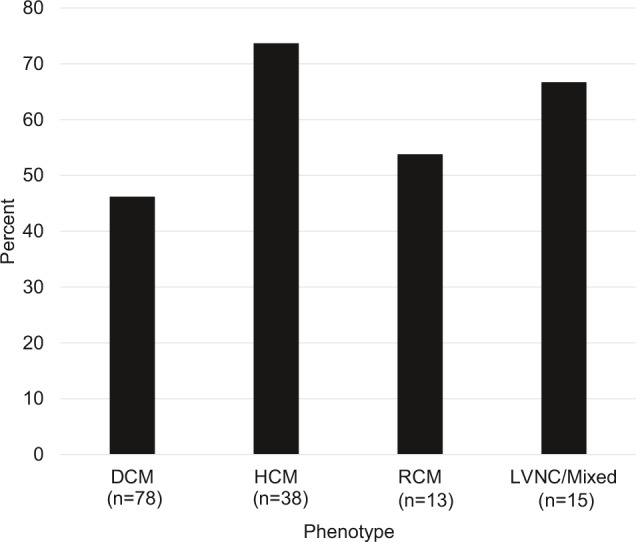
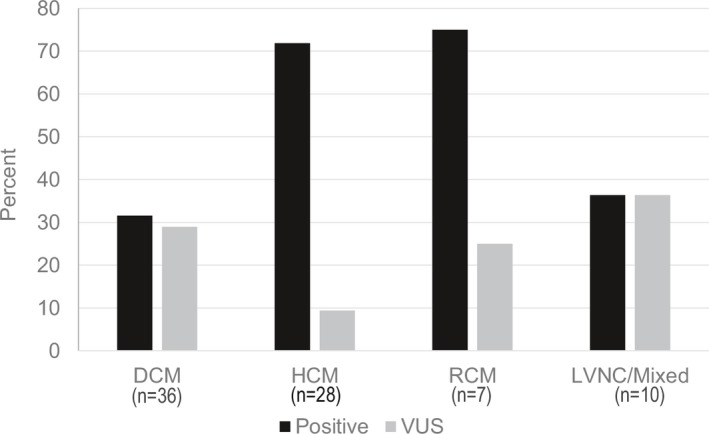
Background Pediatric cardiomyopathy is a genetically heterogeneous disease with substantial morbidity and mortality. Current guidelines recommend genetic testing in children with hypertrophic, dilated, or restrictive cardiomyopathy, but practice variations exist. Robust data on clinical testing practices and diagnostic yield in children are lacking. This study aimed to identify the genetic causes of cardiomyopathy in children and to investigate clinical genetic testing practices. Methods and Results Children with familial or idiopathic cardiomyopathy were enrolled from 14 institutions in North America. Probands underwent exome sequencing. Rare sequence variants in 37 known cardiomyopathy genes were assessed for pathogenicity using consensus clinical interpretation guidelines. Of the 152 enrolled probands, 41% had a family history of cardiomyopathy. Of 81 (53%) who had undergone clinical genetic testing for cardiomyopathy before enrollment, 39 (48%) had a positive result. Genetic testing rates varied from 0% to 97% between sites. A positive family history and hypertrophic cardiomyopathy subtype were associated with increased likelihood of genetic testing (P=0.005 and P=0.03, respectively). A molecular cause was identified in an additional 21% of the 63 children who did not undergo clinical testing, with positive results identified in both familial and idiopathic cases and across all phenotypic subtypes. Conclusions A definitive molecular genetic diagnosis can be made in a substantial proportion of children for whom the cause and heritable nature of their cardiomyopathy was previously unknown. Practice variations in genetic testing are great and should be reduced. Improvements can be made in comprehensive cardiac screening and predictive genetic testing in first-degree relatives. Overall, our results support use of routine genetic testing in cases of both familial and idiopathic cardiomyopathy. Registration URL: https://www.clinicaltrials.gov; Unique identifier: NCT01873963.
Keywords: exome; heart failure; infant; molecular; mutation.
Conflict of interest statement
Dr Steven E. Lipshultz is a consultant for Tenaya Therapeutics, Bayer, and on an advisory board for Myokardia.
Figures
References
-
- Maron BJ, Towbin JA, Thiene G, Antzelevitch C, Corrado D, Arnett D, Moss AJ, Seidman CE, Young JB; American Heart Association, Council on Clinical Cardiology Heart Failure, and Transplantation Committee, Quality of Care and Outcomes Research and Functional Genomics and Translational Biology Interdisciplinary Working Group; Council on Epidemiology and Prevention . Contemporary definitions and classification of the cardiomyopathies: an American Heart Association Scientific Statement from the Council on Clinical Cardiology, Heart Failure and Transplantation Committee; Quality of Care and Outcomes Research and Functional Genomics and Translational Biology Interdisciplinary Working Groups; and Council on Epidemiology and Prevention. Circulation. 2006;113:1807–1816. DOI: 10.1161/CIRCULATIONAHA.106.174287. - DOI - PubMed
-
- Gersh BJ, Maron BJ, Bonow RO, Dearani JA, Fifer MA, Link MS, Naidu SS, Nishimura RA, Ommen SR, Rakowski H, et al. 2011 ACCF/AHA guideline for the diagnosis and treatment of hypertrophic cardiomyopathy: executive summary: a report of the American College of Cardiology Foundation/American Heart Association Task Force on Practice Guidelines. J Am Coll Cardiol. 2011;58:2703–2738. DOI: 10.1016/j.jacc.2011.10.825. - DOI - PubMed
-
- Ackerman MJ, Priori SG, Willems S, Berul C, Brugada R, Calkins H, Camm AJ, Ellinor PT, Gollob M, Hamilton R, et al. HRS/EHRA expert consensus statement on the state of genetic testing for the channelopathies and cardiomyopathies this document was developed as a partnership between the Heart Rhythm Society (HRS) and the European Heart Rhythm Association (EHRA). Heart Rhythm. 2011;8:1308–1339. DOI: 10.1016/j.hrthm.2011.05.020. - DOI - PubMed
Publication types
MeSH terms
Associated data
Grants and funding
LinkOut - more resources
Full Text Sources
Other Literature Sources
Medical
