


Cognitive Outcomes in Children with Mild Traumatic Brain Injury: An Examination Using the National Institutes of Health Toolbox Cognition Battery
- PMID: 33906429
- PMCID: PMC8403208
- DOI: 10.1089/neu.2020.7513
Cognitive Outcomes in Children with Mild Traumatic Brain Injury: An Examination Using the National Institutes of Health Toolbox Cognition Battery
Abstract
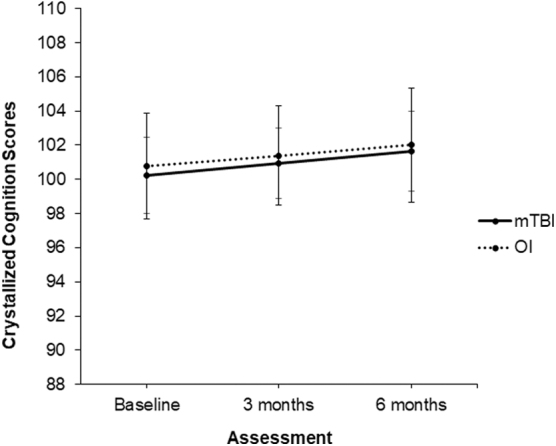
This study is the first to examine cognitive outcomes after pediatric mild TBI using the National Institutes of Health Toolbox Cognition Battery (NIHTB-CB), a computerized cognitive test battery. The NIHTB-CB includes two complex measures of attention and executive function that allow differentiation of accuracy and response speed. We compared performance on the NIHTB-CB among children 8-16 years of age with mild TBI (n = 143) versus children with orthopedic injuries (OIs; n = 74) recruited in emergency departments and followed for 6 months post-injury. Mixed-model analyses showed that the mild TBI group showed significantly lower Fluid Cognition composite scores than the OI group at 10 days (group intercept, p = 0.018); the magnitude of group differences declined modestly over time (group × time interaction, p = 0.055). Effect sizes were d = 0.34 at 10 days post-injury, d = 0.27 at 3 months, and d = 0.10 at 6 months. No significant effects of group or time were found for the Crystallized Cognition composite. Analyses of Fluid Cognition subtests indicated that children with mild TBI displayed deficits for as long as 3 months on measures of attention and executive function (e.g., cognitive flexibility, inhibitory control), but not on measures of explicit memory, working memory, or processing speed. The poorer performance of the mild TBI group on measures of attention and executive function was attributable largely to slowed reaction time, not decreased accuracy. The findings suggest that children with mild TBI demonstrate persistent deficits in fluid cognition that are most apparent on tasks that combine demands for both speed and executive function.
Keywords: cognitive assessment; crystalized cognition; fluid cognition; pediatric; traumatic brain injury.
Conflict of interest statement
Erin D. Bigler reports forensic consultation.
Figures

References
-
- Centers for Disease Control and Prevention, National Center for Injury Prevention and Control. (2019). Surveillance report of traumatic brain injury-related emergency department visits, hospitalizations, and deaths—United States, 2014. Centers for Disease Control and Prevention, National Center for Injury Prevention and Control: Atlanta, GA
-
- Cassidy, J.D., Carroll, L.J., Peloso, P.M., Borg, J., von Holst, H., Holm, L., Kraus, J., and Coronado, V.G.; WHO Collaborating Centre Task Force on Mild Traumatic Brain Injury. (2004). Incidence, risk factors and prevention of mild traumatic brain injury: results of the WHO Collaborating Centre Task Force on Mild Traumatic Brain Injury. J. Rehabil. Med. 36, 28–60 - PubMed
-
- Schneier, A.J., Shields, B.J., Hostetler, S.G., Xiang, H., and Smith, G.A. (2006). Incidence of pediatric traumatic brain injury and associated hospital resource utilization in the United States. Pediatrics 118, 483–492 - PubMed
-
- Fay, G.C., Jaffe, K.M., Polissar, N.L., Liao, S., Rivara, J.B., and Martin, K.M. (1994). Outcome of pediatric traumatic brain injury at three years: a cohort study. Arch. Phys. Med. Rehabil. 75, 733–741 - PubMed
Publication types
MeSH terms
Grants and funding
LinkOut - more resources
Full Text Sources
Other Literature Sources
Medical
