The impact of cash transfers on mental health in children and young people in low-income and middle-income countries: a systematic review and meta-analysis
- PMID: 33906845
- PMCID: PMC8088245
- DOI: 10.1136/bmjgh-2020-004661
The impact of cash transfers on mental health in children and young people in low-income and middle-income countries: a systematic review and meta-analysis
Abstract
Introduction: Although cash transfer programmes are not explicitly designed to improve mental health, by reducing poverty and improving the life chances of children and young people, they may also improve their mental health. This systematic review and meta-analysis assessed the evidence on the effectiveness of cash transfers to improve the mental health of children and young people in low-income and middle-income countries.
Methods: We searched Pubmed, EBSCOhost, Scientific Electronic Library Online, ISI Web of Science and Social Sciences Citation Index and grey literature (from January 2000 to July 2020) for studies which quantitatively assessed the impact of cash transfers on mental health in young people (aged 0-24 years), using a design that incorporated a control group. We extracted Cohen's d effects size and used a random-effects model for the meta-analysis on studies that measured depressive symptoms, I2 statistic and assessment of study quality.
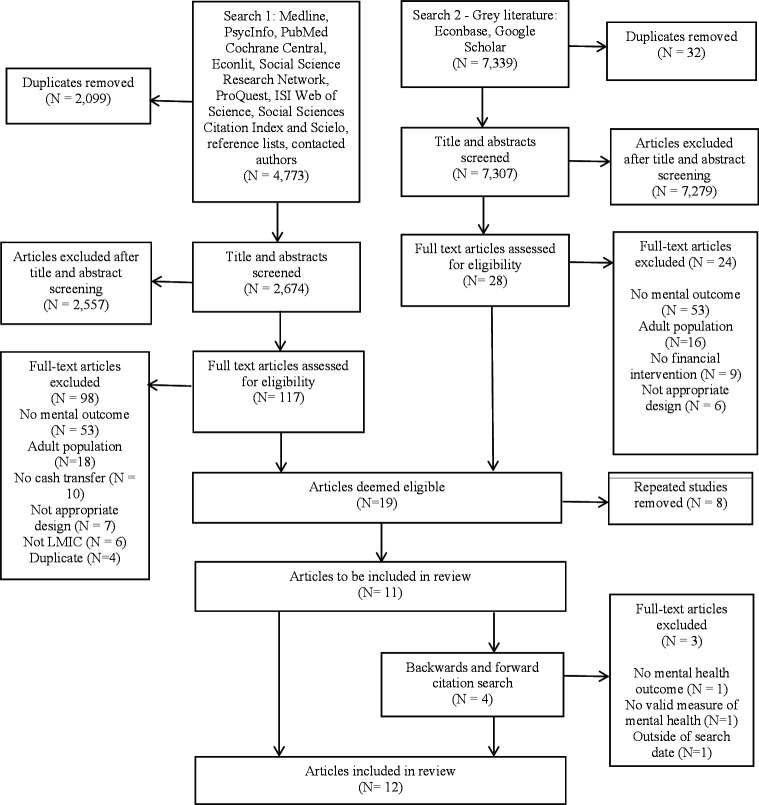
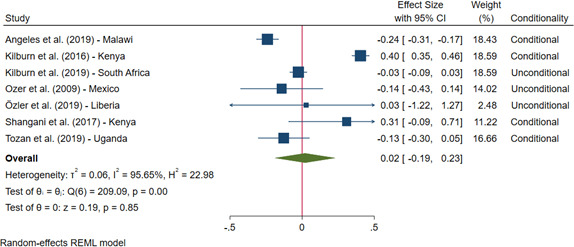
Results: We identified 12 116 articles for screening, of which 12 were included in the systematic review (covering 13 interventions) and seven in the meta-analysis assessing impact on depressive symptoms specifically. There was high heterogeneity (I2=95.2) and a high risk of bias (0.38, 95% CIs: -5.08 to 5.85; p=0.86) across studies. Eleven interventions (85%) showed a significant positive impact of cash transfers on at least one mental health outcome in children and young people. However, no study found a positive effect on all mental health outcomes examined, and the meta-analysis showed no impact of cash transfers on depressive symptoms (0.02, 95% CIs: -0.19 to 0.23; p=0.85).
Conclusion: Cash transfers may have positive effects on some mental health outcomes for young people, with no negative effects identified. However, there is high heterogeneity across studies, with some interventions showing no effects. Our review highlights how the effect of cash transfers may vary by social and economic context, culture, design, conditionality and mental health outcome.
Keywords: child health; health economics; health policy; mental health & psychiatry; systematic review.
© Author(s) (or their employer(s)) 2021. Re-use permitted under CC BY-NC. No commercial re-use. See rights and permissions. Published by BMJ.
Conflict of interest statement
Competing interests: None declared.
Figures
References
-
- Toye JI M. Social inclusion and community economic development: literature review. The Canadian CED Network 2004;4:Cd008137.
-
- Unicef . Child poverty UNICEF, 2020. Available: https://www.unicef.org/social-policy/child-poverty
Publication types
MeSH terms
LinkOut - more resources
Full Text Sources
Medical