


Immune-mediated entities of (primary) focal segmental glomerulosclerosis
- PMID: 33907872
- PMCID: PMC8523460
- DOI: 10.1007/s00441-021-03454-3
Immune-mediated entities of (primary) focal segmental glomerulosclerosis
Abstract
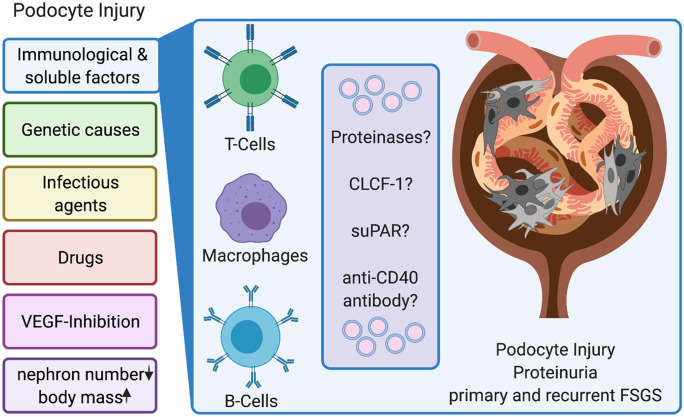
Focal segmental glomerulosclerosis (FSGS) represents a glomerular scar formation downstream of various different mechanisms leading to podocytopathy and podocyte loss. Recently, significant advances were made in understanding genetic factors, podocyte intrinsic mechanisms, and adaptive mechanisms causing FSGS. However, while most cases of nephrotic FSGS are being treated with immunosuppressants, the underlying immune dysregulation, involved immune cells, and soluble factors are only incompletely understood. Thus, we here summarize the current knowledge of proposed immune effector cells, secreted soluble factors, and podocyte response in immune-mediated (primary) FSGS.
Keywords: Immune cell; Immune epithelial interaction; Podocyte; Primary focal segmental glomerulosclerosis; Soluble factor.
© 2021. The Author(s).
Conflict of interest statement
Tobias B. Huber declares advisory activities for Alexion, AstraZeneca, Bayer, Boehringer-Ingelheim, DaVita, Deerfield, Fresenius Medical Care/Unicyte, Goldfinch, Mantra Bio, Novartis and Travere. All other authors declare no conflict of interest.
Figures
References
Publication types
MeSH terms
Grants and funding
LinkOut - more resources
Full Text Sources
Other Literature Sources
