


Development and Feasibility Study of an Addiction-Focused Phenotyping Assessment Battery
- PMID: 33908104
- PMCID: PMC8243823
- DOI: 10.1111/ajad.13170
Development and Feasibility Study of an Addiction-Focused Phenotyping Assessment Battery
Abstract
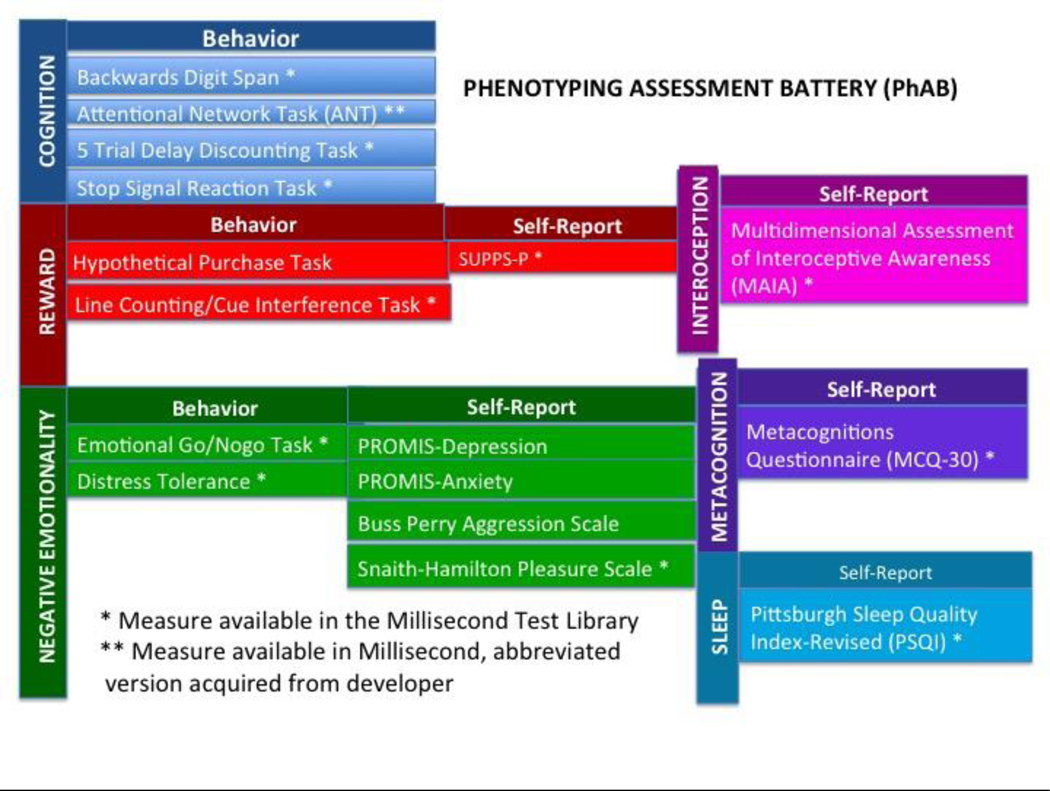
Background and objectives: Current methods of classifying individuals with substance use disorder (SUD) result in vast heterogeneity among persons within a given diagnosis. These approaches, while clinically allowing for distinctions between patient groups, are less than ideal when attempting to recruit a neurobehaviorally defined subset of subjects into clinical trials. To address this gap, alternative strategies have been proposed, including behavioral phenotyping. The NIDA Phenotyping Assessment Battery (PhAB) is a modular package of assessments and neurocognitive tasks that was developed for use in clinical trials. The goal of the present study is to assess the feasibility of the NIDA PhAB with regard to ease of administration and time burden.
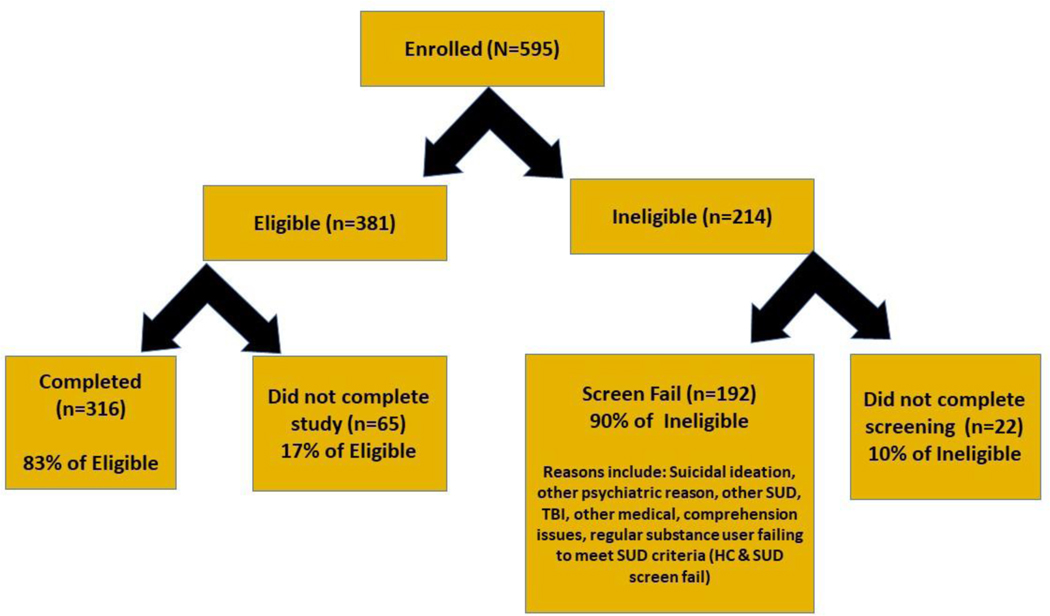
Methods: Healthy controls, persons with cocaine use disorder (CocUD), opioid use disorder (OUD), cannabis use disorder (CanUD), and combined opioid and cocaine use disorder (OCUD) were recruited from various sources (N = 595). Participants completed screening and one to three assessment visits. Time to complete the measures was recorded and a satisfaction interview was administered.
Results: Of the participants enrolled, 381 were deemed eligible. The majority of eligible participants (83%) completed all assessments. The average completion time was 3 hours. High participant satisfaction ratings were noted, with over 90% of participants endorsing a willingness to participate in a similar study and recommend the study to others. CONCLUSION AND SCIENTIFIC SIGNIFICANCE: These findings corroborate the ease with which the PhAB may be easily incorporated into a study assessment visit without undue participant burden. The PhAB is an efficient method for behavioral phenotyping in addiction clinical trials. (Am J Addict 2021;00:00-00).
© 2021 American Academy of Addiction Psychiatry.
Figures
References
-
- Sheehan DV, Lecrubier Y, Sheehan KH, et al. The Mini-International Neuropsychiatric Interview (M.I.N.I.): the development and validation of a structured diagnostic psychiatric interview for DSM-IV and ICD-10. J Clin Psychiatry. 1998;59 Suppl 20:22–57 - PubMed
-
- Mothi SS, Sudarshan M, Tandon N, et al. Machine learning improved classification of psychoses using clinical and biological stratification: Update from the bipolar-schizophrenia network for intermediate phenotypes (B-SNIP). Schizophr Res. 2019;214:60–69. doi: 10.1016/j.schres.2018.04.037 - DOI - PubMed
-
- Latzman RD, DeYoung CG, HiTOP Neurobiological Foundations Workgroup. Using empirically-derived dimensional phenotypes to accelerate clinical neuroscience: The Hierarchical Taxonomy of Psychopathology (HiTOP) framework. Neuropsychopharm. 2020; 45, 1083–1085. doi: 10.1038/s41386-020-0639-6 - DOI - PMC - PubMed
Publication types
MeSH terms
Grants and funding
LinkOut - more resources
Full Text Sources
Other Literature Sources
Miscellaneous
