


Assessment of Fall-Related Emergency Medical Service Calls and Transports after a Community-Level Fall-Prevention Initiative
- PMID: 33909512
- PMCID: PMC8626520
- DOI: 10.1080/10903127.2021.1922556
Assessment of Fall-Related Emergency Medical Service Calls and Transports after a Community-Level Fall-Prevention Initiative
Abstract
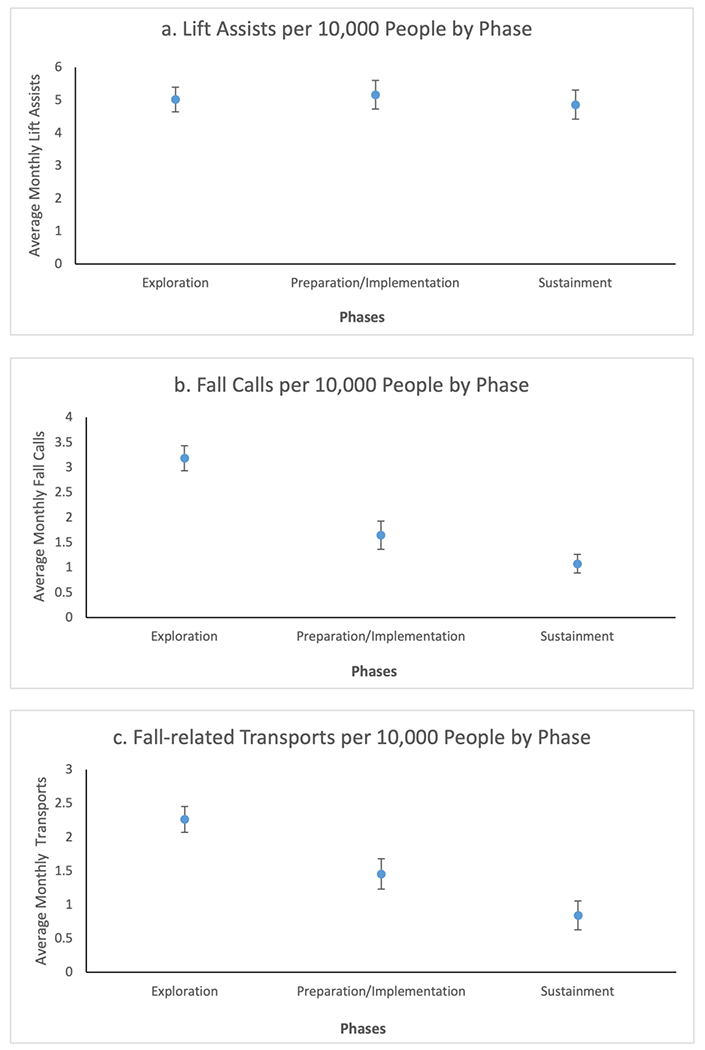
Background: Getting effective fall prevention into the homes of medically and physically vulnerable individuals is a critical public health challenge. Community paramedicine is emerging globally as a new model of care that allows emergency medical service units to evaluate and treat patients in non-emergency contexts for prevention efforts and chronic care management. The promise of community paramedicine as a delivery system for fall prevention that scales to community-level improvements in outcomes is compelling but untested.Objective: To study the impact of a community paramedic program's optimization of a fall prevention system entailing a clinical pathway and learning health system (called Community-FIT) on community-level fall-related emergency medical service utilization rates.Methods: We used an implementation science framework and quality improvement methods to design and optimize a fall prevention model of care that can be embedded within community paramedic operations. The model was implemented and optimized in an emergency medical service agency servicing a Midwestern city in the United States (∼35,000 residents). Primary outcome measures included relative risk reduction in the number of community-level fall-related 9-1-1 calls and fall-related hospital transports. Interrupted time series analysis was used to evaluate relative risk reduction from a 12-month baseline period (September 2016 - August 2017) to a 12-month post-implementation period (September 2018-August 2019).Results: Community paramedic home visits increased from 25 in 2017, to 236 in 2018, to 517 in 2019, indicating a large increase in the number of households that benefited from the efforts. A relative risk reduction of 0.66 (95% [CI] 0.53, 0.76) in the number of fall calls and 0.63 (95% [CI] 0.46, 0.75) in the number of fall-related calls resulting in transports to the hospital were observed.Conclusions: Community-FIT may offer a powerful mechanism for community paramedics to reduce fall-related 9-1-1 calls and transports to hospitals that can be implemented in emergency medical agencies across the country.
Keywords: community paramedicine; fall prevention; injury prevention; older adult falls.
Conflict of interest statement
Declaration of Interest Statement
The authors have no relevant financial or non-financial competing interests to report for this project.
Figures

References
-
- Nkanang B, Parker M, Parker E, Griffiths R. Perioperative mortality for patients with a hip fracture. Injury. 2017;48(10):2180–3. - PubMed
-
- CDC. Older Adult Falls 2018. [updated February 10, 2017 March 16, 2018]. Available from: https://www.cdc.gov/homeandrecreationalsafety/falls/adultfalls.html.
-
- Ho P, Bulsara M, Downs J, Patman S, Bulsara C, Hill A-M. Incidence and prevalence of falls in adults with intellectual disability living in the community: a systematic review. JBI Database System Rev Implement Rep. 2019;17(3):390–413. - PubMed
Publication types
MeSH terms
Grants and funding
LinkOut - more resources
Full Text Sources
Other Literature Sources
Medical
