


She's got nerve: roles of octopamine in insect female reproduction
- PMID: 33909537
- PMCID: PMC8455407
- DOI: 10.1080/01677063.2020.1868457
She's got nerve: roles of octopamine in insect female reproduction
Abstract
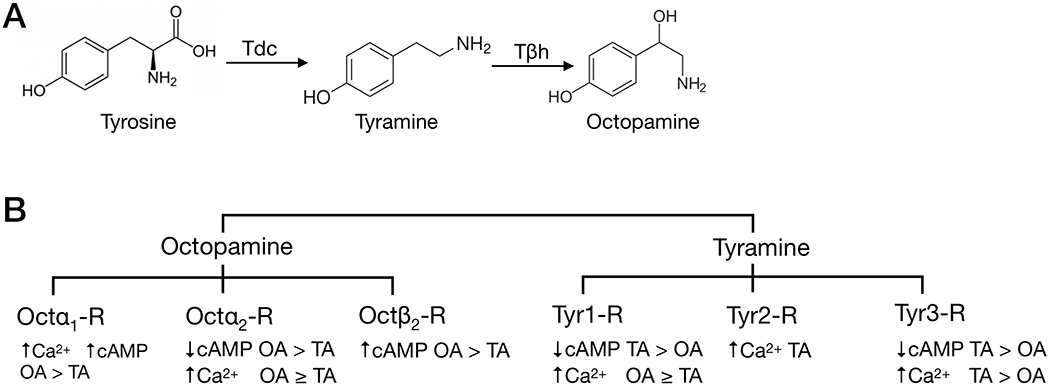
The biogenic monoamine octopamine (OA) is a crucial regulator of invertebrate physiology and behavior. Since its discovery in the 1950s in octopus salivary glands, OA has been implicated in many biological processes among diverse invertebrate lineages. It can act as a neurotransmitter, neuromodulator and neurohormone in a variety of biological contexts, and can mediate processes including feeding, sleep, locomotion, flight, learning, memory, and aggression. Here, we focus on the roles of OA in female reproduction in insects. OA is produced in the octopaminergic neurons that innervate the female reproductive tract (RT). It exerts its effects by binding to receptors throughout the RT to generate tissue- and region-specific outcomes. OA signaling regulates oogenesis, ovulation, sperm storage, and reproductive behaviors in response to the female's internal state and external conditions. Mating profoundly changes a female's physiology and behavior. The female's OA signaling system interacts with, and is modified by, male molecules transferred during mating to elicit a subset of the post-mating changes. Since the role of OA in female reproduction is best characterized in the fruit fly Drosophila melanogaster, we focus our discussion on this species but include discussion of OA in other insect species whenever relevant. We conclude by proposing areas for future research to further the understanding of OA's involvement in female reproduction in insects.
Keywords: Octopamine; fertility; insect; reproduction.
Figures


References
-
- Akster HA, Smit WA. 1977. The Structure of the Terminal Filament, the Ovariole Sheath and the Oviduct Musculature of the Colorado Beetle (Leptinotarsa Decemlineata Say, 1824). Bijdragen tot de Dierkunde. 46(2):136–150. doi: 10.1163/26660644-04602002. 10.1163/26660644-04602002. - DOI
-
- Al-Wathiqui N, Dopman EB, Lewis SM. 2016. Postmating transcriptional changes in the female reproductive tract of the European corn borer moth. Insect Mol Biol. 25(5):629–645. - PubMed
Publication types
MeSH terms
Substances
Grants and funding
LinkOut - more resources
Full Text Sources
Other Literature Sources
Molecular Biology Databases
