Effectiveness of a primary care-based integrated mobile health intervention for stroke management in rural China (SINEMA): A cluster-randomized controlled trial
- PMID: 33909607
- PMCID: PMC8115798
- DOI: 10.1371/journal.pmed.1003582
Effectiveness of a primary care-based integrated mobile health intervention for stroke management in rural China (SINEMA): A cluster-randomized controlled trial
Abstract
Background: Managing noncommunicable diseases through primary healthcare has been identified as the key strategy to achieve universal health coverage but is challenging in most low- and middle-income countries. Stroke is the leading cause of death and disability in rural China. This study aims to determine whether a primary care-based integrated mobile health intervention (SINEMA intervention) could improve stroke management in rural China.
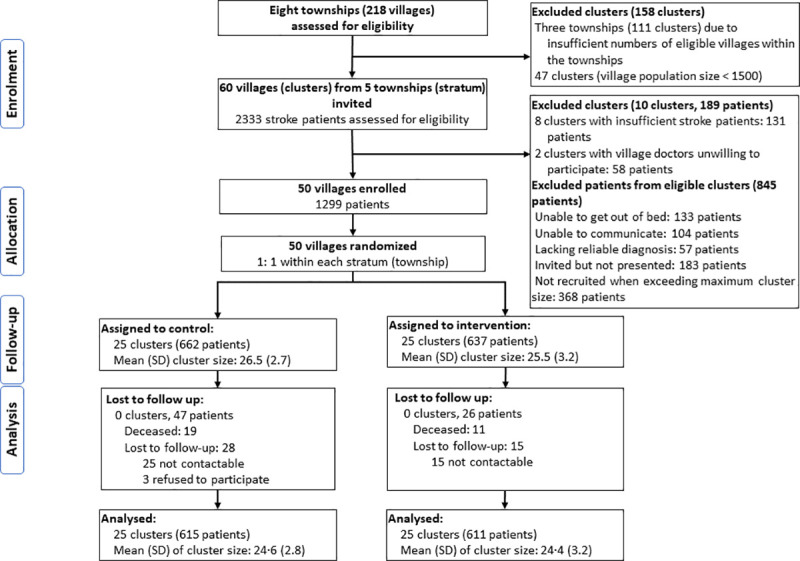
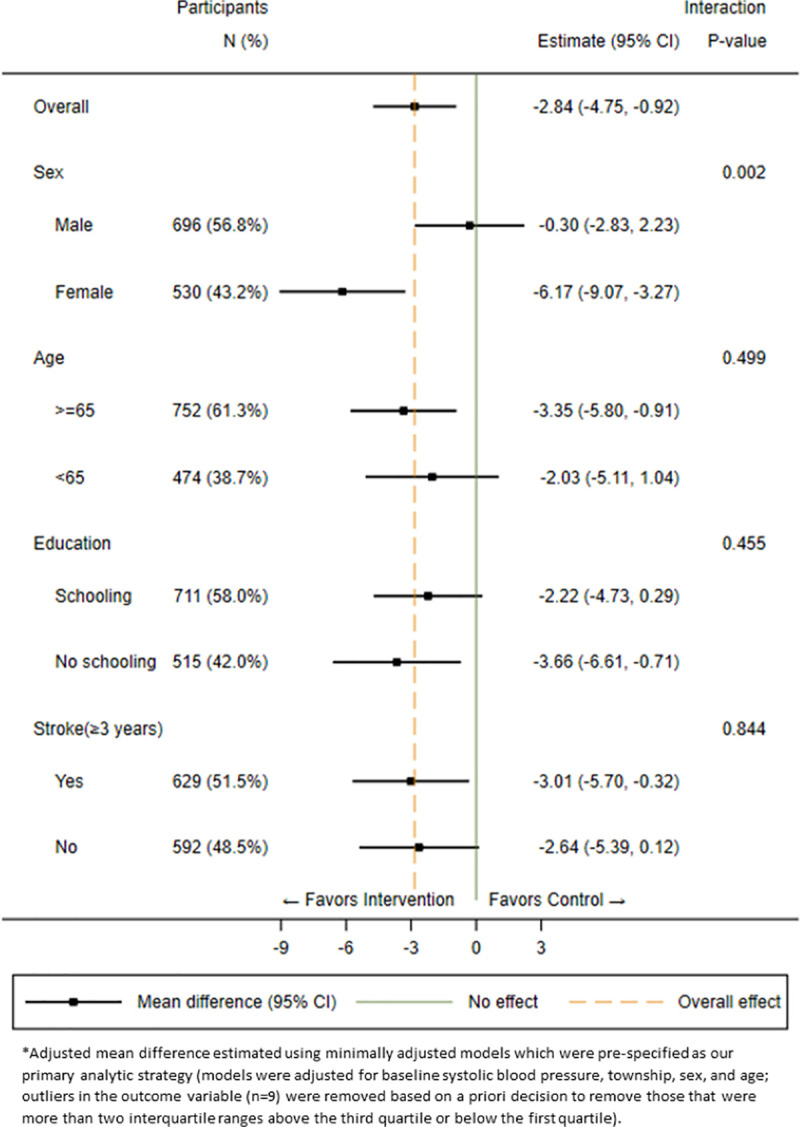
Methods and findings: Based on extensive barrier analyses, contextual research, and feasibility studies, we conducted a community-based, two-arm cluster-randomized controlled trial with blinded outcome assessment in Hebei Province, rural Northern China including 1,299 stroke patients (mean age: 65.7 [SD:8.2], 42.6% females, 71.2% received education below primary school) recruited from 50 villages between June 23 and July 21, 2017. Villages were randomly assigned (1:1) to either the intervention or control arm (usual care). In the intervention arm, village doctors who were government-sponsored primary healthcare providers received training, conducted monthly follow-up visits supported by an Android-based mobile application, and received performance-based payments. Participants received monthly doctor visits and automatically dispatched daily voice messages. The primary outcome was the 12-month change in systolic blood pressure (BP). Secondary outcomes were predefined, including diastolic BP, health-related quality of life, physical activity level, self-reported medication adherence (antiplatelet, statin, and antihypertensive), and performance in "timed up and go" test. Analyses were conducted in the intention-to-treat framework at the individual level with clusters and stratified design accounted for by following the prepublished statistical analysis plan. All villages completed the 12-month follow-up, and 611 (intervention) and 615 (control) patients were successfully followed (3.4% lost to follow-up among survivors). The program was implemented with high fidelity, and the annual program delivery cost per capita was US$24.3. There was a significant reduction in systolic BP in the intervention as compared with the control group with an adjusted mean difference: -2.8 mm Hg (95% CI -4.8, -0.9; p = 0.005). The intervention was significantly associated with improvements in 6 out of 7 secondary outcomes in diastolic BP reduction (p < 0.001), health-related quality of life (p = 0.008), physical activity level (p < 0.001), adherence in statin (p = 0.003) and antihypertensive medicines (p = 0.039), and performance in "timed up and go" test (p = 0.022). We observed reductions in all exploratory outcomes, including stroke recurrence (4.4% versus 9.3%; risk ratio [RR] = 0.46, 95% CI 0.32, 0.66; risk difference [RD] = 4.9 percentage points [pp]), hospitalization (4.4% versus 9.3%; RR = 0.45, 95% CI 0.32, 0.62; RD = 4.9 pp), disability (20.9% versus 30.2%; RR = 0.65, 95% CI 0.53, 0.79; RD = 9.3 pp), and death (1.8% versus 3.1%; RR = 0.52, 95% CI 0.28, 0.96; RD = 1.3 pp). Limitations include the relatively short study duration of only 1 year and the generalizability of our findings beyond the study setting.
Conclusions: In this study, a primary care-based mobile health intervention integrating provider-centered and patient-facing technology was effective in reducing BP and improving stroke secondary prevention in a resource-limited rural setting in China.
Trial registration: ClinicalTrials.gov NCT03185858.
Conflict of interest statement
The authors have declared that no competing interests exist.
Figures
References
-
- Naghavi M, Abajobir AA, Abbafati C, Abbas KM, Abd-Allah F, Abera SF, et al. Global, regional, and national age-sex specific mortality for 264 causes of death, 1980–2016: a systematic analysis for the Global Burden of Disease Study 2016. Lancet. 2017;390(10100):1151–210. 10.1016/S0140-6736(17)32152-9 - DOI - PMC - PubMed
-
- Schwalm J-D, McCready T, Lopez-Jaramillo P, Yusoff K, Attaran A, Lamelas P, et al. A community-based comprehensive intervention to reduce cardiovascular risk in hypertension (HOPE 4): a cluster-randomised controlled trial. Lancet. 2019;394(10205):1231–42. 10.1016/S0140-6736(19)31949-X - DOI - PubMed
Publication types
MeSH terms
Associated data
Grants and funding
LinkOut - more resources
Full Text Sources
Other Literature Sources
Medical
Miscellaneous