Cardiovascular Risk Estimates in Ten Years in the Brazilian Population, a Population-Based Study
- PMID: 33909770
- PMCID: PMC8159568
- DOI: 10.36660/abc.20190861
Cardiovascular Risk Estimates in Ten Years in the Brazilian Population, a Population-Based Study
Abstract
Background: Cardiovascular diseases are the leading cause of morbidity and mortality, resulting in high health costs and significant economic losses. The Framingham score has been widely used to stratify the cardiovascular risk of the individuals, identifying those at higher risk for the implementation of prevention measures directed to this group.
Objective: To estimate cardiovascular risk at 10 years in the adult Brazilian population.
Methods: Cross-sectional study using laboratory data from a subsample of the National Health Survey. To calculate cardiovascular risk, the Framingham score stratified by sex was used.
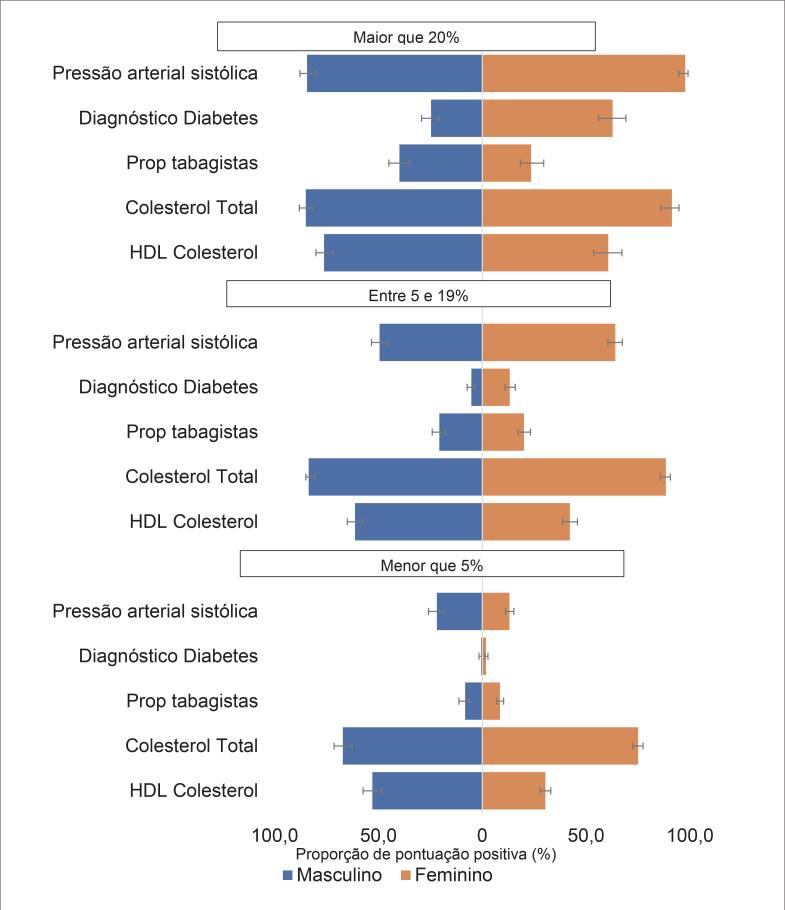
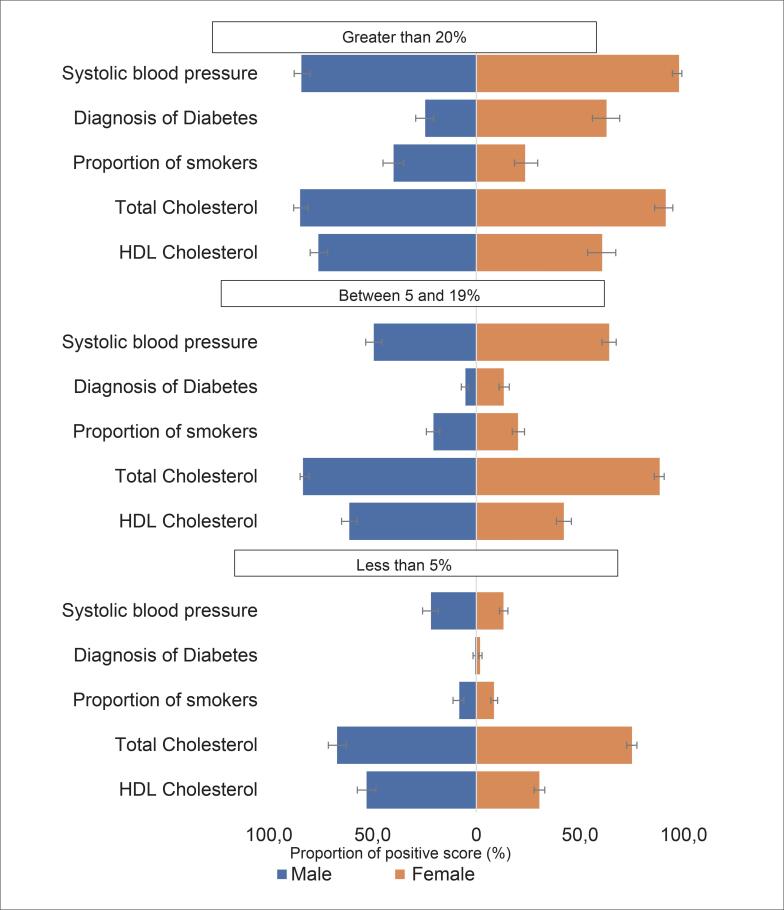
Results: Most women (58.4%) had low cardiovascular risk, 32.9% had medium risk and 8.7% had high risk. Among men, 36.5% had low cardiovascular risk, 41.9% had medium risk and 21.6% had high risk. The risk increased with age and was high in the low-educated population. The proportion of the components of the Framingham model, by risk and sex, shows that, among women at high risk, the indicators that mostly contributed to cardiovascular risk were: systolic blood pressure, total cholesterol, HDL, diabetes and tobacco. Among men, systolic blood pressure, total cholesterol, HDL, tobacco and diabetes.
Conclusion: The study estimates, for the first time in Brazil, the risk of developing cardiovascular disease in ten years. The risk score is useful to support the prevention practices of these diseases, considering the clinical and epidemiological context.
Fundamento: As doenças cardiovasculares são a principal causa de morbimortalidade, altos custos com saúde e perdas econômicas importantes. O escore de Framingham tem sido amplamente utilizado para estratificar o risco dos indivíduos avaliados, identificando aqueles com risco maior para que sejam implementadas medidas de prevenção direcionadas para esse grupo.
Objetivos: Estimar o risco cardiovascular em 10 anos da população brasileira adulta.
Métodos: Estudo transversal, utilizando dados laboratoriais de uma subamostra da Pesquisa Nacional de Saúde. Para calcular o risco cardiovascular, utilizou-se o escore de Framingham, estratificado por sexo.
Resultados: A maioria das mulheres (58,4%) apresentou baixo risco cardiovascular, 32,9%, risco médio e 8,7%, risco elevado. Entre homens, 36,5% apresentaram risco cardiovascular baixo, 41,9%, risco médio e 21,6%, risco elevado. O risco aumentou com a idade e foi elevado na população com baixa escolaridade. A proporção dos componentes do modelo de Framingham, por grupos de risco e sexo, mostra que, no risco elevado entre mulheres, os indicadores que mais contribuíram para o risco cardiovascular foram: a pressão arterial sistólica, colesterol total, HDL, diabetes e tabagismo. Entre homens, pressão arterial sistólica, colesterol total, HDL, tabagismo e diabetes.
Conclusões: Trata-se do primeiro estudo nacional com dados laboratoriais a estimar o risco de doença cardiovascular em dez anos. Os escores de risco são úteis para subsidiar as práticas de prevenção dessas doenças, considerando o contexto clínico e epidemiológico.
Conflict of interest statement
Nenhum potencial conflito de interesses relevante para este artigo foi relatado.
Figures
Comment in
-
"Know the Enemy and Know Yourself". Cardiovascular Risk in the National Health Survey.Arq Bras Cardiol. 2021 Mar;116(3):432-433. doi: 10.36660/abc.20210105. Arq Bras Cardiol. 2021. PMID: 33909771 Free PMC article. English, Portuguese. No abstract available.
References
-
- World Health Organization. (WHO) [Cited in 2019 Nov 29];Cardiovascular diseases: Key facts. Available from: https://www.who.int/news-room/fact-sheets/detail/cardiovascular-diseases(cvds)
- 1. World Health Organization. (WHO) Cardiovascular diseases: Key facts. [Cited in 2019 Nov 29]. Available from: https://www.who.int/news-room/fact-sheets/detail/cardiovascular-diseases...
-
- World Health Organization. (WHO) Global Action Plan for the Prevention and Control of NCDs 2013-2020. Geneva: 2013. [Cited in 2020 Dec 12]. Available from: https://apps.who.int/iris/bitstream/handle/10665/94384/9789241506236_eng....
- 2. World Health Organization. (WHO). Global Action Plan for the Prevention and Control of NCDs 2013-2020. Geneva;2013. [Cited in 2020 Dec 12] Available from: https://apps.who.int/iris/bitstream/handle/10665/94384/9789241506236_eng....
-
- World Health Organization. (WHO) Global Health Estimates 2016: Disease burden by Cause, Age, Sex, by Country and by Region, 2000-2016. Geneva: 2018. [Cited in 2020 Dec 12]. Available from: http://www.who.int/healthinfo/global_burden_disease/estimates/en/index1.....
- 3. World Health Organization. (WHO). Global Health Estimates 2016: Disease burden by Cause, Age, Sex, by Country and by Region, 2000-2016. Geneva; 2018.[Cited in 2020 Dec 12] Available from: http://www.who.int/healthinfo/global_burden_disease/estimates/en/index1.....
-
- Malta DC, Santos NB, Perillo RD, Szwarcwald CL. Prevalence of high blood pressure measured in the Brazilian population, National Health Survey, 2013. [Cited in 2020 Dec 12];Sao Paulo Med J. 2016 134(2):163–170. Available from: http://www.scielo.br/scielo.php?script=sci_arttext&pid=S1516318020160002.... - PMC - PubMed
- 4. Malta DC, Santos NB, Perillo RD, Szwarcwald CL. Prevalence of high blood pressure measured in the Brazilian population, National Health Survey, 2013. Sao Paulo Med J. 2016, 134(2):163-70. [Cited in 2020 Dec 12] Available from: http://www.scielo.br/scielo.php?script=sci_arttext&pid=S151631802016.... - PMC - PubMed
-
- Nascimento BR, Brant LCC, Oliveira GMM, Malachias MVB, Reis GMA, Teixeira RA, et al. Epidemiologia das Doenças Cardiovasculares em Países de Língua Portuguesa: Dados do “Global Burden of Disease”, 1990 a 2016. [Citado em 2020 13 Jun];Arq Bras Cardiol. 2018 110(6):500–511. Disponível em: http://www.scielo.br/scielo.php?script=sci_arttext&pid=S0066782X20180006....
- 5. Nascimento BR, Brant LCC, Oliveira GMM, Malachias MVB, Reis GMA, Teixeira RA, et al. Epidemiologia das Doenças Cardiovasculares em Países de Língua Portuguesa: Dados do “Global Burden of Disease”, 1990 a 2016. Arq Bras Cardiol. 2018; 110(6):500-11. [Citado em 2020 13 Jun] Disponível em: http://www.scielo.br/scielo.php?script=sci_arttext&pid=S0066782X2018....
Publication types
MeSH terms
LinkOut - more resources
Full Text Sources
Other Literature Sources