. 2021 Apr 28;12(1):29.
doi: 10.1186/s13229-020-00411-9.

Shifted phase of EEG cross-frequency coupling in individuals with Phelan-McDermid syndrome

Affiliations

Shifted phase of EEG cross-frequency coupling in individuals with Phelan-McDermid syndrome

Michael G Mariscal et al. Mol Autism. .

Abstract

Background: Phelan-McDermid Syndrome (PMS) is a rare condition caused by deletion or mutation of the SHANK3 gene. Individuals with PMS frequently present with intellectual disability, autism spectrum disorder, and other neurodevelopmental challenges. Electroencephalography (EEG) can provide a window into network-level function in PMS.

Methods: Here, we analyze EEG data collected across multiple sites in individuals with PMS (n = 26) and typically developing individuals (n = 15). We quantify oscillatory power, alpha-gamma phase-amplitude coupling strength, and phase bias, a measure of the phase of cross frequency coupling thought to reflect the balance of feedforward (bottom-up) and feedback (top-down) activity.

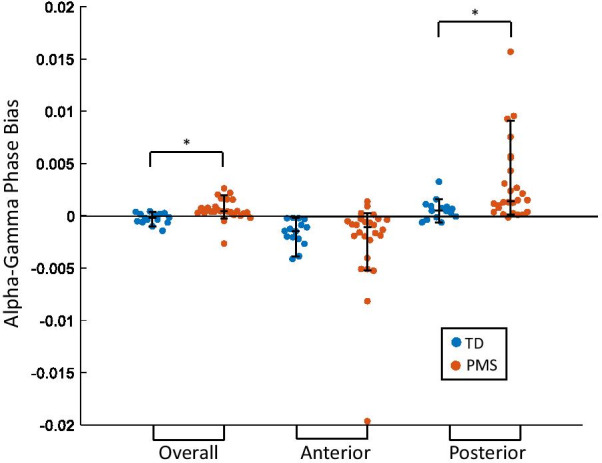
Results: We find individuals with PMS display increased alpha-gamma phase bias (U = 3.841, p < 0.0005), predominantly over posterior electrodes. Most individuals with PMS demonstrate positive overall phase bias while most typically developing individuals demonstrate negative overall phase bias. Among individuals with PMS, strength of alpha-gamma phase-amplitude coupling was associated with Sameness, Ritualistic, and Compulsive behaviors as measured by the Repetitive Behavior Scales-Revised (Beta = 0.545, p = 0.011).

Conclusions: Increased phase bias suggests potential circuit-level mechanisms underlying phenotype in PMS, offering opportunities for back-translation of findings into animal models and targeting in clinical trials.

Keywords: Cross-frequency coupling; EEG; Phase bias; Phelan-McDermid syndrome; Power.


Conflict of interest statement

The authors declare that they have no competing interests.

Figures
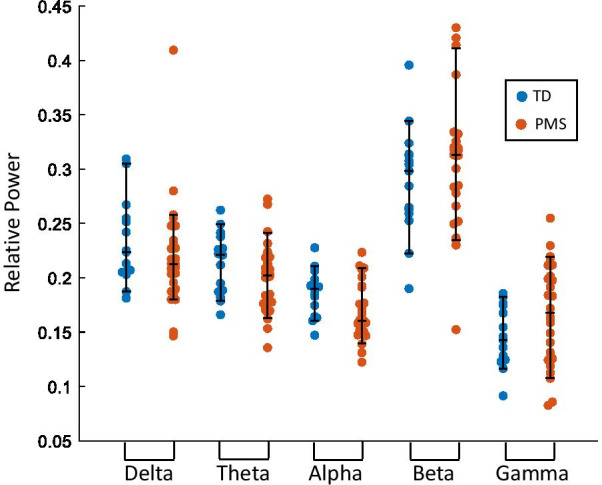
Fig. 1
Fig. 1
Relative power values over all electrodes in the 10–20 system at each frequency band of TD individuals compared with individuals with PMS. Median, 10th and 90th percentiles are plotted
Fig. 2
Fig. 2
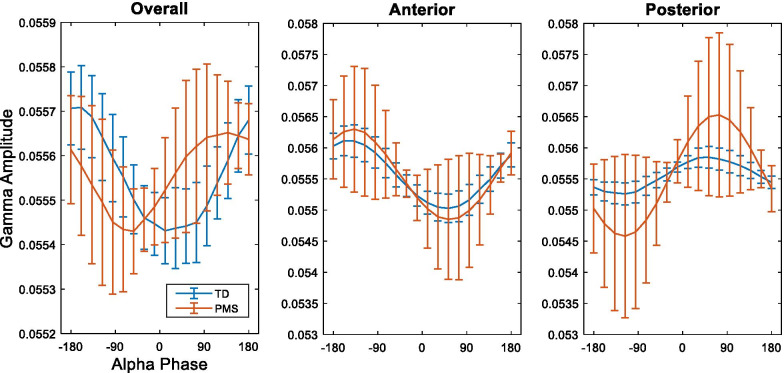
Gamma (28–56 Hz) amplitude plotted as a function of alpha (8–12 Hz) phase, in all channels (left), anterior channels (middle), and posterior channels (right). For each group, amplitude mean and standard deviation values are plotted
Fig. 3
Fig. 3
Alpha (8–12 Hz)–Gamma (28–56 Hz) phase bias values of TD individuals compared to individuals with PMS. Comparisons were done using phase bias values averaged across all channels (Overall), all anterior channels (Anterior), and all posterior channels (Posterior). Median, 10th and 90th percentiles are plotted. *Indicates significance at Benjamini–Hochberg corrected p value of .0167
Fig. 4
Fig. 4
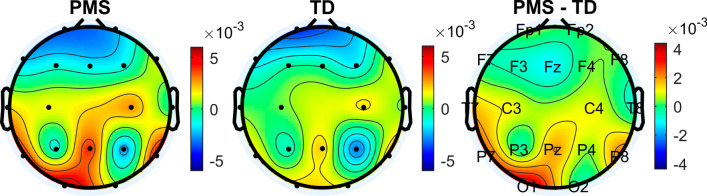
Topographies of Alpha (8–12 Hz)–Gamma (28–56 Hz) phase bias values. The mean phase bias values for each group are shown, as well as the difference between the group means
Fig. 5
Fig. 5
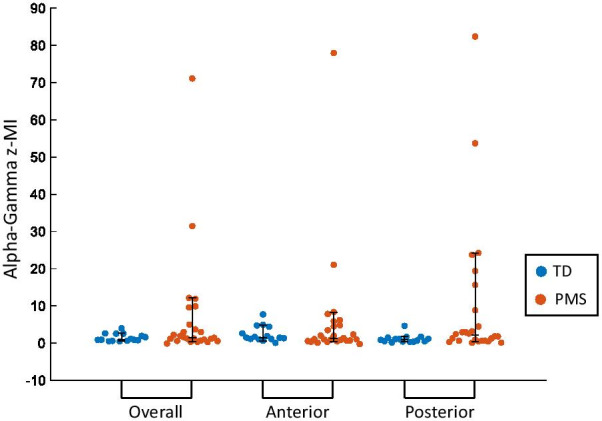
z-MI values of Alpha (8–12 Hz)–Gamma (28–56 Hz) coupling in TD individuals compared to individuals with PMS. Comparisons were done using z-MI values averaged across all channels (Overall), all anterior channels (Anterior), and all posterior channels (Posterior). Median, 10th and 90th percentiles are plotted
Fig. 6
Fig. 6
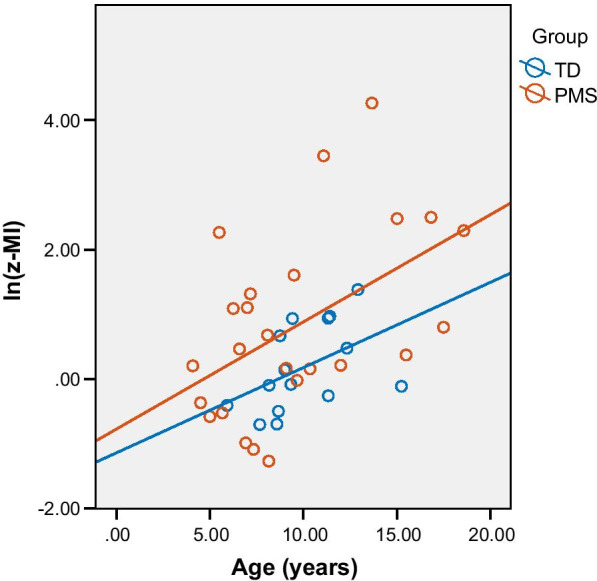
Relationship between age and ln(z-MI). Trend lines are plotted separately for typically developing individuals and individuals with PMS

References

    1. Nesslinger NJ, Gorski JL, Kurczynski TW, Shapira SK, Siegel-Bartelt J, Dumanski JP, et al. Clinical, cytogenetic, and molecular characterization of seven patients with deletions of chromosome 22q13.3. Am J Hum Genet. 1994;54(3):464–472. - PMC - PubMed
    1. Phelan MC, Rogers RC, Saul RA, Stapleton GA, Sweet K, McDermid H, et al. 22q13 deletion syndrome. Am J Med Genet. 2001;101(2):91–99. doi: 10.1002/1096-8628(20010615)101:2<91::AID-AJMG1340>3.0.CO;2-C. - DOI - PubMed
    1. Oberman LM, Boccuto L, Cascio L, Sarasua S, Kaufmann WE. Autism spectrum disorder in Phelan-McDermid syndrome: initial characterization and genotype-phenotype correlations. Orphanet J Rare Dis. 2015;10(1):105. doi: 10.1186/s13023-015-0323-9. - DOI - PMC - PubMed
    1. Soorya L, Kolevzon A, Zweifach J, Lim T, Dobry Y, Schwartz L, et al. Prospective investigation of autism and genotype-phenotype correlations in 22q13 deletion syndrome and SHANK3 deficiency. Mol Autism. 2013;4(1):18. doi: 10.1186/2040-2392-4-18. - DOI - PMC - PubMed
    1. Holder JL, Quach MM. The spectrum of epilepsy and electroencephalographic abnormalities due to SHANK3 loss-of-function mutations. Epilepsia. 2016;57(10):1651–1659. doi: 10.1111/epi.13506. - DOI - PMC - PubMed

Publication types

MeSH terms

Supplementary concepts