


Ethnobotany of the medicinal plants used by the ethnic communities of Kerman province, Southeast Iran
- PMID: 33910616
- PMCID: PMC8082778
- DOI: 10.1186/s13002-021-00438-z
Ethnobotany of the medicinal plants used by the ethnic communities of Kerman province, Southeast Iran
Abstract
Background: Traditional medicine is a major component in the primary healthcare system in the southeast of Iran, which has a rich floral diversity. However, there is no comprehensive report on the use of medicinal herbs in this specific region. This traditional usage of medicinal plants by local communities could serve as a source for pharmacological and phytochemical studies. The main objective of this study was to identify ethnopharmacological knowledge on medicinal plant species and their local healing applications by the folk communities of Kerman province in the southeast of Iran.
Methods: In this cross-sectional study, data were collected from 217 herbal healers using semi-structured questionnaires, open interviews, and field surveys. Factors including use reports (UR) for each species, frequency of citation (FC), and informant consensus factor (ICF) were used to analyze the data. Plant species were identified by botanists through standard taxonomic methods.
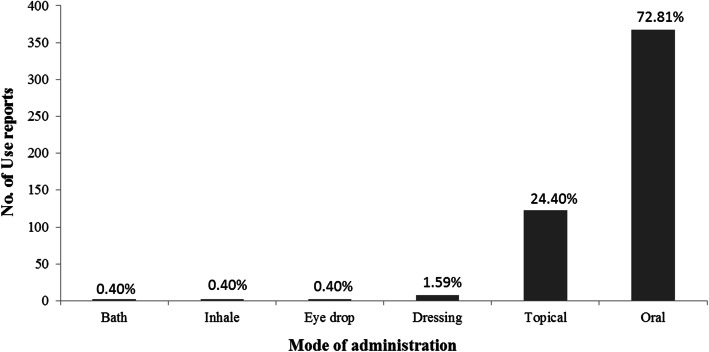
Results: A total of 402 medicinal plants were used in healing practices by the local communities of Kerman province. These species belong to 273 genera of 73 families, among which 367 species are dicotyledons, 27 are monocotyledons, 7 species are cryptogam, and one species is gymnosperm. An important implication from the current study is the identification of the traditional medicinal use of 292 plant species in this region for the first time. Asteraceae, Apiaceae, Lamiaceae, and Fabaceae were the dominant medicinally utilized plant families, respectively. Leaf, flower, fruit, and seed were the most common plant parts used. Generally, crude drugs were used in the form of decoction, followed by poultice and infusion forms. Moreover, oral route is considered as the most common administration route followed by topical route. Endocrine (diabetes), dermatological, gastrointestinal, and respiratory problems were ranked as the most frequent ailment categories for which medicinal plants in this region were applied, respectively. Our findings suggested dominant use of Asteraceae and Apiaceae plants for the treatment of gastrointestinal disorders, Lamiaceae plants for respiratory and gastrointestinal ailments, and Apocynaceae plants for dermatological problems.
Conclusion: Our findings suggested that Asteraceae and Apiaceae plants were used for the treatment of gastrointestinal disorders, Lamiaceae plants for respiratory and gastrointestinal ailments, and Apocynaceae and Euphorbiaceae plants for dermatological problems. Among the medicinal plants with high UR and new ethnobotanical uses, Rhazya stricta was used for wound healing, Calotropis procera, Clematis ispahanica and Euphorbia spp. for eczema, Cionura erecta for the treatment of cough, Launaea acanthodes for the treatment of gastrointestinal parasites, Berberis integrrima as an antidiabetic medicinal herb, Dracocephalum polychaetum and Rydingia persica for various types of chronic diseases, Citrus limon and Citrus aurantium for the treatment of ocular diseases and making the traditional kohl, Calendula officinalis for the treatment of pterygium and Prosopis farcta for preventing nasal bleeding. The identified medicinal plants can be further evaluated for their pharmacological activity and underlying mechanisms of action.
Keywords: Ethnobotany; ICPC category; Iran; Kerman province; Medicinal plants.
Conflict of interest statement
All the authors declare no conflict of interest.
Figures


References
-
- Feng L, Zhai Y-Y, Xu J, Yao W-F, Cao Y-D, Cheng F-F, et al. A review on traditional uses, phytochemistry and pharmacology of Eclipta prostrata (L.) L. J Ethnopharmacol. 2019;245:112109. - PubMed
-
- Prasad S, Tyagi AK. Traditional medicine: the goldmine for modern drugs. Adv Tech Biol Med. 2015;3(1):1–2. doi: 10.4172/2379-1764.1000e108. - DOI
MeSH terms
Grants and funding
LinkOut - more resources
Full Text Sources
Other Literature Sources
Miscellaneous
