. 2021 Apr 28;9(1):96.
doi: 10.1186/s40168-021-01042-9.

Protist diversity and community complexity in the rhizosphere of switchgrass are dynamic as plants develop

Affiliations

Protist diversity and community complexity in the rhizosphere of switchgrass are dynamic as plants develop

Javier A Ceja-Navarro et al. Microbiome. .

Abstract

Background: Despite their widespread distribution and ecological importance, protists remain one of the least understood components of the soil and rhizosphere microbiome. Knowledge of the roles that protists play in stimulating organic matter decomposition and shaping microbiome dynamics continues to grow, but there remains a need to understand the extent to which biological and environmental factors mediate protist community assembly and dynamics. We hypothesize that protists communities are filtered by the influence of plants on their rhizosphere biological and physicochemical environment, resulting in patterns of protist diversity and composition that mirror previously observed diversity and successional dynamics in rhizosphere bacterial communities.

Results: We analyzed protist communities associated with the rhizosphere and bulk soil of switchgrass (SG) plants (Panicum virgatum) at different phenological stages, grown in two marginal soils as part of a large-scale field experiment. Our results reveal that the diversity of protists is lower in rhizosphere than bulk soils, and that temporal variations depend on soil properties but are less pronounced in rhizosphere soil. Patterns of significantly prevalent protists groups in the rhizosphere suggest that most protists play varied ecological roles across plant growth stages and that some plant pathogenic protists and protists with omnivorous diets reoccur over time in the rhizosphere. We found that protist co-occurrence network dynamics are more complex in the rhizosphere compared to bulk soil. A phylogenetic bin-based null model analysis showed that protists' community assembly in our study sites is mainly controlled by homogenous selection and dispersal limitation, with stronger selection in rhizosphere than bulk soil as SG grew and senesced.

Conclusions: We demonstrate that environmental filtering is a dominant determinant of overall protist community properties and that at the rhizosphere level, plant control on the physical and biological environment is a critical driver of protist community composition and dynamics. Since protists are key contributors to plant nutrient availability and bacterial community composition and abundance, mapping and understanding their patterns in rhizosphere soil is foundational to understanding the ecology of the root-microbe-soil system. Video Abstract.

Keywords: Community assembly; Rhizosphere; Soil microbiome; Soil protist; Switchgrass.


Conflict of interest statement

The authors declare that they have no competing interests.

Figures
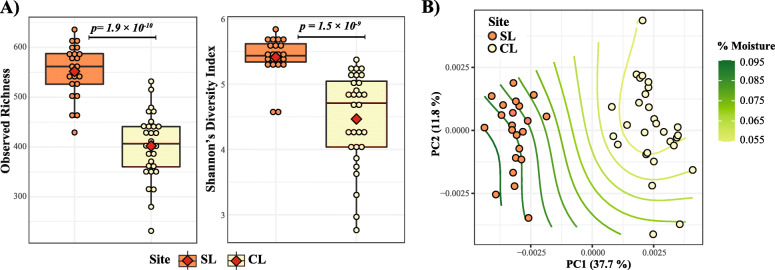
Fig. 1
Fig. 1
Diversity and community composition of protists communities in two marginal soil sites in southern Oklahoma. a Alpha diversity of protist communities in the two marginal soil sites. In each boxplot, a point represents a replicated sample per site and its calculated diversity index, and the diamond symbols represent the mean. The box boundaries represent the first and third quartiles of the distribution and the median is represented as the horizontal line inside each box. Boxplots whiskers span 1.5 times the interquartile range of the distribution. b Ordination plot depicting community structure of protist communities in the CL and SL sites calculated from a weighted Unifrac similarity matrix. The trend surface of the variable moisture was plotted onto the ordination space using the ordisurf function of the vegan package. CL = Clay Loam, SL = Sandy Loam; n = 30 for SL, n = 29 for CL
Fig. 2
Fig. 2
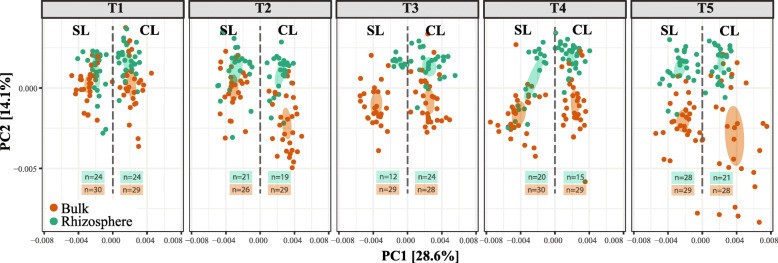
Community composition dynamics from sampling time T1 to T5 for protists in bulk and rhizosphere soil samples. The percent value for each axis represents the proportion of total variation explained. The ellipses were calculated around barycenters with a confidence level of 0.99 using the stat_conf_ellipse function in ggpubr v.0.2.4. SL = Sandy Loam site, CL = Clay Loam site. N values  correspond to the number of biological replicates that were used for analyses
Fig. 3
Fig. 3
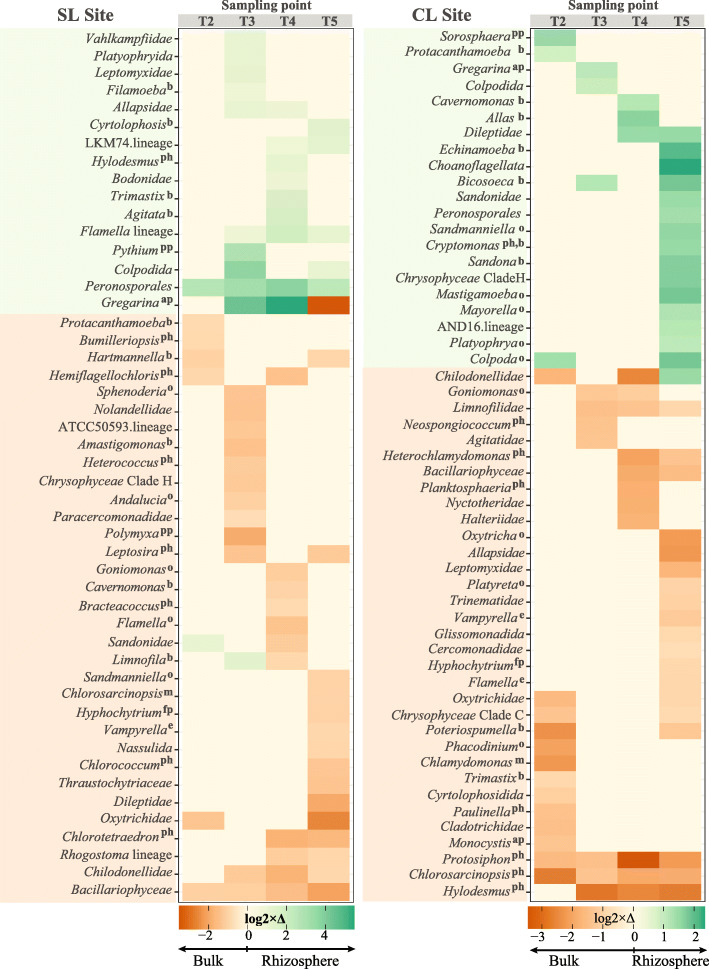
Differential abundance patterns of protist groups in rhizosphere and bulk soil over time. Green color indicates log2-fold abundance increase in the rhizosphere, while brown color indicates an increase of abundance in bulk soil. Only groups with a log2-fold change higher than 0.8 and lower than − 0.8 are represented in the figure. Significant differences for the groups had an FDR corrected p value < 0.01. Feeding/nutrition preferences are indicated based on published reports (see “Materials and methods” section) for those groups identified at the genus level and that were detected as prevalent in the rhizosphere. b = bacterivore, o= omnivore (feeds on bacteria and protists), e = eukaryvore, pp = plant pathogen, ph = photosynthesis, ap = animal pathogen, fp = pathogen of fungi. SL = Sandy Loam site, CL = Clay Loam site. For the SL site n-values were as follows: Rhizosphere-T2 = 21, T3 = 12, T4 = 20, T5=28; bulk-T2 = 26, T3 = 29, T4 = 30, T5 = 29. For the CL site n-values were: Rhizosphere-T2 = 19, T3 = 24, T4 = 15, T5 = 21; bulk-T2 = 29, T3 = 28, T4 = 29, T5 = 28
Fig. 4
Fig. 4
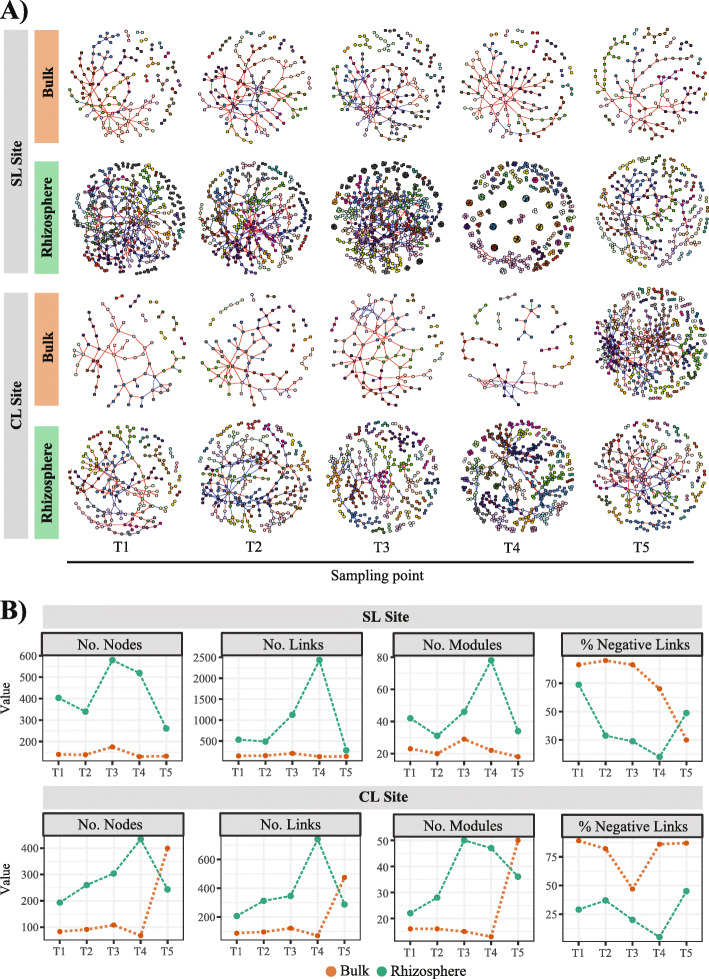
a Succession of rhizosphere and bulk soil networks for protist communities over time. The five sampling points corresponded with different developmental stages of switchgrass plants in two sampling sites. Networks represent RMT co-occurrence models from biological replicates (minimum of 10) at each sampling point, where nodes represent ZOTUs or exact sequence variants, and links between nodes represent significant correlations. Modules are randomly colored. Red and blue links represent significant negative and positive correlations. b Network topological parameters for both sites over time for bulk and rhizosphere protists networks. SL = sandy loam site, CL = clay loam site
Fig. 5
Fig. 5
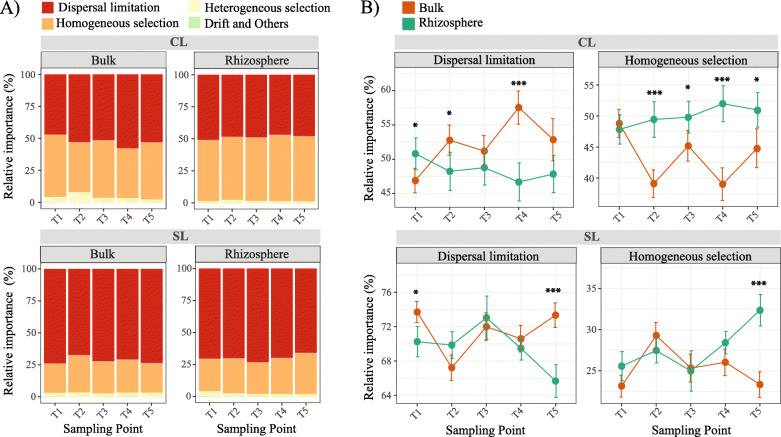
Relative importance of different ecological processes in protist community assembly. a Dispersal limitation and homogenous selection were the most influential ecological processes in both sampling sites for bulk soil and rhizosphere communities across sampling times. b Comparison between bulk soil and rhizosphere show that rhizosphere protists are under higher homogeneous selection but lower dispersal limitation during the growth and/or senescence of switchgrass. Significance is based on bootstrapping with 1000 replications. *P < 0.1; **P < 0.05; ***P < 0.01

References

    1. Heckman DS. Molecular evidence for the early colonization of land by fungi and plants. Science (80- ) 2001;293:1129–33. 10.1126/science.1061457 - PubMed
    1. Lambers H, Mougel C, Jaillard B, Hinsinger P. Plant-microbe-soil interactions in the rhizosphere: an evolutionary perspective. Plant Soil. 2009;321(1-2):83–115. doi: 10.1007/s11104-009-0042-x. - DOI
    1. Broeckling CD, Broz AK, Bergelson J, Manter DK, Vivanco JM. Root exudates regulate soil fungal community composition and diversity. Appl Environ Microbiol. 2008;74(3):738–744. doi: 10.1128/AEM.02188-07. - DOI - PMC - PubMed
    1. Zhalnina K, Louie KB, Hao Z, Mansoori N, da Rocha UN, Shi S, et al. Dynamic root exudate chemistry and microbial substrate preferences drive patterns in rhizosphere microbial community assembly. Nat Microbiol. 2018;3(4):470–80. 10.1038/s41564-018-0129-3. - PubMed

    1. Chaparro JM, Badri DV, Vivanco JM. Rhizosphere microbiome assemblage is affected by plant development. ISME J. 2014;8(4):790–803. doi: 10.1038/ismej.2013.196. - DOI - PMC - PubMed

Publication types