


Work-Related Musculoskeletal Disorders among Office Workers in Higher Education Institutions: A Cross-Sectional Study
- PMID: 33911832
- PMCID: PMC8047279
- DOI: 10.4314/ejhs.v30i5.10
Work-Related Musculoskeletal Disorders among Office Workers in Higher Education Institutions: A Cross-Sectional Study
Abstract
Background: Work-related musculoskeletal disorders (WMSDs) currently pose a challenge to public health and elicit considerable financial, physical and social problems for workers. There is a need to attain a deeper understanding of this predicament among office workers, in order to tackle it successfully. This study sought to investigate the prevalence of WMSDs among office workers in Higher Education Institutions (HEIs) as well as discover its associations with their personal/work details and reported risk factors.
Methods: A cross-sectional survey was executed among 217 office workers in different HEIs, who filled self-report questionnaires on WMSDs. Data were analyzed via descriptive and inferential statistics.
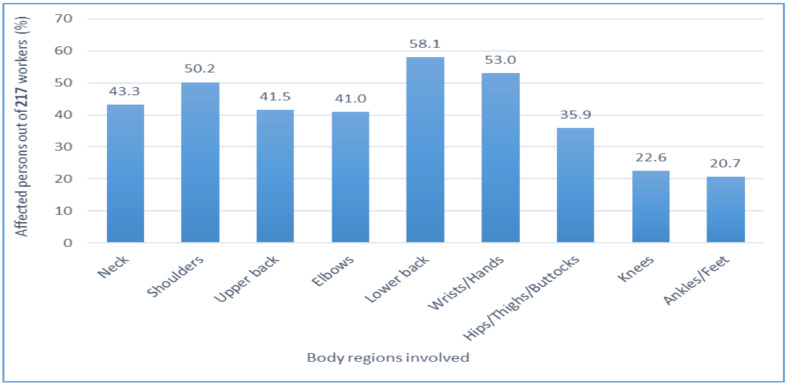
Results: The overall prevalence rate of WMSDs was 71.9% among these staff. The lower back, wrists/hands and shoulders were the most reported body regions for these disorders. WMSD prevalence had significant associations with sex (p = 0.004), age (p = 0.028), working hours (p = 0.003) and work experience (p = 0.014). There were significant positive relationships (p < 0.05) between WMSD prevalence and these risk factors: awkward posture, sustained body position, improper bending, workplace stress, inappropriate furniture and inadequate rest breaks.
Conclusion: Most of the study participants were affected with WMSDs, which were primarily reported in the back and upper extremities. Office workers who were older, female, more experienced and work for longer hours, displayed higher risks for these disorders and should be given special attention. Several factors reported by these HEI staff were revealed to significantly influence WMSD prevalence, emphasizing the need for their effective detection and curtailment.
Keywords: HEI; Higher education institution; Office workers; WMSD; Work-related Musculoskeletal Disorder.
© 2020 Okezue O.C., et al.
Figures
References
-
- European Agency for Safety and Health at Work. Annual Report. 2017. [December 31, 2018]. EU-OSHA. Available at: http://www.osha.europa.eu/en/tools-andpublications.com.
-
- Janga D, Akinfenwa O. Work-related repetitive strain injuries among practitioners of obstetric and gynaecological ultrasound worldwide. Arch Gynecol Obstet. 2012;286:353–356. - PubMed
-
- Das D, Kumar A, Sharma M. A systematic review of work-related musculoskeletal disorders among handicraft workers. Int J Occup Saf Ergon. 2018 May 31;:1–16. - PubMed
MeSH terms
LinkOut - more resources
Full Text Sources
Medical