Review
. 2021 Apr 12:11:656938.
doi: 10.3389/fcimb.2021.656938. eCollection 2021.

HIV-1 Impact on Malaria Transmission: A Complex and Relevant Global Health Concern

Affiliations
Review

HIV-1 Impact on Malaria Transmission: A Complex and Relevant Global Health Concern

Ashleigh Roberds et al. Front Cell Infect Microbiol. .

Abstract

Malaria/HIV-1 co-infection has become a significant public health problem in the tropics where there is geographical overlap of the two diseases. It is well described that co-infection impacts clinical progression of both diseases; however, less is known about the impact of co-infection on disease transmission. Malaria transmission is dependent upon multiple critical factors, one of which is the presence and viability of the sexual-stage gametocyte. In this review, we summarize evidence surrounding gametocyte production in Plasmodium falciparum and the development factors and the consequential impact that HIV-1 has on malaria parasite transmission. Epidemiological and clinical evidence surrounding anemia, immune dysregulation, and chemotherapy as it pertains to co-infection and gametocyte transmission are reviewed. We discuss significant gaps in understanding that are often due to the biological complexities of both diseases as well as the lack of entomological data necessary to define transmission success. In particular, we highlight special epidemiological populations, such as co-infected asymptomatic gametocyte carriers, and the unique role these populations have in a future focused on malaria elimination and eradication.

Keywords: HIV; HIV-1; Plasmodium falciparum; co-infection; gametocytes; malaria; review (article); transmission.


Conflict of interest statement

The authors declare that the research was conducted in the absence of any commercial or financial relationships that could be constructed as a potential conflict of interest.

Figures
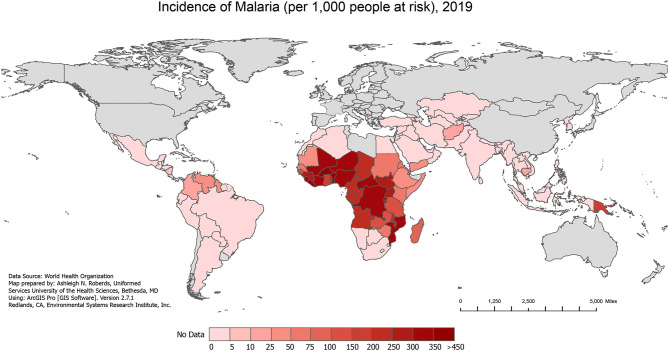
Figure 1
Figure 1
Incidence of Malaria, 2019. The incidence of all malaria cases per 1,000 people at risk in 2019, extracted from the World Health Organization (WHO) 2020 World Malaria Report.
Figure 2
Figure 2
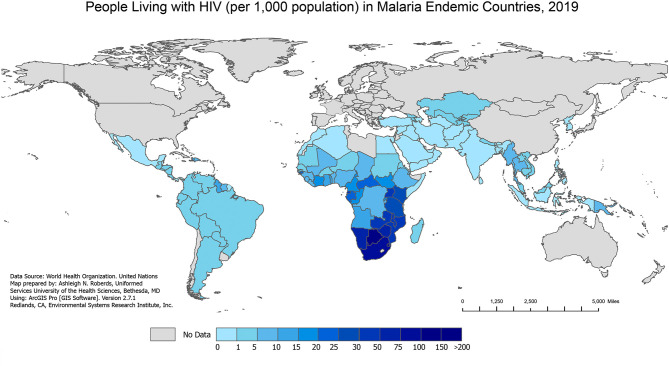
People Living with HIV in Malaria Endemic Countries, 2019. The number of people living with HIV (per 1,000 population) in 2019 in malaria endemic countries from the WHO 2020 World Malaria Report. The 2019 HIV data are extracted from the Joint United Nations Programme on HIV/AIDS (UNAIDS) AIDSinfo data sheet. The 2019 country populations are extracted from the United Nations 2019 World Population Prospects.
Figure 3
Figure 3
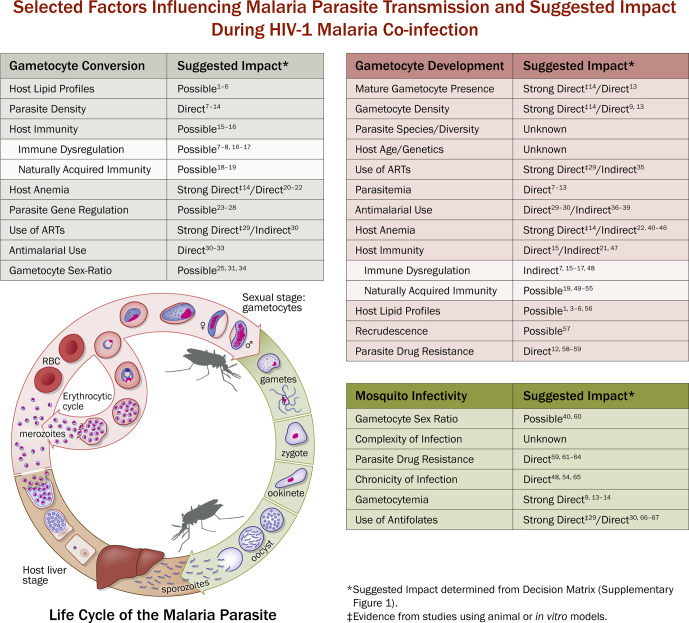
Malaria Life Cycle and Selected Factors Influencing Malaria Parasite Transmission and Suggested Impact During HIV-1 Malaria Co-infection. Example of selected factors that are known to be associated with malaria parasite transmission and the suggested impact (determined using Decision Matrix, Supplementary Figure 1 .) with HIV-1 and/or malaria/HIV-1 co-infection. Suggestive impact is used due to the lack of available statistical evidence and the difficulty in ascertaining the biological relationship between malaria/HIV-1 co-infection and malaria parasite transmission success. Strong Direct Impact means that there is evidence, which includes mosquito transmission data, to suggest that HIV-1 malaria co-infection directly alters gametocyte conversion (GC), gametocyte development (GD), or mosquito infectivity (MI). Direct Impact means there is evidence, sans mosquito data, to suggest that HIV-1 malaria co-infection directly alters GC, GD, or MI. Indirect impact means there is evidence to suggest that HIV-1 or HIV-1 malaria co-infection indirectly alters factors that influence GC, GD, or MI. Possible Impact means there is evidence to suggest that HIV-1 or HIV-1 malaria co-infection may alter factors associated with GC, GD, or MI. Unknown Impact means there is currently not enough evidence to suggest that HIV-1 or HIV-1 malaria co-infection directly or indirectly alter GC, GD, MI, or the factors associated with GC, GD, or MI. The left table (gray, “Gametocyte Conversion”) represents selected transmission factors that pertain to the gametocytogenesis and gametocyte commitment. The center table (red, “Gametocyte Development”) represents selected transmission factors that pertain to the sexual stage development. The right table (green, “Mosquito Infectivity”) represents selected factors that may influence infectivity to mosquitoes and subsequent mosquito transmission success. In the middle is a representation of the life cycle of Plasmodium falciparum (adapted from NIAID/NIH, 2016, https://www.niaid.nih.gov/diseases-conditions/malaria-parasite) representing the exo-erythrocytic (liver) cycle, erythrocytic cycle (bloodstream), and sexual stage (gametocyte) development in the host, and the sporogonic cycle in the mosquito. 1Brancucci et al., 2017; 2Tanaka et al., 2019; 3Orikiiriza et al., 2017; 4Drobnik et al., 2003; 5Belury et al., 2003; 6Bowman et al., 2019; 7Whitworth et al., 2000; 8Patnaik et al., 2005; 9Abu-Raddad et al., 2006; 10Laufer et al., 2006; 11Onyenekwe et al., 2007; 12Van Geertruyden et al., 2008; 13Stiffler et al., 2020; 14Trott et al., 2011; 15Koehler et al., 2009; 16Okonkwo et al., 2016; 17Mbale et al., 2016; 18Graves et al., 1988; 19Nassir et al., 2005; 20Lingnau et al., 1993; 21Bousema et al., 2011; 22Belperio and Rhew, 2004; 23Eksi et al., 2012; 24Brancucci et al., 2014; 25Josling et al., 2020; 26Coleman et al., 2014; 27Kafsack et al., 2014; 28Filarsky et al., 2018; 29Hobbs et al., 2013; 30Azevedo et al., 2019; 31Buckling et al., 1999; 32Elbasit et al., 2006; 33Ittiravivongs et al., 1984; 34Josling et al., 2018; 35Sandison et al., 2011; 36Puta and Manyando, 1997; 37Schneider et al., 2006; 38Barnes et al., 2008; 39Bouyou Akotet et al., 2018; 40Sowunmi et al., 2008; 41Quintero et al., 2011; 42Nacher et al., 2002; 43Tay et al., 2015; 44Sanyaolu et al., 2013; 45Okechukwu et al., 2018; 46Van Geertruyden et al., 2009; 47Stone et al., 2018; 48Kamya et al., 2006; 49Schneider et al., 2007; 50Babiker et al., 2008; 51Djimde et al., 2003; 52Rogerson et al., 2010; 53Tadesse et al., 2018; 54Wargo et al., 2007; 55Tukwasibwe et al., 2014; 56Gulati et al., 2015; 57Birku et al., 2002; 58Oesterholt et al., 2009; 59Torrevillas et al., 2020; 60Paul et al., 2000b; 61Robert et al., 2000; 62Hogh et al., 1998; 63Beavogui et al., 2010; 64Kone et al., 2010; 65Kakuru et al., 2013; 66Kamya et al., 2007; 67Mermin et al., 2006.

References

    1. Abu-Raddad L. J., Patnaik P., Kublin J. G. (2006). Dual infection with HIV and malaria fuels the spread of both diseases in sub-Saharan Africa. Science 314 (5805), 1603–1606. 10.1126/science.1132338 - DOI - PubMed
    1. Alves F. P., Gil L. H., Marrelli M. T., Ribolla P. E., Camargo E. P., Da Silva L. H. (2005). Asymptomatic carriers of Plasmodium falciparum spp. as infection source for malaria vector mosquitoes in the Brazilian Amazon. J. Med. Entomol. 42 (5), 777–779. 10.1093/jmedent/42.5.777 - DOI - PubMed
    1. Amin A. A., Zurovac D., Kangwana B. B., Greenfield J., Otieno D. N., Akhwale W. S., et al. (2007). The challenges of changing national malaria drug policy to artemisinin-based combinations in Kenya. Malar. J. 6, 72. 10.1186/1475-2875-6-72 - DOI - PMC - PubMed
    1. Ateba-Ngoa U., Jones S., Zinsou J. F., Honkpehedji J., Adegnika A. A., Agobe J. C., et al. (2016). Associations Between Helminth Infections, Plasmodium falciparum Parasite Carriage and Antibody Responses to Sexual and Asexual Stage Malarial Antigens. Am. J. Trop. Med. Hyg. 95 (2), 394–400. 10.4269/ajtmh.15-0703 - DOI - PMC - PubMed
    1. Azevedo R., Mendes A. M., Prudencio M. (2019). The Impact of Antiretroviral Therapy on Malaria Parasite Transmission. Front. Microbiol. 10, 3048. 10.3389/fmicb.2019.03048 - DOI - PMC - PubMed

Publication types