Review
. 2021 Apr 1;13(7):1666.
doi: 10.3390/cancers13071666.

O-GlcNAcylation and O-GlcNAc Cycling Regulate Gene Transcription: Emerging Roles in Cancer

Affiliations
Review

O-GlcNAcylation and O-GlcNAc Cycling Regulate Gene Transcription: Emerging Roles in Cancer

Matthew P Parker et al. Cancers (Basel). .

Abstract

O-linked β-N-acetylglucosamine (O-GlcNAc) is a single sugar post-translational modification (PTM) of intracellular proteins linking nutrient flux through the Hexosamine Biosynthetic Pathway (HBP) to the control of cis-regulatory elements in the genome. Aberrant O-GlcNAcylation is associated with the development, progression, and alterations in gene expression in cancer. O-GlcNAc cycling is defined as the addition and subsequent removal of the modification by O-GlcNAc Transferase (OGT) and O-GlcNAcase (OGA) provides a novel method for cells to regulate various aspects of gene expression, including RNA polymerase function, epigenetic dynamics, and transcription factor activity. We will focus on the complex relationship between phosphorylation and O-GlcNAcylation in the regulation of the RNA Polymerase II (RNAP II) pre-initiation complex and the regulation of the carboxyl-terminal domain of RNAP II via the synchronous actions of OGT, OGA, and kinases. Additionally, we discuss how O-GlcNAcylation of TATA-box binding protein (TBP) alters cellular metabolism. Next, in a non-exhaustive manner, we will discuss the current literature on how O-GlcNAcylation drives gene transcription in cancer through changes in transcription factor or chromatin remodeling complex functions. We conclude with a discussion of the challenges associated with studying O-GlcNAcylation and present several new approaches for studying O-GlcNAc regulated transcription that will advance our understanding of the role of O-GlcNAc in cancer.

Keywords: O-GlcNAc; O-GlcNAc transferase; O-GlcNAcase; transcription.


Conflict of interest statement

The authors declare no conflict of interest.

Figures

Figure 1
Figure 1
The Hexosamine Biosynthetic Pathway (HBP) and O-GlcNAc Cycling. Glucose enters the cells and is enzymatically converted to Glucose-6-phosphate (Glc-6-P) by Hexokinase (HK). Glucose-6-phosphate isomerase (GPI) then converts Glc-6-P to Fructose-6-phosphate (Fruc-6-P), after which approximately 95% of it proceeds to glycolysis and 3–5% is converted to Glucosamine-6-phosphate (GlcN-6-P) by the enzyme Glutamine fructose-6-phosphate amidotransferase (GFAT). Glutamine is required for this enzymatic reaction. This enzymatic reaction also constitutes the rate-limiting step of the HBP. Glucosamine-6-phosphate N-acetyltransferase 1 (GNPNAT1) then utilizes acetyl-CoA to convert GlcN-6-P into N-acetylglucosamine-6-phosphate (GlcNAc-6-P). This is then converted to N-acetylglucosamine-1-phosphate (GlcNAc-1-P) by Phosphoacetylglucosamine mutase 1 (AGM1). Uridine triphosphate (UTP) is then utilized by UDP-N-acetylglucosamine pyrophosphorylase (UAP) to convert GlcNAc-1-P to Uridine diphosphate N-acetylglucosamine (UDP-GlcNAc). O-GlcNAc transferase (OGT) and O-GlcNAcase (OGA) facilitate O-GlcNAc cycling “on and off” serine and threonine amino acid residues of target proteins.
Figure 2
Figure 2
O-GlcNAc cycling and RNAP II-mediated transcription. Model demonstrating how O-GlcNAc cycling regulates various steps of RNAP II transcriptional initiation. In this model, RNAP IIA (unmodified) is recruited to gene promoters by basal transcription factors and core promoter elements (Step 1). RNAP IIA then interacts with OGT (Step 2) and is then O-GlcNAcylated, generating RNAP IIγ (Step 3). OGT may be part of the basal transcription factors at the core promoter elements or is recruited to these cis-regulatory elements after RNAP IIA is bound. O-GlcNAcylation of RNAP II, and possibly other basal transcription proteins, lead to the formation of the PIC. OGA associates with the PIC to convert RNAP IIγ back to RNAP IIA (Step 4). Finally, RNAP IIA is phosphorylated to generate RNAP IIO (Step 5). RNAP IIO is released from the PIC to initiate transcription (Step 6).
Figure 3
Figure 3
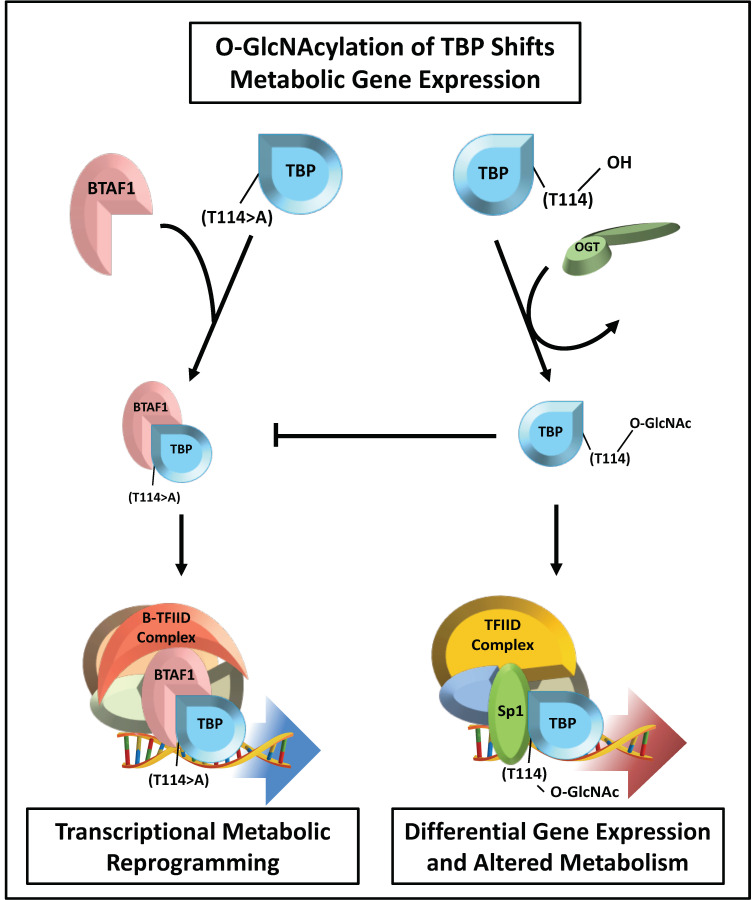
O-GlcNAcylation of TBP regulates metabolic gene expression. O-GlcNAcylation of TBP at the amino acid residue T114 impairs B-TFIID complex formation by disrupting BTAF1 binding. Disruption of TBP O-GlcNAcylation results in significant metabolic transcriptome reprogramming, leading to a profound alteration in lipid storage. Using O-GlcNAc as a nutrient sensor, cells can fine-tune the metabolic transcriptome. Dysregulation of O-GlcNAc signaling has catastrophic effects on metabolic gene expression.
Figure 4
Figure 4
O-GlcNAcylation regulates the formation and function of the NuRD complex. Aγ-globin expression is silenced by the recruitment of NuRD complex to the –566 GATA binding site. OGA removes O-GlcNAc (green circle “G”) from CHD4 (a subunit of the NuRD complex), thereby preventing the assembly of the NuRD complex at the –566 site (left panel). When OGA is inhibited by TMG, OGT associates and O-GlcNAcylates CHD4, stimulating the formation of the NuRD complex at the –566 site, which represses Aγ-globin gene transcription (right panel). Additional O-GlcNAc sites have been found on every subunit of the NuRD complex, however, their function remains unknown.
Figure 5
Figure 5
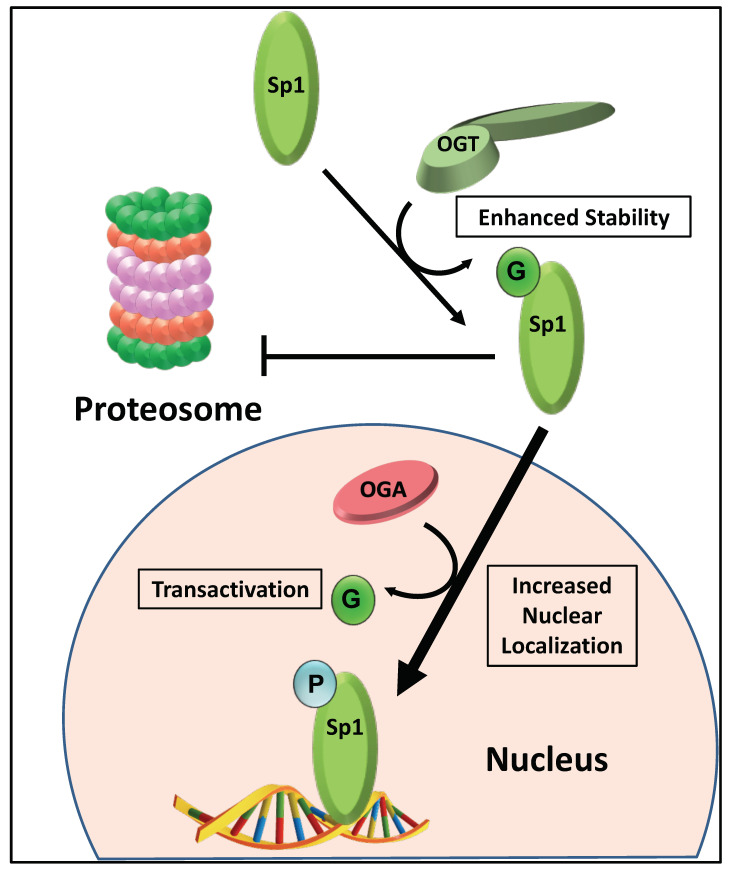
O-GlcNAcylation regulates the stability, nuclear localization, and transactivation of Sp1. Sp1 is a transcription factor that serves as a prototype of how transcription factors are regulated by O-GlcNAcylation at multiple levels. The O-GlcNAcylation of Sp1 (green circle “G”) prevents proteasomal degradation and promotes nuclear localization (large arrow). Once in the nucleus, OGA must remove O-GlcNAc from Sp1 so that it can be phosphorylated to facilitate binding to DNA.
Figure 6
Figure 6
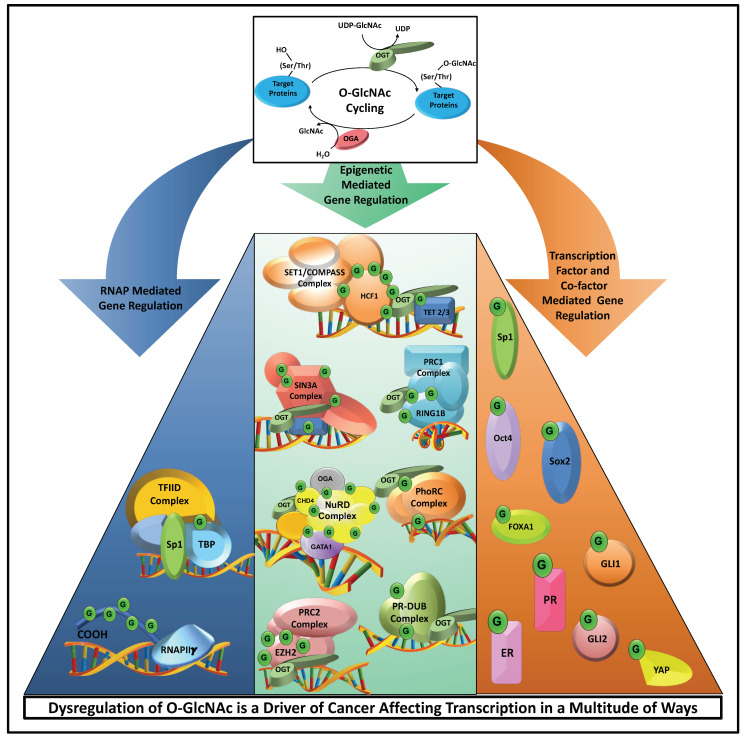
Dysregulation of O-GlcNAc is a driver of cancer by affecting transcription. O-GlcNAcylation is a nutrient-sensitive PTM that modulates gene transcription (green circle “G”). O-GlcNAcylation of the RNAP II CTD affects transcription initiation. It is also found on TBP and numerous RNAP core transcriptional proteins which connects nutrient flux to gene expression. O-GlcNAcylation also influences epigenetic gene regulation via regulation of the SET1/COMPASS, SIN3A, NuRD, PRC1, PRC2, PhoRC, and PR-DUB complexes. Additionally, many transcription factors such as Sp1, Oct4, Sox2, FOXA1, PR, ER, GLI 1, GLI2, and the co-activator YAP all require O-GlcNAcylation to properly regulate their target genes. In general, O-GlcNAcylation of RNAP II, RNAP accessory transcription factors, co-activators, co-repressors, and lineage-specific transcription factors affect their activity, localization, and/or stability. All cancers exhibit aberrant O-GlcNAcylatio; dysregulation of O-GlcNAcylation triggers or exacerbates cancer phenotypes by disrupting normal gene regulation.

References

    1. Hardiville S., Hart G.W. Nutrient Regulation of Signaling, Transcription, and Cell Physiology by O-GlcNAcylation. Cell Metab. 2014;20:208–213. doi: 10.1016/j.cmet.2014.07.014. - DOI - PMC - PubMed
    1. Brimble S., Wollaston-Hayden E.E., Teo C.F., Morris A.C., Wells L. The Role of the O-GlcNAc Modification in Regulating Eukaryotic Gene Expression. Curr. Signal. Transduct. Ther. 2010;5:12–24. doi: 10.2174/157436210790226465. - DOI - PMC - PubMed
    1. Torres C.R., Hart G.W. Topography and Polypeptide Distribution of Terminal N-acetylglucosamine Residues on the Surfaces of Intact Lymphocytes. Evidence for O-linked GlcNAc. J. Biol. Chem. 1984;259:3308–3317. doi: 10.1016/S0021-9258(17)43295-9. - DOI - PubMed
    1. Hart G.W., Housley M.P., Slawson C. Cycling of O-linked beta-N-acetylglucosamine on Nucleocytoplasmic Proteins. Nature. 2007;446:1017–1022. doi: 10.1038/nature05815. - DOI - PubMed
    1. Hart G.W., Slawson C., Ramirez-Correa G., Lagerlof O. Cross Talk between O-GlcNAcylation and Phosphorylation: Roles in Signaling, Transcription, and Chronic Disease. Annu. Rev. Biochem. 2011;80:825–858. doi: 10.1146/annurev-biochem-060608-102511. - DOI - PMC - PubMed

LinkOut - more resources