. 2021 Apr 7;9(4):397.
doi: 10.3390/biomedicines9040397.

Mesothelin Expression in Human Tumors: A Tissue Microarray Study on 12,679 Tumors

Affiliations

Mesothelin Expression in Human Tumors: A Tissue Microarray Study on 12,679 Tumors

Sören Weidemann et al. Biomedicines. .

Abstract

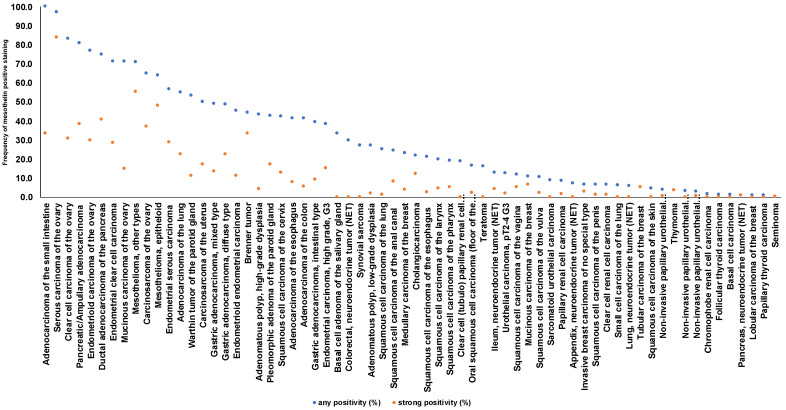
Mesothelin (MSLN) represents an attractive molecule for targeted cancer therapies. To identify tumors that might benefit from such therapies, tissue microarrays including 15,050 tumors from 122 different tumor types and 76 healthy organs were analyzed for MSLN expression by immunohistochemistry. Sixty-six (54%) tumor types showed at least occasional weak staining, including 50 (41%) tumor types with at least one strongly positive sample. Highest prevalence of MSLN positivity had ovarian carcinomas (serous 97%, clear cell 83%, endometrioid 77%, mucinous 71%, carcinosarcoma 65%), pancreatic adenocarcinoma (ductal 75%, ampullary 81%), endometrial carcinomas (clear cell 71%, serous 57%, carcinosarcoma 50%, endometrioid 45%), malignant mesothelioma (69%), and adenocarcinoma of the lung (55%). MSLN was rare in cancers of the breast (7% of 1138), kidney (7% of 807), thyroid gland (1% of 638), soft tissues (0.3% of 931), and prostate (0 of 481). High expression was linked to advanced pathological tumor (pT) stage (p < 0.0001) and metastasis (p < 0.0001) in 1619 colorectal adenocarcinomas, but unrelated to parameters of malignancy in 1072 breast-, 386 ovarian-, 174 lung-, 757 kidney-, 171 endometrial-, 373 gastric-, and 925 bladder carcinomas. In summary, numerous important cancer types with high-level MSLN expression might benefit from future anti-MSLN therapies, but MSLN's prognostic relevance appears to be limited.

Keywords: immunohistochemistry; mesothelin; multi-tumor tissue micro array.


Conflict of interest statement

The mesothelin (MSLN) antibody clone MSVA-235 was provided from MS Validated Antibodies GmbH (owned by a family member of GS).

Figures
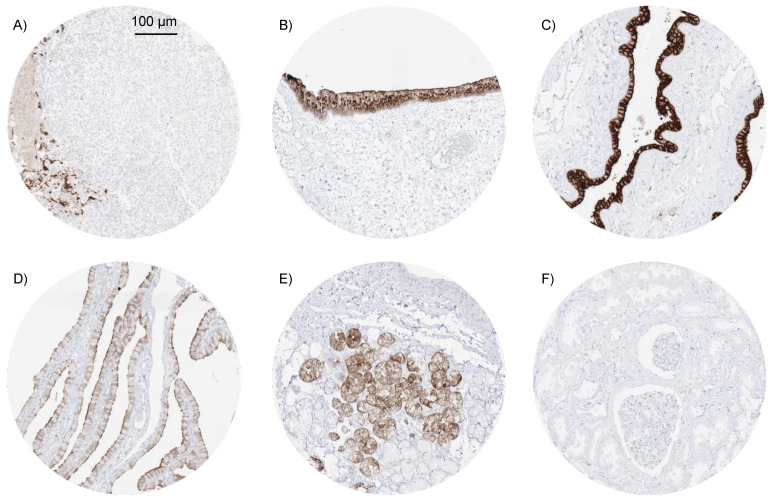
Figure 1
Figure 1
Mesothelin (MSLN) immunostaining in normal tissues. Among normal tissues, MSLN immunostaining is particularly strong in a fraction of squamous epithelial cells in tonsil crypts (A), the anal transitional epithelium (B) and amnion cells (C). A somewhat weaker MSLN staining is seen at the apical cell border and in cilia of fallopian tube epithelium (D) and in a fraction mucinous cells (often grouped together) in sublingual glands (E). MSLN immunostaining was consistently lacking in the kidney (F).
Figure 2
Figure 2
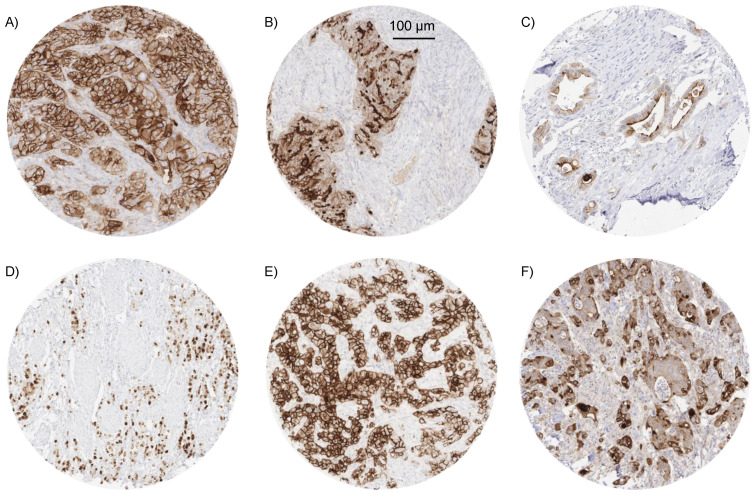
Pattern of MSLN immunostaining in cancer. MSLN immunostaining was found to be strong and predominantly membranous (A) or predominantly situated at the apical/luminal cell border (B) in two serous high-grade ovarian cancers, variable but predominantly apical in a cholangiocellular carcinoma (C), strong and predominantly cytoplasmic in a diffuse type adenocarcinoma of the stomach (D), strong and predominantly membranous in a malignant (epitheloid) mesothelioma (E), and weak to moderate, cytoplasmic and membranous in a colorectal adenocarcinoma (F).
Figure 3
Figure 3
Ranking order of MSLN immunostaining in cancers. Both the frequency of positive cases (blue dots) and the frequency of strongly positive cases (orange dots) are shown. Fifty-six additional tumor entities without any MSLN positive cases are not shown due to space restrictions.
Figure 4
Figure 4
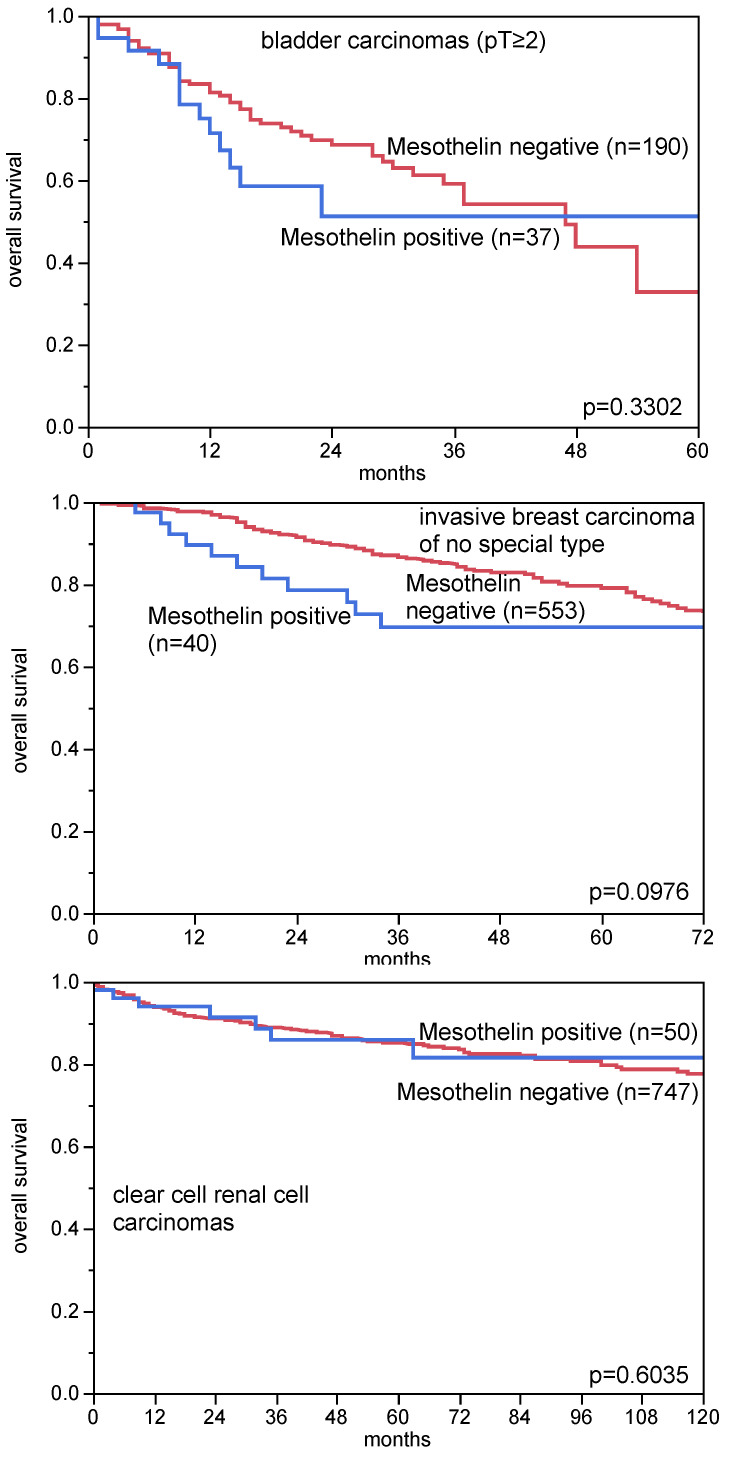
MSLN immunostaining and patient prognosis. All bladder cancer patients had at least pT2 cancers and were treated by cystectomy.
Figure 5
Figure 5
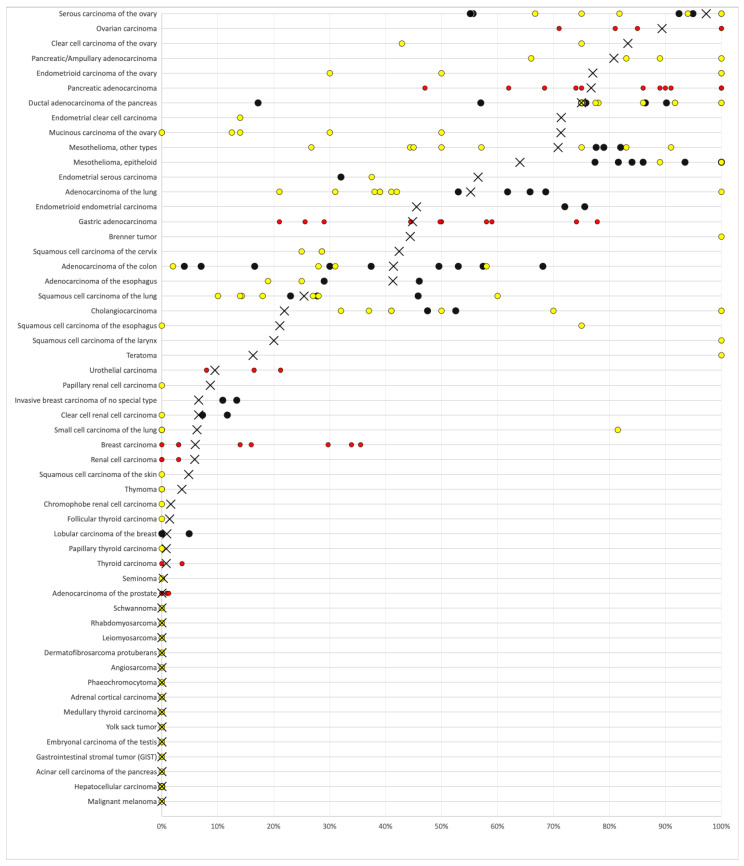
Graphical comparison of MSLN data from this study (×) in comparison with the previous literature. Yellow dots are used for studies involving 1–50 cases, and black dots are used for studies involving more than 50 cases. Red dots are used for studies without subtype analyses. All studies are quoted in the list of references.

References

    1. Chang K., Pastan I. Molecular cloning of mesothelin, a differentiation antigen present on mesothelium, mesotheliomas, and ovarian cancers. Proc. Natl. Acad. Sci. USA. 1996;93:136–140. doi: 10.1073/pnas.93.1.136. - DOI - PMC - PubMed
    1. Yamaguchi N., Hattori K., Oh-Eda M., Kojima T., Imai N., Ochi N. A novel cytokine exhibiting megakaryocyte potentiating activity from a human pancreatic tumor cell line HPC-Y. J. Biol. Chem. 1994;269:805–808. doi: 10.1016/S0021-9258(17)42180-6. - DOI - PubMed
    1. Urwin D., Lake R.A. Structure of the Mesothelin/MPF Gene and Characterization of Its Promoter. Mol. Cell Biol. Res. Commun. 2000;3:26–32. doi: 10.1006/mcbr.2000.0181. - DOI - PubMed
    1. Chang K., Pastan I., Willingham M.C. Isolation and characterization of a monoclonal antibody, K1, reactive with ovarian cancers and normal mesothelium. Int. J. Cancer. 1992;50:373–381. doi: 10.1002/ijc.2910500308. - DOI - PubMed
    1. Inaguma S., Wang Z., Lasota J., Onda M., Czapiewski P., Langfort R., Rys J., Szpor J., Waloszczyk P., Okoń K., et al. Comprehensive immunohistochemical study of mesothelin (MSLN) using different monoclonal antibodies 5B2 and MN-1 in 1562 tumors with evaluation of its prognostic value in malignant pleural mesothelioma. Oncotarget. 2017;8:26744–26754. doi: 10.18632/oncotarget.15814. - DOI - PMC - PubMed