Review
. 2021 Apr 7;7(4):279.
doi: 10.3390/jof7040279.

Infections due to Rare Cryptococcus Species. A Literature Review

Affiliations
Review

Infections due to Rare Cryptococcus Species. A Literature Review

Soraya E Morales-López et al. J Fungi (Basel). .

Abstract

Infections due to rare Cryptococcus species (other than C. neoformans species complex, C. gattii species complex, C. albidus or C. laurentii) are barely reported. The aim of this work is to present a comprehensive literature review of all the papers describing infections due to these species referenced in the main databases (PubMed/MEDLINE, ScienceDirect, Scopus, and Google Scholar). Clinical and epidemiological data together with laboratory findings (identification and antifungal susceptibility) of each isolate were analyzed. Fifty-eight cryptococosis due to rare species were described in 46 papers between 1934-2018. These reports included 16 rare Cryptococcus spp. that were generally associated with nervous system infections and fungemias. Some species are non-capsulated and are not able to grow at 37 °C. Few species were identified by commercially available methods, making internal transcriber spacer (ITS) and D1/D2 regions sequencing mandatory. The most potent antifungal was amphotericin B (although some species showed high MIC values). The studied strains showed high MICs values to 5-fluorocytosine (all >64 µg/mL), echinocandins (all >8 µg/mL), and fluconazole (>80% of the MICs >4 µg/mL). Due to the scarcity of the data and the absence of guidelines for the treatment of these infections, this review could be informative and could help in the diagnosis and treatment of these infections.

Keywords: Cryptococcus sp.; cryptococcosis; rare yeast.


Conflict of interest statement

The authors declare no conflict of interest.

Figures
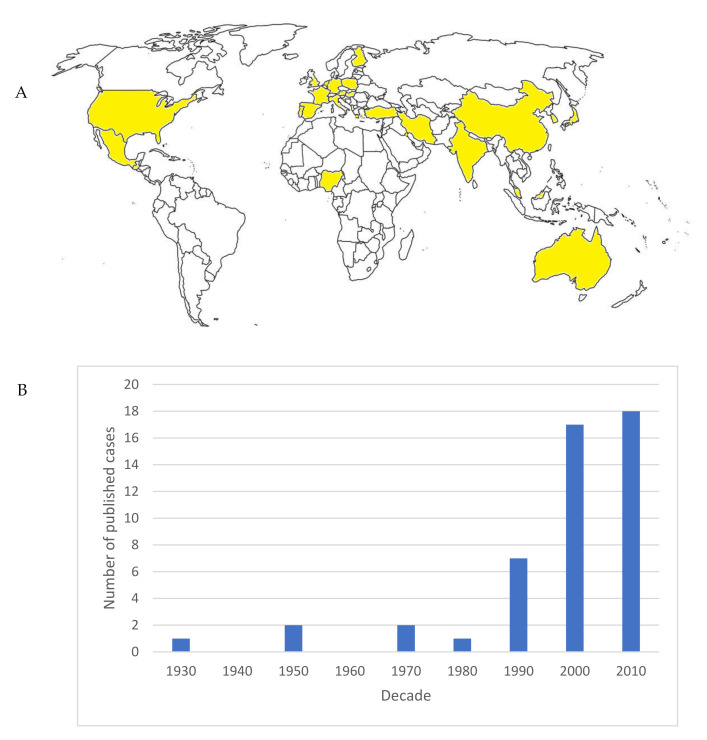
Figure 1
Figure 1
(A) Map showing the countries were rare Cryptococcus spp. isolates were reported (highlighted in yellow). (B) Published cases per decade.
Figure 2
Figure 2
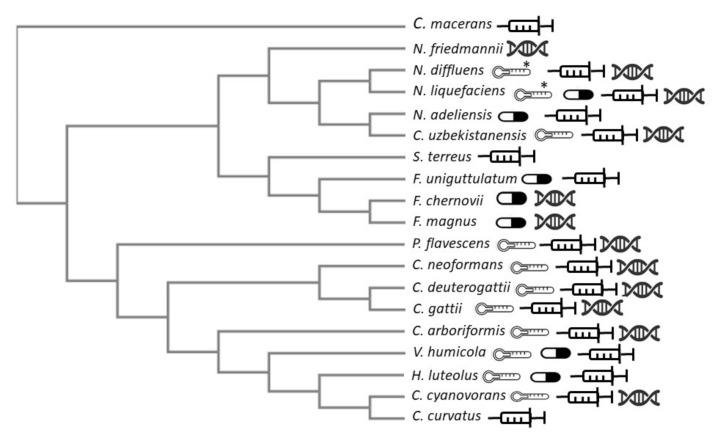
Neighbor-joining tree without distance corrections obtained using the clustal omega tool (https://www.ebi.ac.uk/). The following Genebank LSU D1/D2 sequences were used: FJ534907 (Cryptococcus deuterogattii CBS 10514T), AF075526 (Cryptococcus gattii CBS 6289T), FJ534909.1 (Cryptococcus neoformans CBS 8710), AB260936 (Cutaneotrichosporon arboriformis CBS 10441T), AF189834 (Cutaneotrichosporon curvatus CBS 570T), JF680899 (Cutaneotrichosporon cyanovorans CBS 11948T), NG_059011.1 (Cystofilobasidium macerans CBS 10757T), AF181530 (Filobasidium chernovii CBS 8679T), AF181851 (Filobasidium magnum CBS 140T), AF075468 (Filobasidium uniguttulatum CBS 1730T), AF075482 (Hannaella luteola/luteolus CBS 943T), AF137603.1 (Naganishia adeliensis CBS 8351T), AF075502 (Naganishia diffluens CBS 160T), AF075478 (Naganishia friedmannii CBS 7160T), AF181515 (Naganishia liquefaciens CBS 968T), AF181508 (Naganishia uzbekistanensis CBS 8683T), AB035042 (Papiliotrema flavescens CBS 942T), AF075479 (Solicoccozyma terreus CBS 1895T), AF189836 (Vanrija humicola CBS 571T). The thermometer graphic represents the species able to grow at 37 °C. * represent poor growth at 37 °C. Pill graphics show species with the highest fluconazole MIC (>16 ug/mL). Syringe graphs show species isolated from normally sterile sites. Double strand graphs show the species identified by molecular-based methods.

References

    1. Hadano Y., Yoshii H., Hayashi M., Oono H., Tanaka R. Case report: A rare case report of central line-associated bloodstream infection caused by Cryptococcus arboriformis. Intern. Med. 2015;54:1141–1143. doi: 10.2169/internalmedicine.54.3664. - DOI - PubMed
    1. Bernal-Martinez L., Gomez-Lopez A., Castelli M.V., Mesa-Arango A.C., Zaragoza O., Rodriguez-Tudela J.L., Cuenca-Estrella M. Susceptibility profile of clinical isolates of non- Cryptococcus neoformans/non- Cryptococcus gattii species and literature review. Med Mycol. 2010;48:90–96. doi: 10.3109/13693780902756073. - DOI - PubMed
    1. Ghajari A., Lotfali E., Norouzi M., Arab-Mazar Z. First report of Vulvovaginitis due to Cryptococcus magnus in Iran. Curr. Med. Mycol. 2018;4:30–33. doi: 10.18502/cmm.4.1.32. - DOI - PMC - PubMed
    1. McCurdy L.H., Morrow J.D. Ventriculitis due to Cryptococcus uniguttulatus. South Med. J. 2001;94:65–66. doi: 10.1097/00007611-200194010-00012. - DOI - PubMed
    1. McCurdy L.H., Morrow J.D. Infections due to non neoformans Cryptococcal species. Compr. Ther. 2003;29:95–101. doi: 10.1007/s12019-003-0012-9. - DOI - PubMed

LinkOut - more resources