Review
. 2021 Apr 8;9(4):359.
doi: 10.3390/vaccines9040359.

Lipid-Based Nanoparticles in the Clinic and Clinical Trials: From Cancer Nanomedicine to COVID-19 Vaccines

Affiliations
Review

Lipid-Based Nanoparticles in the Clinic and Clinical Trials: From Cancer Nanomedicine to COVID-19 Vaccines

Thai Thanh Hoang Thi et al. Vaccines (Basel). .

Abstract

COVID-19 vaccines have been developed with unprecedented speed which would not have been possible without decades of fundamental research on delivery nanotechnology. Lipid-based nanoparticles have played a pivotal role in the successes of COVID-19 vaccines and many other nanomedicines, such as Doxil® and Onpattro®, and have therefore been considered as the frontrunner in nanoscale drug delivery systems. In this review, we aim to highlight the progress in the development of these lipid nanoparticles for various applications, ranging from cancer nanomedicines to COVID-19 vaccines. The lipid-based nanoparticles discussed in this review are liposomes, niosomes, transfersomes, solid lipid nanoparticles, and nanostructured lipid carriers. We particularly focus on the innovations that have obtained regulatory approval or that are in clinical trials. We also discuss the physicochemical properties required for specific applications, highlight the differences in requirements for the delivery of different cargos, and introduce current challenges that need further development. This review serves as a useful guideline for designing new lipid nanoparticles for both preventative and therapeutic vaccines including immunotherapies.

Keywords: COVID-19; immunotherapy; lipid nanoparticles; liposomes; vaccines.


Conflict of interest statement

The authors declare no conflict of interest.

Figures
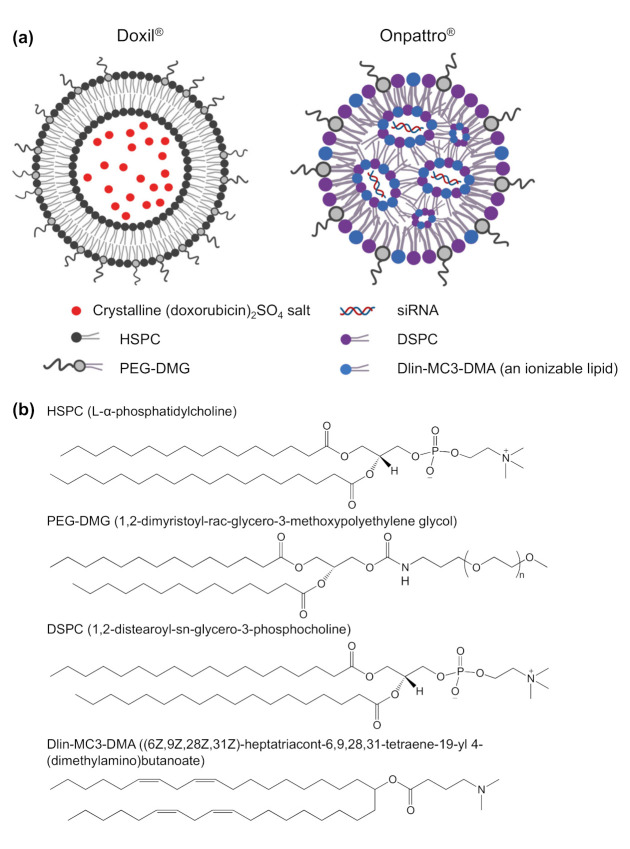
Figure 1
Figure 1
(a) Structure of FDA approved Doxil® and Onpattro® (patisiran) nanoparticles—the first FDA approved liposome and lipid nanoparticle, Created in BioRender.com; (b) chemical structure of the lipids inDoxil® and Onpattro®.
Figure 2
Figure 2
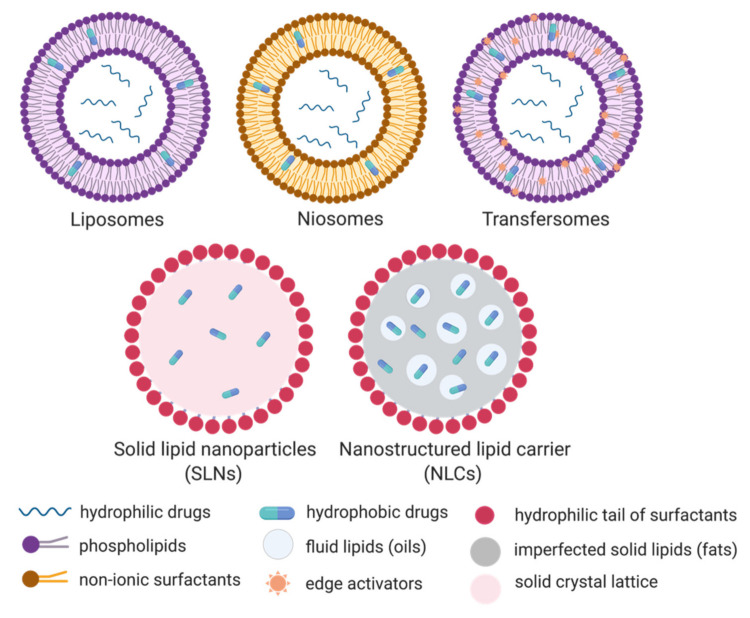
Schematic representation of the five categories of lipid-based nanoparticles: Liposomes, niosomes, transfersomes, solid lipid nanoparticles (SLNs) and the nanostructured lipid carriers (NLCs). Created in BioRender.com.
Figure 3
Figure 3
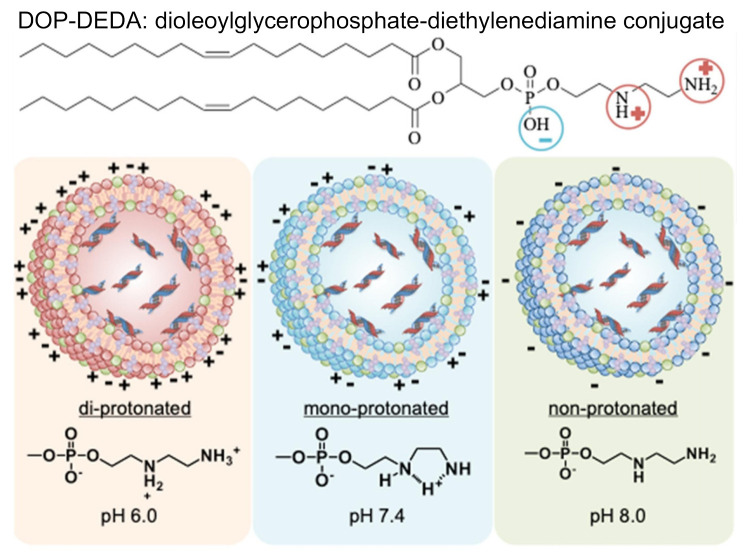
Impact of pH on the protonation and structure of charge-reversible lipid-based nanoparticles encapsulating siRNA. These lipid nanoparticles become positive charge at pH of 6.0, neutral at pH of 7.4 and a negative charge at pH of 8.0 gained due to an ionizable lipid of di-oleoylglycerophosphate-diethylenediamine conjugate (DOP-DEDA). Used with permission from [48].
Figure 4
Figure 4
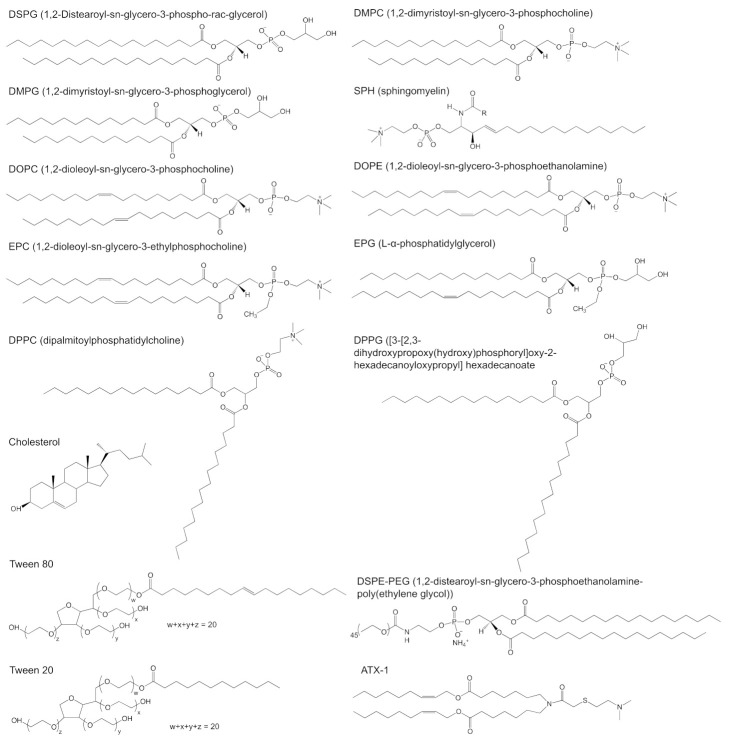
Chemical structure of targeting lipids? DSPG (1,2-distearoyl-sn-glycero-3-phospho-rac-glycerol), DMPC (1,2-dimyristoyl-sn-glycero-3-phosphocholine), DMPG (1,2-dimyristoyl-sn-glycero-3-phosphoglycerol), SPH (sphingomyelin), DOPC (1,2-dioleoyl-sn-glycero-3-phosphocholine), DOPE (1,2-dioleoyl-sn-glycero-3-phosphoethanolamine), EPC (1,2-dioleoyl-sn-glycero-3-ethylphosphocholine), EPG (L-α-phosphatidylglycerol), DPPC (dipalmitoylphosphatidylcholine), DPPG ([3-[2,3-dihydroxypropoxy(hydroxy)phosphoryl]oxy-2-hexadecanoyloxypropyl]hexadecanoate, cholesterol, Tween 80 (2-[2-[3,5-bis(2-hydroxyethoxy)oxolan-2-yl]-2-(2-hydroxyethoxy)ethoxy]ethyl (E)-octadec-9-enoate), Tween 20 (2-[2-[3,4-bis(2-hydroxyethoxy)oxolan-2-yl]-2-(2-hydroxyethoxy)ethoxy]ethyl dodecanoate), ATX-1 (one of the LUNAR lipids of Arturus Therapeutics, Inc., San Diego, CA, USA) and DSPE-PEG (1,2-distearoyl-sn-glycero-3-phosphoethanolamine-poly(ethylene glycol)).
Figure 5
Figure 5
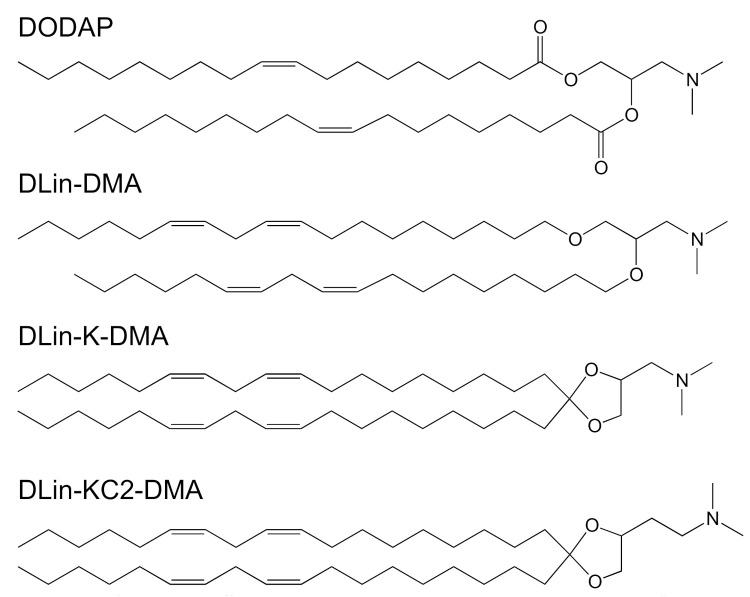
Chemical structures of the most common ionizable cationic lipids: 1,2-dioleoyl-3-dimethylaminopropane (DODAP), 1,2-dilinoleoyl-3-dimethylaminopropane, 1,2- dilinoleyloxy-3-dimethylaminopropane (DLin-DMA), 2,2-dilinoleyl- 4-dimethylaminomethyl-[1,3]-dioxolane (DLin-K-DMA) and 2,2-dilinoleyl-4-(2- dimethylaminoethyl)-[1,3]-dioxolane (DLin-KC2-DMA).
Figure 6
Figure 6
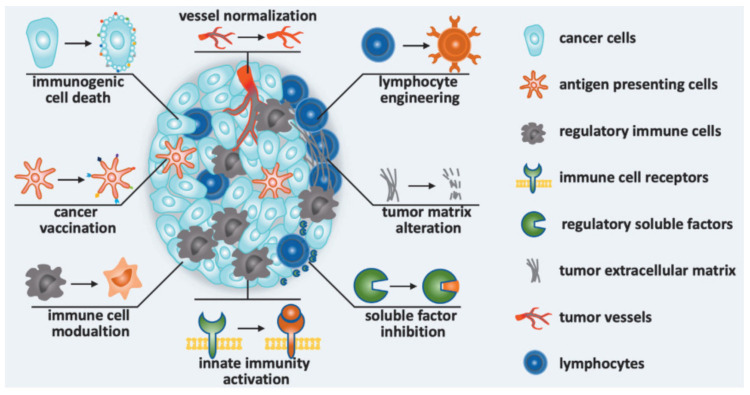
Immunomodulation strategies to improve cancer immunotherapy in nanomedicines: Nanomedicine was designed to induce immunogenic cell death, to promote antitumor immunity (cancer vaccination), to modulate immune cells, to activate innate immunity, to inhibit soluble immunosuppressive factors, to alternate tumor matrix, to engineer lymphocyte and normalize vessel [129].

References

    1. Ventola C.L. Progress in nanomedicine: Approved and investigational nanodrugs. PT Peer-Rev. J. Formul. Manag. 2017;42:742–755. - PMC - PubMed
    1. Bobo D., Robinson K.J., Islam J., Thurecht K.J., Corrie S.R. Nanoparticle-based medicines: A review of FDA-approved materials and clinical trials to date. Pharm. Res. 2016;33:2373.:2387. doi: 10.1007/s11095-016-1958-5. - DOI - PubMed
    1. Anselmo A.C., Mitragotri S. Nanoparticles in the clinic: An update. Bioeng. Transl. Med. 2019;4:e10143. doi: 10.1002/btm2.10143. - DOI - PMC - PubMed
    1. Germain M., Caputo F., Metcalfe S., Tosi G., Spring K., Åslund A.K.O., Pottier A., Schiffelers R., Ceccaldi A., Schmid R. Delivering the power of nanomedicine to patients today. J. Control. Release. 2020;326:164–171. doi: 10.1016/j.jconrel.2020.07.007. - DOI - PMC - PubMed
    1. Sabnis S., Kumarasinghe E.S., Salerno T., Mihai C., Ketova T., Senn J.J., Lynn A., Bulychev A., McFadyen I., Chan J., et al. A novel amino lipid series for mRNA delivery: Improved endosomal escape and sustained pharmacology and safety in non-human primates. Mol. Ther. 2018;26:1509–1519. doi: 10.1016/j.ymthe.2018.03.010. - DOI - PMC - PubMed