


Loss of p16: A Bouncer of the Immunological Surveillance?
- PMID: 33918220
- PMCID: PMC8065641
- DOI: 10.3390/life11040309
Loss of p16: A Bouncer of the Immunological Surveillance?
Abstract
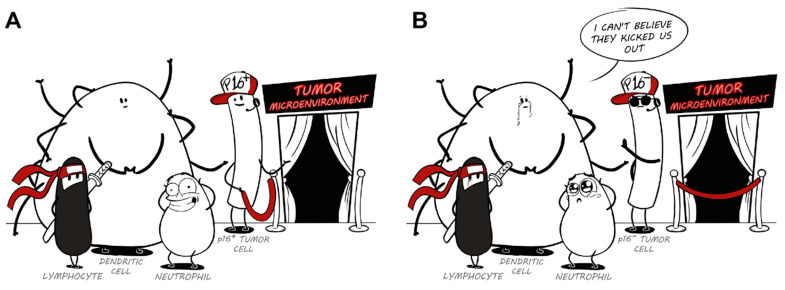
p16INK4A (hereafter called p16) is an important tumor suppressor protein frequently suppressed in human cancer and highly upregulated in many types of senescence. Although its role as a cell cycle regulator is very well delineated, little is known about its other non-cell cycle-related roles. Importantly, recent correlative studies suggest that p16 may be a regulator of tissue immunological surveillance through the transcriptional regulation of different chemokines, interleukins and other factors secreted as part of the senescence-associated secretory phenotype (SASP). Here, we summarize the current evidence supporting the hypothesis that p16 is a regulator of tumor immunity.
Keywords: cell-cycle; chemotherapy resistance; melanoma; pancreatic adenocarcinoma; senescence; senescence-associated secretory phenotype (SASP); tumor infiltration.
Conflict of interest statement
The authors declare no conflict of interest.
Figures
References
-
- Coppe J.P., Patil C.K., Rodier F., Sun Y., Munoz D.P., Goldstein J., Nelson P.S., Desprez P.Y., Campisi J. Senescence-associated secretory phenotypes reveal cell-nonautonomous functions of oncogenic RAS and the p53 tumor suppressor. PLoS Biol. 2008;6:2853–2868. doi: 10.1371/journal.pbio.0060301. - DOI - PMC - PubMed
Publication types
Grants and funding
LinkOut - more resources
Full Text Sources
Other Literature Sources
