. 2021 Apr 9;13(4):651.
doi: 10.3390/v13040651.

Screening of FDA-Approved Drugs Using a MERS-CoV Clinical Isolate from South Korea Identifies Potential Therapeutic Options for COVID-19

Affiliations

Screening of FDA-Approved Drugs Using a MERS-CoV Clinical Isolate from South Korea Identifies Potential Therapeutic Options for COVID-19

Meehyun Ko et al. Viruses. .

Abstract

Therapeutic options for coronaviruses remain limited. To address this unmet medical need, we screened 5406 compounds, including United States Food and Drug Administration (FDA)-approved drugs and bioactives, for activity against a South Korean Middle East respiratory syndrome coronavirus (MERS-CoV) clinical isolate. Among 221 identified hits, 54 had therapeutic indexes (TI) greater than 6, representing effective drugs. The time-of-addition studies with selected drugs demonstrated eight and four FDA-approved drugs which acted on the early and late stages of the viral life cycle, respectively. Confirmed hits included several cardiotonic agents (TI > 100), atovaquone, an anti-malarial (TI > 34), and ciclesonide, an inhalable corticosteroid (TI > 6). Furthermore, utilizing the severe acute respiratory syndrome coronavirus 2 (SARS-CoV-2), we tested combinations of remdesivir with selected drugs in Vero-E6 and Calu-3 cells, in lung organoids, and identified ciclesonide, nelfinavir, and camostat to be at least additive in vitro. Our results identify potential therapeutic options for MERS-CoV infections, and provide a basis to treat coronavirus disease 2019 (COVID-19) and other coronavirus-related illnesses.

Keywords: COVID-19; FDA-approved drugs; Middle East respiratory syndrome coronavirus; clinical isolate; drug combinations; drug repurposing; high-content screening; lung organoids; pandemic; severe acute respiratory syndrome coronavirus disease.


Conflict of interest statement

The authors declare no conflict of interest.

Figures
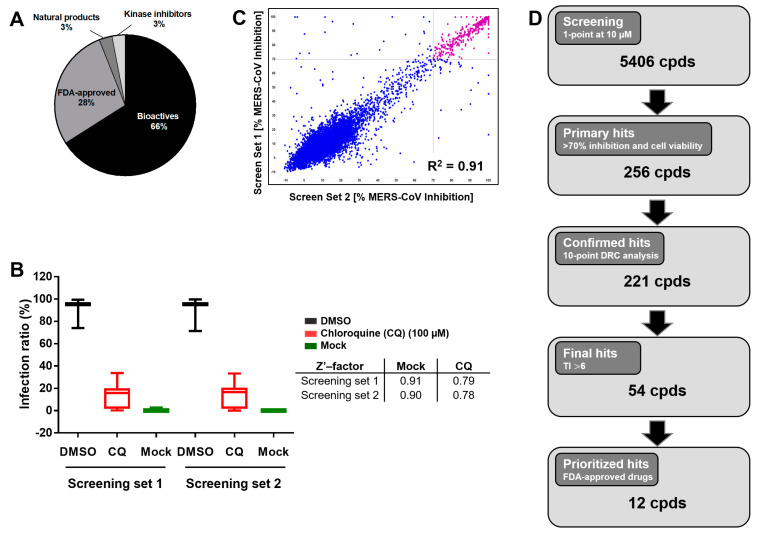
Figure 1
Figure 1
Overview of the library composition and triage of hits. (A) Our small-molecule compound library primarily comprised bioactives and FDA-approved drugs, with a small proportion of natural products and kinase inhibitors. (B) High-content screening (HCS) of 5406 compounds (cpds) in two batches in duplicate, and calculation of Z’-factors between high (MERS-CoV infection, black) and low (mock, green) values. Chloroquine (CQ). (C) Correlation between duplicate screens. The scatter plot shows Middle East respiratory syndrome coronavirus (MERS-CoV) inhibition ratios overlaid with cell viability ratios. Compounds with MERS-CoV inhibition >70% and cell viability >70% were regarded as primary hits. (D) Flowchart of HCS hit selection and confirmation of final hit selection.
Figure 2
Figure 2
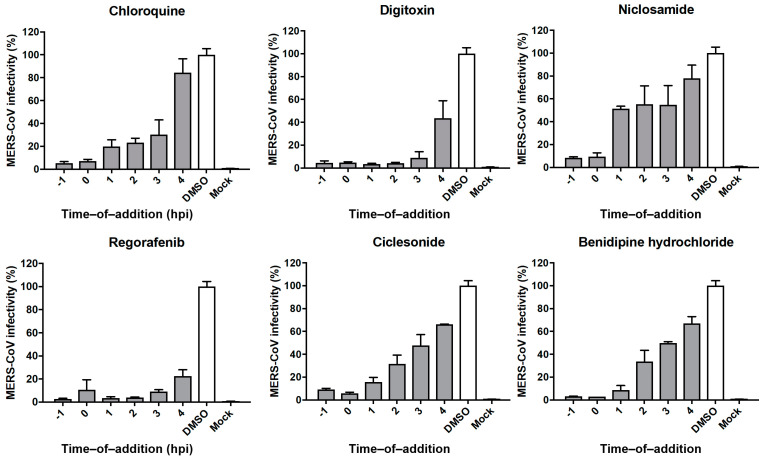
Time-of-addition study with selected FDA-approved drugs. Five FDA-approved drugs were analyzed by time-course experiments to determine the stage of the MERS-CoV life cycle inhibited. Vero cells were infected with MERS-CoV at a multiplicity of infection of 5, and FDA-approved drugs were administered at six time points pre- or post-infection as indicated. Drugs were used at concentrations above their 90% inhibitory concentration (IC90) values. Chloroquine served as a known early stage inhibitor.
Figure 3
Figure 3
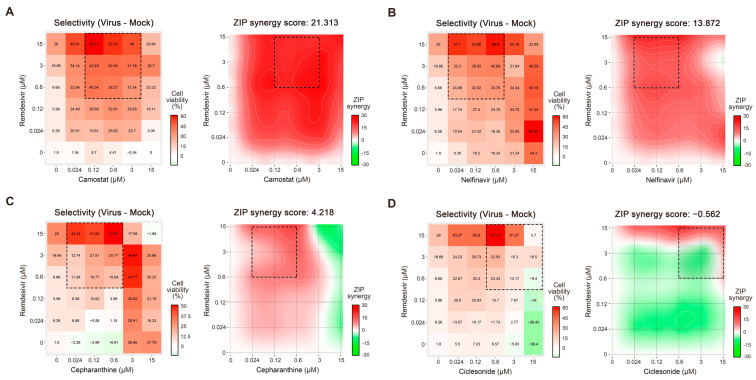
Evaluation of drug combinations in severe acute respiratory syndrome coronavirus 2 (SARS-CoV-2)-infected Vero-E6 cells. As a read-out, virus-mediated cell death in the presence and absence of drugs was assessed. (A) Remdesivir–camostat; (B) remdesivir–nelfinavir; (C) remdesivir–cepharanthine; and (D) remdesivir–ciclesonide interactions were monitored. Dose–response matrices and synergy distribution maps are shown on the right and left panels with corresponding cell viability and zero interaction potency (ZIP) synergy, respectively. X and Y axes indicate drug concentrations (μM). ZIP synergy scores were calculated as described in the Material and Methods section.
Figure 4
Figure 4
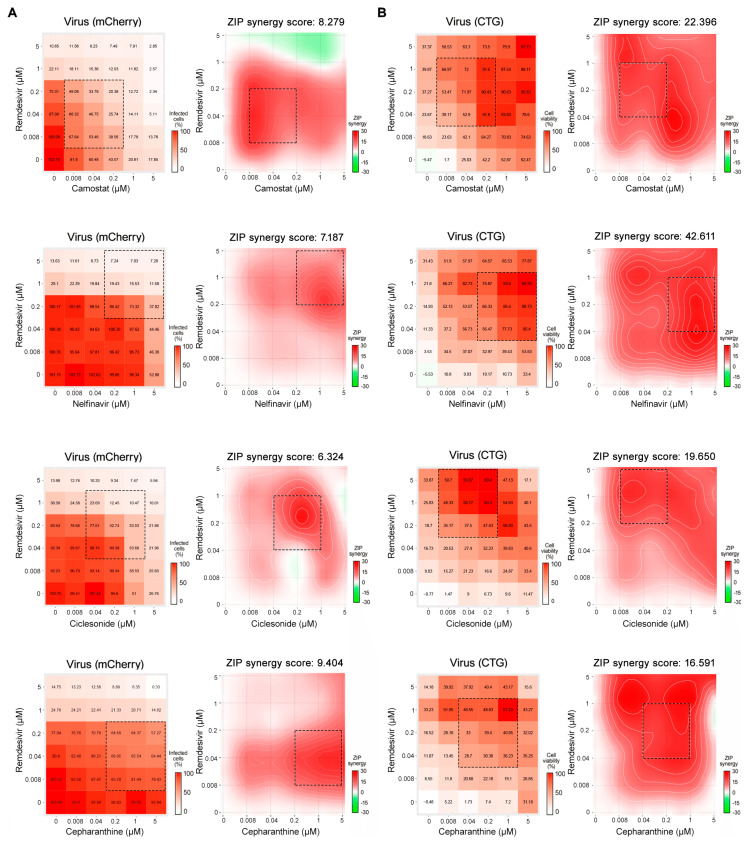
Evaluation of drug combinations in SARS-CoV-2-mCherry-infected Calu-3 cells. (A) The 6 × 6 dose–response matrices and interaction landscapes of remdesivir–camostat; remdesivir–nelfinavir; remdesivir–cepharanthine; and remdesivir–ciclesonide obtained using fluorescence analysis of SARS-CoV-2-mCherry-infected Calu-3 cells. ZIP synergy scores were calculated for indicated drug combinations. (B) The 6 × 6 dose–response matrices and interaction landscapes of remdesivir–camostat; remdesivir–nelfinavir; remdesivir–cepharanthine; and remdesivir–ciclesonide obtained using a cell viability assay (CTG) on mock-, and SARS-CoV-2-mCherry-infected Calu-3 cells. The selectivity for the indicated drug concentrations was calculated (selectivity = efficacy-(100-Toxicity)). ZIP synergy scores were calculated for indicated drug combinations.
Figure 5
Figure 5
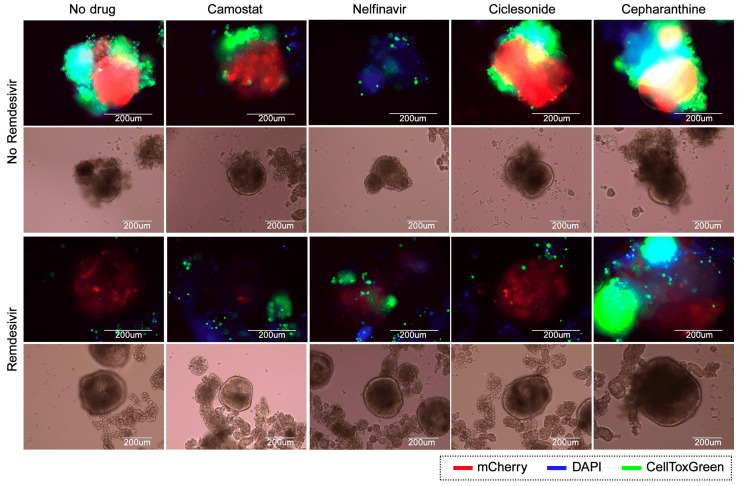
Evaluation of antiviral effects of drug combinations in human lung organoids (LOs). Fluorescent and bright-field analysis of drug or carrier-treated SARS-CoV-2-mCherry-infected LOs at 72 hpi (multiplicity of infection (MOI) 0.1). Virus infection, cell nuclei, and cytotoxicity are shown in red, blue, and green, respectively. Scale bars, 200 μm.
Figure 6
Figure 6
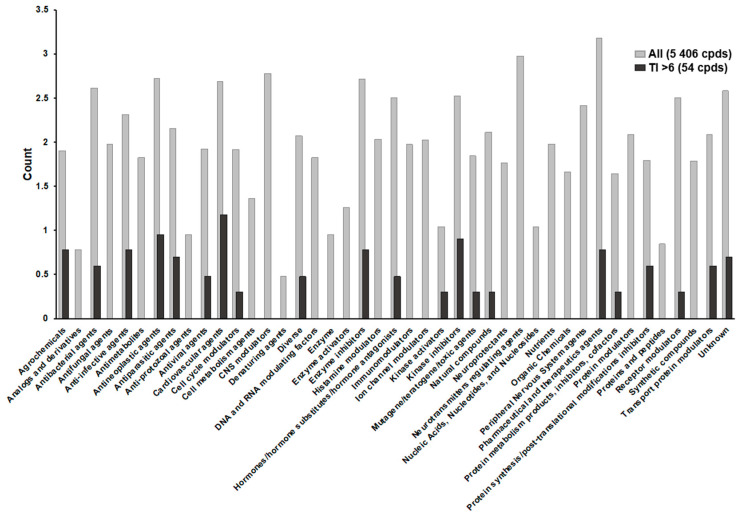
Pharmacological action profiling of all library compounds and confirmed hits. The 54 final hits were sorted into 43 pharmacological action categories. Gray and black bars indicate the distribution of all screened compounds and confirmed hits with a therapeutic index (TI) >6. The vertical axis displays counts of each compound on a log scale.

References

    1. Perlman S., Netland J. Coronaviruses post-SARS: Update on replication and pathogenesis. Nat. Rev. Microbiol. 2009;7:439–450. doi: 10.1038/nrmicro2147. - DOI - PMC - PubMed
    1. Hamre D., Procknow J.J. A new virus isolated from the human respiratory tract. Proc. Soc. Exp. Biol. Med. 1966;121:190–193. doi: 10.3181/00379727-121-30734. - DOI - PubMed
    1. McIntosh K., Dees J.H., Becker W.B., Kapikian A.Z., Chanock R.M. Recovery in tracheal organ cultures of novel viruses from patients with respiratory disease. Proc. Natl. Acad. Sci. USA. 1967;57:933–940. doi: 10.1073/pnas.57.4.933. - DOI - PMC - PubMed
    1. World Health Organization Summary of Probably SARS Cases with Onset of Illness from 1 November 2002 to 31 July 2003. [(accessed on 16 November 2020)]; Available online: https://www.who.int/publications/m/item/summary-of-probable-sars-cases-w....
    1. Zaki A.M., van Boheemen S., Bestebroer T.M., Osterhaus A.D., Fouchier R.A. Isolation of a novel coronavirus from a man with pneumonia in Saudi Arabia. N. Engl. J. Med. 2012;367:1814–1820. doi: 10.1056/NEJMoa1211721. - DOI - PubMed

Publication types

MeSH terms