


Essential Oils: A Natural Weapon against Antibiotic-Resistant Bacteria Responsible for Nosocomial Infections
- PMID: 33920237
- PMCID: PMC8070240
- DOI: 10.3390/antibiotics10040417
Essential Oils: A Natural Weapon against Antibiotic-Resistant Bacteria Responsible for Nosocomial Infections
Abstract
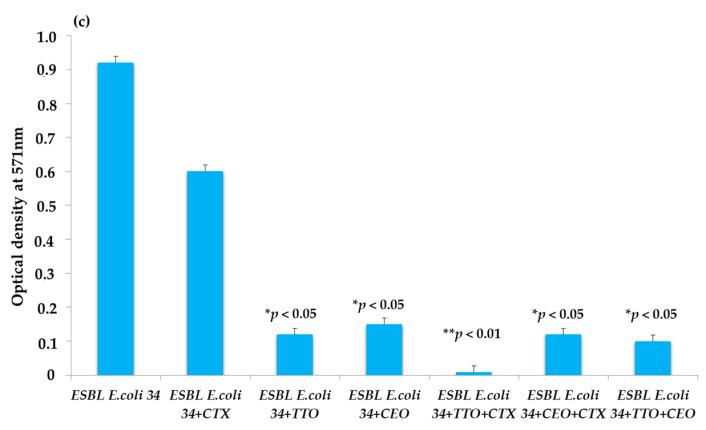
The emergence of antibiotic-resistant bacteria has become a major concern worldwide. This trend indicates the need for alternative agents to antibiotics, such as natural compounds of plant origin. Using agar disc diffusion and minimum inhibitory concentration (MIC) assays, we investigated the antimicrobial activity of Citrus aurantium (AEO), Citrus x limon (LEO), Eucalyptus globulus (EEO), Melaleuca alternifolia (TTO), and Cupressus sempervirens (CEO) essential oils (EOs) against three representatives of antibiotic-resistant pathogens and respective biofilms: vancomycin-resistant enterococci (VRE), methicillin-resistant Staphylococcus aureus (MRSA), and extended-spectrum β-lactamase (ESBL)-producing Escherichia coli. Using the checkerboard method, the efficacy of the EOs alone, in an association with each other, or in combination with the reference antibiotics was quantified by calculating fractional inhibitory concentrations (FICs). All the EOs displayed antibacterial activity against all strains to different extents, and TTO was the most effective. The results of the EO-EO associations and EO-antibiotic combinations clearly showed a synergistic outcome in most tests. Lastly, the effectiveness of EOs both alone and in association or combination against biofilm formed by the antibiotic-resistant strains was comparable to, and sometimes better than, that of the reference antibiotics. In conclusion, the combination of EOs and antibiotics represents a promising therapeutic strategy against antibiotic-resistant bacteria, even protected inside biofilms, which can allow decreasing the concentrations of antibiotics used.
Keywords: ESBL; MRSA; VRE; anti-biofilm activity; antibiotic-resistant pathogens; antibiotics; essential oils; extended-spectrum β-lactamase Escherichia coli; methicillin-resistant Staphylococcus aureus; synergy association; vancomycin-resistant enterococci.
Conflict of interest statement
The authors declare no conflict of interest.
Figures
References
-
- WHO World Antimicrobial Awareness Week-WAAW from 18 to 24 November 2020. [(accessed on 9 April 2021)]; Available online: https://www.who.int/campaigns/world-antimicrobial-awareness-week/2020.
-
- Bereket W., Hemalatha K., Getenet B., Wondwossen T., Solomon A., Zeynudin A., Kannan S. Update on bacterial nosocomial infections. Eur. Rev. Med. Pharmacol. Sci. 2012;16:1039–1044. - PubMed
-
- Cassini A., Högberg L.D., Plachoura D., Quattrocchi A., Hoxha A., Simonsen G.S., Colomb-Cotinat M., Kretzschmar M.E., Devleesschauwer B., Cecchini M., et al. Attributable deaths and disability-adjusted life-years caused by infections with antibiotic-resistant bacteria in the EU and the European Economic Area in 2015: A population-level modelling analysis. Lancet Infect. Dis. 2019;19:56–66. doi: 10.1016/S1473-3099(18)30605-4. - DOI - PMC - PubMed
LinkOut - more resources
Full Text Sources
Other Literature Sources
