


Management of a High-Performing Mental Health Recovery Research Group
- PMID: 33920382
- PMCID: PMC8070016
- DOI: 10.3390/ijerph18084007
Management of a High-Performing Mental Health Recovery Research Group
Abstract
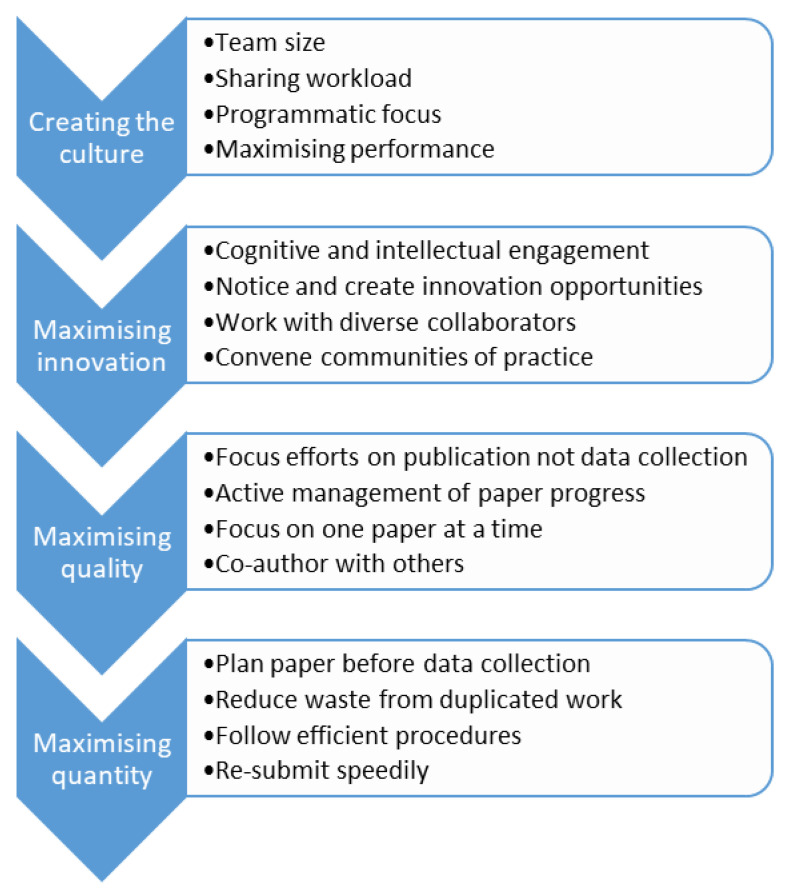
A personal perspective is given on the processes involved in managing and sustaining a high-performing mental health recovery research group. The broader context of scholarship in the United Kingdom is outlined, in which academic productivity is commodified specifically in relation to peer-reviewed journal papers. Four leadership choices in developing a high-performing research group are discussed: optimal group size; sharing the workload; maintaining a programmatic focus; and performance expectations. Approaches to maximising innovation are identified, including emotional and intellectual engagement of team members, working with diverse stakeholders and convening communities of practice. We use a highly managed approach to publications from inception to acceptance, which is described in detail. The use of these approaches is illustrated in relation to the Recovery Research Team which was formed in 2009. Specific recovery-related issues covered include demonstrating the ability to develop a significant recovery research portfolio (our four current large [>UK£2 m] studies relate to recovery narratives, global mental health peer support work, digital interventions and Recovery Colleges); the positive implications of actively recruiting researchers with mental health lived experience; how performance issues are managed; our approach to involving lived experience co-authors in papers; and our decision to conduct mixed-methods rather than solely qualitative studies.
Keywords: lived experience; mental health; productivity; recovery; research management.
Conflict of interest statement
The author declares no conflict of interest.
Similar articles
-
Recovery at 30: Integrating Lived Experience Expertise into Mental Health Research in Israel.Community Ment Health J. 2025 Feb;61(2):293-299. doi: 10.1007/s10597-024-01369-1. Epub 2025 Jan 6. Community Ment Health J. 2025. PMID: 39760963 Free PMC article.
-
Recovery colleges as enablers of personal recovery: qualitative evaluation of the development of a recovery college in the Netherlands.BMC Psychiatry. 2025 May 8;25(1):465. doi: 10.1186/s12888-025-06917-x. BMC Psychiatry. 2025. PMID: 40340916 Free PMC article.
-
The impact of Recovery Colleges on mental health staff, services and society.Epidemiol Psychiatr Sci. 2019 Oct;28(5):481-488. doi: 10.1017/S204579601800063X. Epub 2018 Oct 23. Epidemiol Psychiatr Sci. 2019. PMID: 30348246 Free PMC article. Review.
-
Using Peer Support in Developing Empowering Mental Health Services (UPSIDES): Background, Rationale and Methodology.Ann Glob Health. 2019 Apr 5;85(1):53. doi: 10.5334/aogh.2435. Ann Glob Health. 2019. PMID: 30951270 Free PMC article.
-
Development of the REFOCUS intervention to increase mental health team support for personal recovery.Br J Psychiatry. 2015 Dec;207(6):544-50. doi: 10.1192/bjp.bp.114.155978. Epub 2015 Oct 8. Br J Psychiatry. 2015. PMID: 26450586 Review.
Cited by
-
Embedding lived experience into mental health academic research organizations: Critical reflections.Health Expect. 2022 Oct;25(5):2299-2305. doi: 10.1111/hex.13586. Epub 2022 Aug 23. Health Expect. 2022. PMID: 35999670 Free PMC article.
References
-
- HM Government . Building a Britain Fit for the Future. Department of Business, Energy and Industrial Strategy; London, UK: 2017. Industrial Strategy.
-
- Department of Health . Best Research for Best Health. Department of Health; London, UK: 2007.
-
- Edwards R. Why do academics do unfunded research? Resistance, compliance and identity in the UK neo-liberal university. Stud. High. Educ. 2020:1–11. doi: 10.1080/03075079.2020.1817891. - DOI
-
- World Medical Association . World Medical Association Declaration of Helsinki—Ethical Principles for Medical Research Involving Human Subjects. 64th WMA General Assembly; Fortaleza, Brazil: 2013. - PubMed
-
- Slade M. Personal Recovery and Mental Illness. Cambridge University Press (CUP); Cambridge, UK: 2009.
Publication types
MeSH terms
Grants and funding
LinkOut - more resources
Full Text Sources
Other Literature Sources
Medical
