


Evaluation of Clinical Meaningfulness of Red Clover (Trifolium pratense L.) Extract to Relieve Hot Flushes and Menopausal Symptoms in Peri- and Post-Menopausal Women: A Systematic Review and Meta-Analysis of Randomized Controlled Trials
- PMID: 33920485
- PMCID: PMC8069620
- DOI: 10.3390/nu13041258
Evaluation of Clinical Meaningfulness of Red Clover (Trifolium pratense L.) Extract to Relieve Hot Flushes and Menopausal Symptoms in Peri- and Post-Menopausal Women: A Systematic Review and Meta-Analysis of Randomized Controlled Trials
Abstract
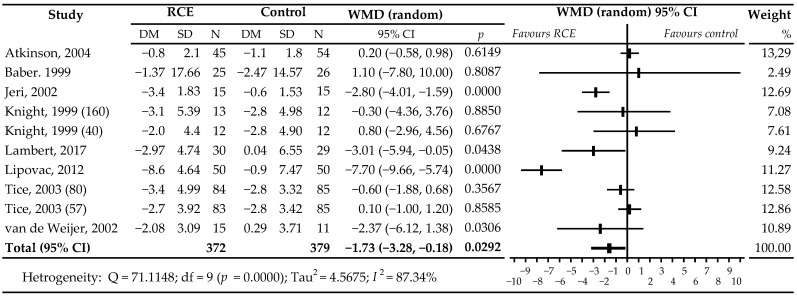
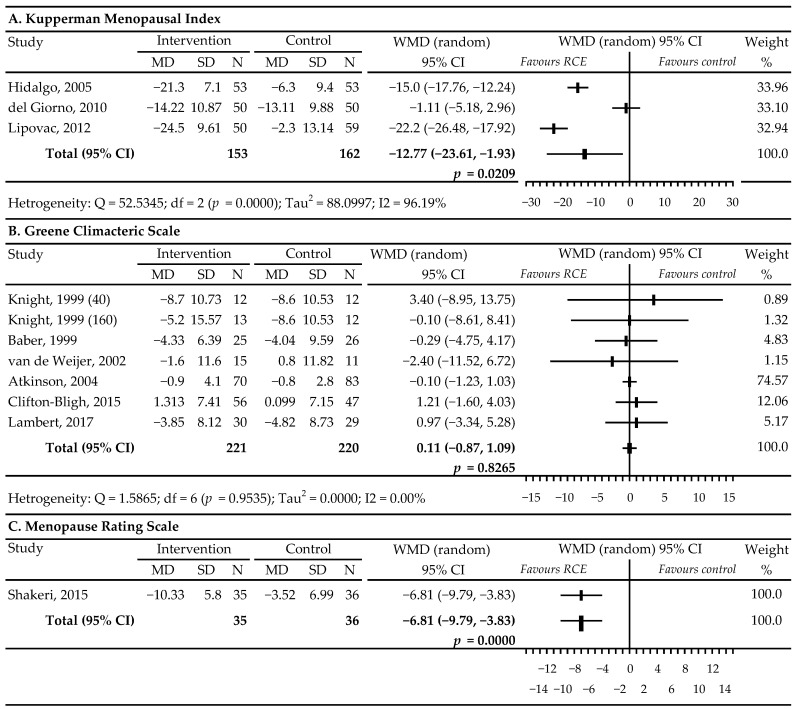
The meta-analysis presented in this article covered the efficacy of red clover isoflavones in relieving hot flushes and menopausal symptoms in perimenopausal and postmenopausal women. Studies were identified by MEDLINE (PubMed), Embase, and the Cochrane Library searches. The quality of the studies was evaluated according to Cochrane criteria. A meta-analysis of eight trials (ten comparisons) demonstrated a statistically significant reduction in the daily incidence of hot flushes in women receiving red clover compared to those receiving placebo: weighted mean difference (WMD-weighted mean difference) -1.73 hot flushes per day, 95% CI (confidence interval) -3.28 to -0.18; p = 0.0292. Due to 87.34% homogeneity, the performed analysis showed substantive difference in comparisons of postmenopausal women with ≥5 hot flushes per day, when the follow-up period was 12 weeks, with an isoflavone dose of ≥80 mg/day, and when the formulations contained a higher proportion of biochanin A. The meta-analysis of included studies assessing the effect of red clover isoflavone extract on menopausal symptoms showed a statistically moderate relationship with the reduction in the daily frequency of hot flushes. However, further well-designed studies are required to confirm the present findings and to finally determine the effects of red clover on the relief of flushing episodes.
Keywords: Trifolium pratense; hot flushes; isoflavones; menopausal symptoms; perimenopausal women; postmenopausal women; red clover.
Conflict of interest statement
The authors declare no conflict of interest.
Figures
References
-
- Avis N.E., Crawford S.L., Greendale G., Bromberger J.T., Everson-Rose S.A., Gold E.B., Hess R., Joffe H., Kravitz H.M., Tepper P.G., et al. Duration of menopausal vasomotor symptoms over the menopause transition. JAMA Intern. Med. 2015;175:531–539. doi: 10.1001/jamainternmed.2014.8063. - DOI - PMC - PubMed
-
- Gold E.B., Colvin A., Avis N., Bromberger J., Greendale G.A., Powell L., Sternfeld B., Matthews K. Longitudinal analysis of the association between vasomotor symptoms and race/ethnicity across the menopausal transition: Study of women’s health across the nation. Am. J. Public Health. 2006;96:1226–1235. doi: 10.2105/AJPH.2005.066936. - DOI - PMC - PubMed
Publication types
MeSH terms
Substances
LinkOut - more resources
Full Text Sources
Other Literature Sources
Medical
