


Factors Associated with the Implementation of Non-Pharmaceutical Interventions for Reducing Coronavirus Disease 2019 (COVID-19): A Systematic Review
- PMID: 33920613
- PMCID: PMC8072790
- DOI: 10.3390/ijerph18084274
Factors Associated with the Implementation of Non-Pharmaceutical Interventions for Reducing Coronavirus Disease 2019 (COVID-19): A Systematic Review
Abstract
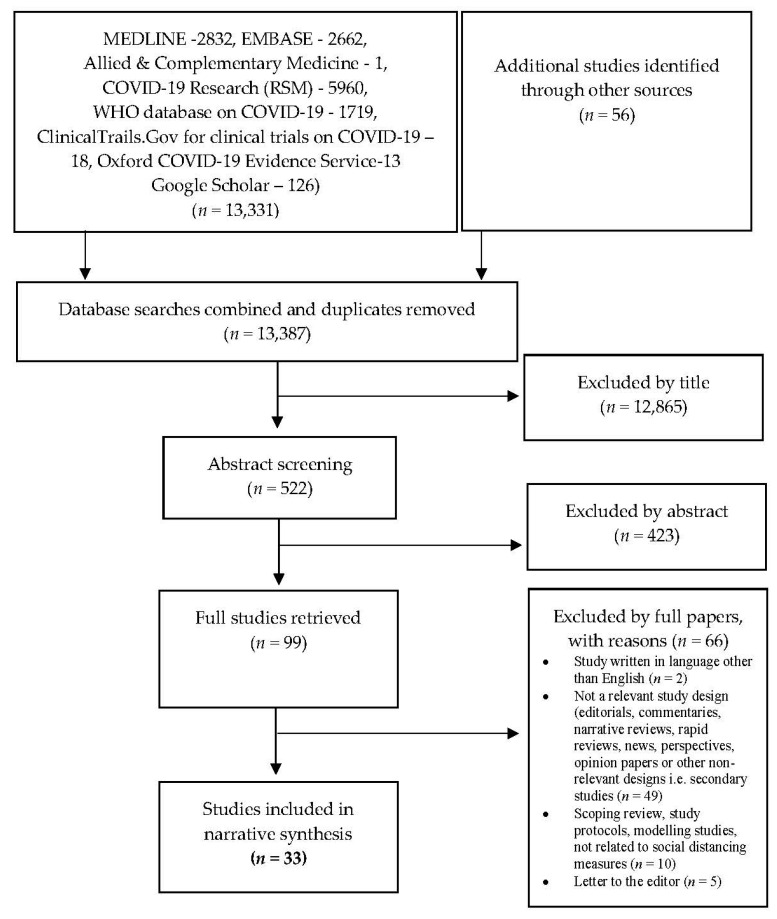
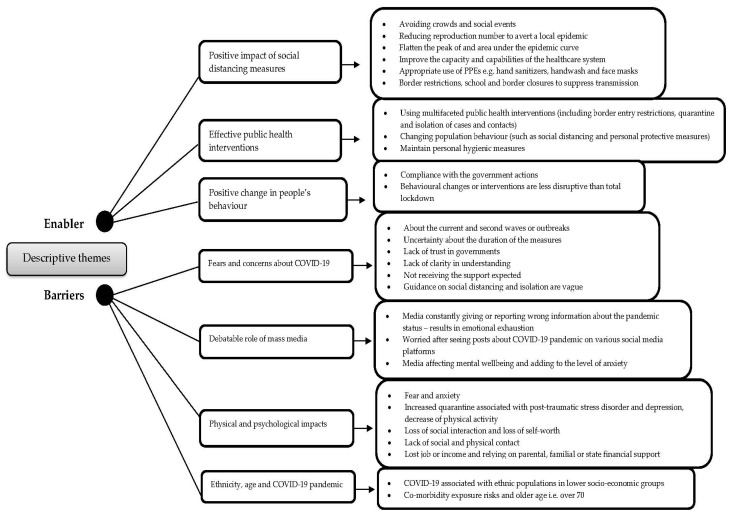
There has been much discussion recently about the importance of implementing non-pharmaceutical interventions (NPIs) to protect the public from coronavirus disease 2019 (COVID-19) infection. Different governments across the world have adopted NPIs (e.g., social distancing, quarantine, isolation, lockdowns, curfews, travel restrictions, closures of schools and colleges). Two fundamental strategies, namely a strict containment strategy-also called suppression strategy-and a mitigation strategy have been adopted in different countries, mainly to reduce the reproduction number (R0) to below one and hence to reduce case numbers to low levels or eliminate human-to-human transmission, as well as to use NPIs to interrupt transmission completely and to reduce the health impact of epidemics, respectively. However, the adoption of these NPI strategies is varied and the factors impacting NPI are inconsistent and unclear. This study, therefore, aimed to review the factors associated with the implementation of NPIs (social distancing, social isolation and quarantine) for reducing COVID-19. Following PRISMA guidelines, we searched for published and unpublished studies, undertaking a systematic search of: MEDLINE, EMBASE, Allied and Complementary Medicine, COVID-19 Research, WHO database on COVID-19, and Google Scholar. Thirty-three studies were included in the study. Seven descriptive themes emerged on enablers and barriers to NPIs: the positive impact of NPIs, effective public health interventions, positive change in people's behaviour and concerns about COVID-19, the role of mass media, physical and psychological impacts, and ethnicity/age associated with COVID-19. This study has highlighted that the effectiveness of NPIs in isolation is likely to be limited, therefore, a combination of multiple measures e.g., SD, isolation and quarantine, and workplace distancing appeared more effective in reducing COVID-19. Studies suggest that targeted approaches alongside social distancing might be the way forward, and more acceptable. Further research to promote country- and context-specific adoption of NPIs to deliver public health measures is needed. Studies comparing the effectiveness of interventions and strategies will help provide more evidence for future pandemics.
Keywords: COVID-19; COVID-19 pandemic; SARS-CoV-2; control; isolation; non-pharmaceutical interventions; prevention; quarantine; social distancing; systematic review.
Conflict of interest statement
The authors declare no conflict of interest.
Figures
References
-
- World Health Organization [(accessed on 10 April 2021)];WHO Coronavirus (COVID-19) Dashboard. Available online: https://covid19.who.int/table.
-
- Alanezi F., Aljahdali A., Alyousef S.M., Alrashed H., Mushcab H., AlThani B., Alghamedy F., Alotaibi H., Saadah A., Alanzi T. A Comparative Study on the Strategies Adopted by the United Kingdom, India, China, Italy, and Saudi Arabia to Contain the Spread of the COVID-19 Pandemic. J. Healthc. Leadersh. 2020;12:117–131. doi: 10.2147/JHL.S266491. - DOI - PMC - PubMed
-
- Ferguson N., Laydon D., Nedjati-Gilani G., Imai N., Ainslie K., Baguelin M., Bhatia S., Boonyasiri A., Cucunubá Z., Cuomo-Dannenburg G., et al. Report 9-Impact of Non-Pharmaceutical Interventions (NPIs) to Reduce COVID-19 Mortality and Healthcare Demand. [(accessed on 10 April 2021)]; Available online: https://www.imperial.ac.uk/mrc-global-infectious-disease-analysis/covid-...
Publication types
MeSH terms
LinkOut - more resources
Full Text Sources
Other Literature Sources
Medical
Miscellaneous
