Review
. 2021 Apr 15;22(8):4076.
doi: 10.3390/ijms22084076.

Multifaceted Roles of CD5L in Infectious and Sterile Inflammation

Affiliations
Review

Multifaceted Roles of CD5L in Infectious and Sterile Inflammation

Lidia Sanchez-Moral et al. Int J Mol Sci. .

Abstract

CD5L, a protein expressed and secreted mainly by macrophages, is emerging as a critical immune effector. In addition to its well-defined function as an anti-apoptotic protein, research over the last decade has uncovered additional roles that range from pattern recognition to autophagy, cell polarization, and the regulation of lipid metabolism. By modulating all these processes, CD5L plays a key role in highly prevalent diseases that develop by either acute or chronic inflammation, including several infectious, metabolic, and autoimmune conditions. In this review, we summarize the current knowledge of CD5L and focus on the relevance of this protein during infection- and sterile-driven inflammatory pathogenesis, highlighting its divergent roles in the modulation of inflammation.

Keywords: AIM; CD36; Spα; apoptosis; macrophage; scavenger receptor cysteine-rich.


Conflict of interest statement

The authors declare no conflict of interest. The funders had no role in the writing of the manuscript.

Figures
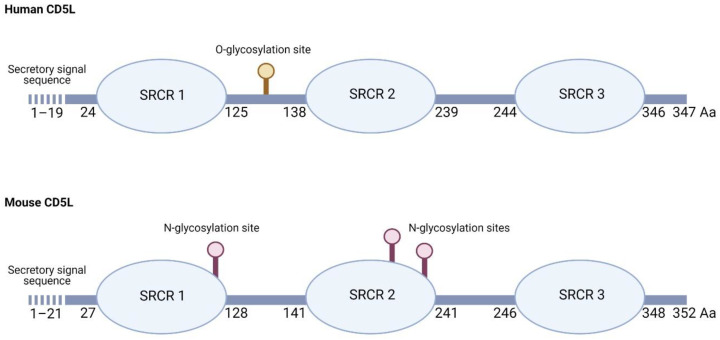
Figure 1
Figure 1
Schematic diagram of human and mouse CD5L. The scavenger receptor cysteine-rich (SRCR) domain structure, secretory signal peptide sequence, O- and N-glycosylation sites, and the amino acid (Aa) number are indicated in each sequence, according to [3,4,5] and the Uniprot Consortium (figure created with Biorender.com).
Figure 2
Figure 2
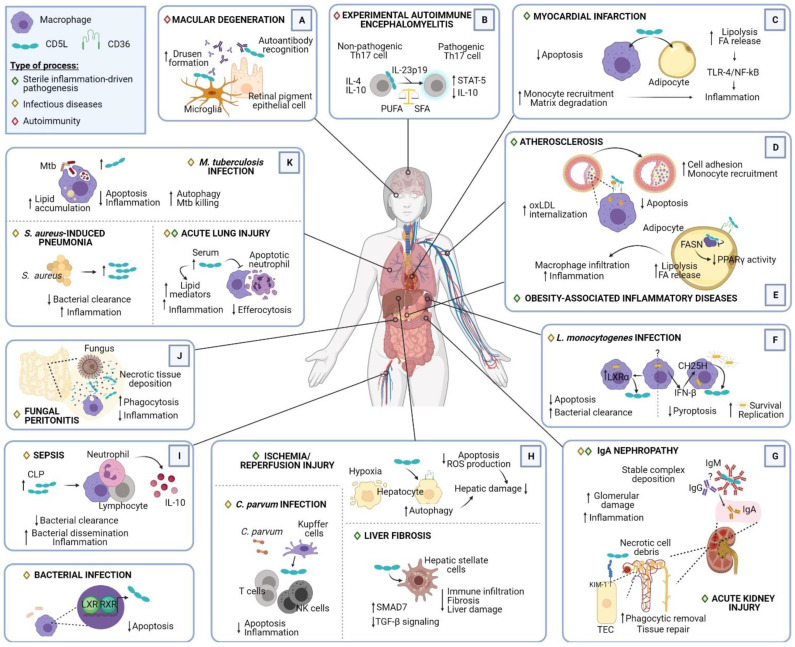
Multiple roles of CD5L in pathogenesis. Representative illustration summarizing the different scenarios in which CD5L plays a role, including its source, target cells, interacting proteins, and main outcomes. The processes have been classified into sterile inflammation-driven pathogenesis, infectious diseases, and autoimmunity, and have been grouped according to the affected region: (A) eye; (B) brain; (C) heart; (D) artery; (E) adipose tissue; (F) spleen; (G) kidney; (H) liver; (I) circulation; (J) peritoneum; (K) lung. ↓, decreased; ↑, increased. Abbreviations: HSC, hepatic stellate cells; TEC, tubular epithelial cells; NK, natural killer cells; ROS, reactive oxygen species, Mtb, M. tuberculosis; CH25H, cholesterol 25-hydroxylase; FA, fatty acids; FASN, fatty acid synthase; PUFA, polyunsaturated fatty acids; SFA, saturated fatty acids; LXR, liver-X-receptor; RXR, retinoid-X-receptor; CLP, cecal ligation puncture; UPR, unfolded protein response (figure created with Biorender.com).

References

    1. Zindel J., Kubes P. DAMPs, PAMPs, and LAMPs in Immunity and Sterile Inflammation. Annu. Rev. Pathol. Mech. Dis. 2020;15:493–518. doi: 10.1146/annurev-pathmechdis-012419-032847. - DOI - PubMed
    1. Furman D., Campisi J., Verdin E., Carrera-Bastos P., Targ S., Franceschi C., Ferrucci L., Gilroy D.W., Fasano A., Miller G.W., et al. Chronic inflammation in the etiology of disease across the life span. Nat. Med. 2019;25:1822–1832. doi: 10.1038/s41591-019-0675-0. - DOI - PMC - PubMed
    1. Gebe J.A., Kiener P.A., Ring H.Z., Li X., Francke U., Aruffo A. Molecular cloning, mapping to human chromosome 1 q21-q23, and cell binding characteristics of Spα, a new member of the scavenger receptor cysteine-rich (SRCR) family of proteins. J. Biol. Chem. 1997;272:6151–6158. doi: 10.1074/jbc.272.10.6151. - DOI - PubMed
    1. Sarrias M.R., Padilla O., Monreal Y., Carrascal M., Abian J., Vives J., Yélamos J., Lozano F. Biochemical characterization of recombinant and circulating human Spα. Tissue Antigens. 2004;63:335–344. doi: 10.1111/j.0001-2815.2004.00193.x. - DOI - PubMed
    1. Mori M., Kimura H., Iwamura Y., Arai S., Miyazaki T. Modification of N -glycosylation modulates the secretion and lipolytic function of apoptosis inhibitor of macrophage (AIM) FEBS Lett. 2012;586:3569–3574. doi: 10.1016/j.febslet.2012.08.017. - DOI - PubMed

Substances

LinkOut - more resources