


Use of Gene Therapy in Retinal Ganglion Cell Neuroprotection: Current Concepts and Future Directions
- PMID: 33920974
- PMCID: PMC8071340
- DOI: 10.3390/biom11040581
Use of Gene Therapy in Retinal Ganglion Cell Neuroprotection: Current Concepts and Future Directions
Abstract
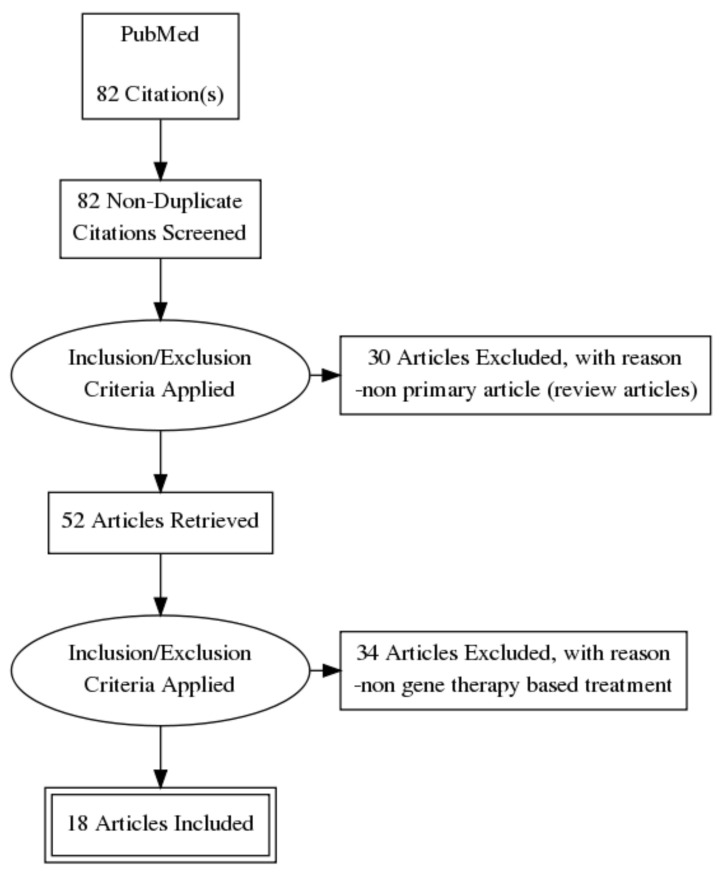
We systematically reviewed published translational research on gene-based therapy for retinal ganglion cell (RGC) neuroprotection. A search was conducted on Entrez PubMed on 23 December 2020 using the keywords "gene therapy", "retinal ganglion cell" and "neuroprotection". The initial search yielded 82 relevant articles. After restricting publications to those with full text available and in the English language, and then curating for only original articles on gene-based therapy, the final yield was 18 relevant articles. From the 18 papers, 17 of the papers utilized an adeno-associated viral (AAV) vector for gene therapy encoding specific genes of interest. Specifically, six of the studies utilized an AAV vector encoding brain-derived neurotrophic factor (BDNF), two of the studies utilized an AAV vector encoding erythropoietin (EPO), the remaining 10 papers utilized AAV vectors encoding different genes and one microRNA study. Although the literature shows promising results in both in vivo and in vitro models, there is still a significant way to go before gene-based therapy for RGC neuroprotection can proceed to clinical trials. Namely, the models of injury in many of the studies were more acute in nature, unlike the more progressive and neurodegenerative pathophysiology of diseases, such as glaucoma. The regulation of gene expression is also highly unexplored despite the use of AAV vectors in the majority of the studies reviewed. It is also expected that with the successful launch of messenger ribonucleic acid (mRNA)-based vaccinations in 2020, we will see a shift towards this technology for gene-based therapy in glaucoma neuroprotection.
Keywords: gene-based therapy; glaucoma neuroprotection; optic nerve injury; retinal ganglion cell.
Conflict of interest statement
The authors declare no conflict of interest.
Figures
References
-
- Fu L., Kwok S.S., Chan Y.K., Lai J.S.M., Pan W., Nie L., Shih K.C. Therapeutic Strategies for Attenuation of Retinal Ganglion Cell Injury in Optic Neuropathies: Concepts in Translational Research and Therapeutic Implications. BioMed Res. Int. 2019;2019:8397521. doi: 10.1155/2019/8397521. - DOI - PMC - PubMed
Publication types
MeSH terms
Substances
LinkOut - more resources
Full Text Sources
Other Literature Sources
Medical
Research Materials
