


The Impact of Intolerance of Uncertainty on Negative Emotions in COVID-19: Mediation by Pandemic-Focused Time and Moderation by Perceived Efficacy
- PMID: 33920976
- PMCID: PMC8103505
- DOI: 10.3390/ijerph18084189
The Impact of Intolerance of Uncertainty on Negative Emotions in COVID-19: Mediation by Pandemic-Focused Time and Moderation by Perceived Efficacy
Abstract
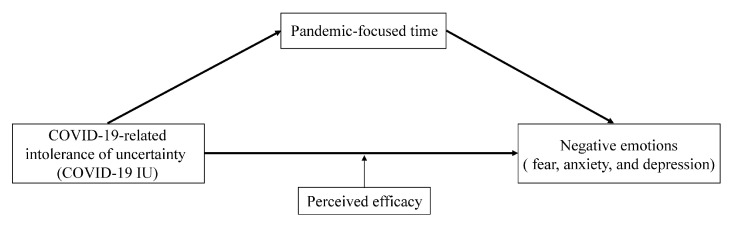
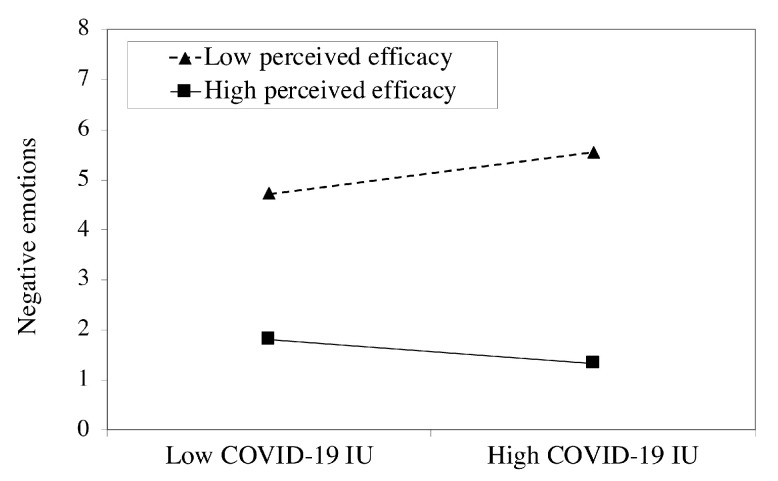
The COVID-19 global pandemic has resulted in a large number of people suffering from emotional problems. However, the mechanisms by which intolerance of uncertainty (IU) affects negative emotions during the COVID-19 pandemic remain unclear. This study aimed to explore the mediating role of pandemic-focused time and the moderating role of perceived efficacy in the association between IU and negative emotions during the COVID-19 pandemic based on the uncertainty-time-efficacy-emotion model (UTEE). 1131 participants were recruited to complete measures of COVID-19 IU, pandemic-focused time, perceived efficacy, negative emotions and demographic variables during the COVID-19 pandemic. The results showed that COVID-19 IU was significantly and positively associated with negative emotions, and this link could be mediated by pandemic-focused time. Moreover, the direct effect of COVID-19 IU on negative emotions was moderated by perceived efficacy. Specifically, the direct effect of COVID-19 IU on negative emotions was much stronger for individuals with lower levels of perceived efficacy. The current study further extended the previous integrative uncertainty tolerance model. Furthermore, the study suggested that policy makers and mental health professionals should reduce the general public's negative emotions during the pandemic through effective interventions such as adjusting COVID-19 IU, shortening pandemic-focused time and enhancing perceived efficacy.
Keywords: COVID-19; intolerance of uncertainty; negative emotions; pandemic; pandemic-focused time; perceived efficacy.
Conflict of interest statement
The authors declare no conflict of interest. The funders had no role in the design of the study; in the collection, analyses, or interpretation of data; in the writing of the manuscript, or in the decision to publish the results.
Figures
References
-
- COVID-19 Weekly Epidemiological Update. World Health Organization; Geneva, Switzerland: Mar 14, 2021. Report.
Publication types
MeSH terms
Grants and funding
LinkOut - more resources
Full Text Sources
Other Literature Sources
Medical
