Review
. 2021 Apr 15;9(4):391.
doi: 10.3390/vaccines9040391.

COVID-19 and Pregnancy: Vertical Transmission and Inflammation Impact on Newborns

Affiliations
Review

COVID-19 and Pregnancy: Vertical Transmission and Inflammation Impact on Newborns

Mohamed Joma et al. Vaccines (Basel). .

Abstract

The COVID-19 pandemic is ongoing and we are still compiling new findings to decipher and understand SARS-CoV-2 infection during pregnancy. No reports encompass any conclusive confirmation of vertical transmission. Nevertheless, cases of fetal distress and multiple organ failure have been reported, as well as rare cases of fetal demise. While clinicians and scientists continue to seek proof of vertical transmission, they miss the greater point, namely the cause of preterm delivery. In this review, we suggest that the cause might not be due to the viral infection but the fetal exposure to maternal inflammation or cytokine storm that translates into a complication of COVID-19. This statement is extrapolated from previous experience with infections and inflammation which were reported to be fatal by increasing the risk of preterm delivery and causing abnormal neonatal brain development and resulting in neurological disorders like atypical behavioral phenotype or autistic syndrome. Given the potentially fatal consequences on neonate health, we highlight the urgent need for an animal model to study vertical transmission. The preclinical model will allow us to make the link between SARS-COV-2 infection, inflammation and long-term follow-up of child brain development.

Keywords: COVID-19; central nervous system; fetus; immunity; inflammation; neurodevelopmental disorders; newborn; preterm delivery; transmission.


Conflict of interest statement

The authors declare no conflict of interest.

Figures
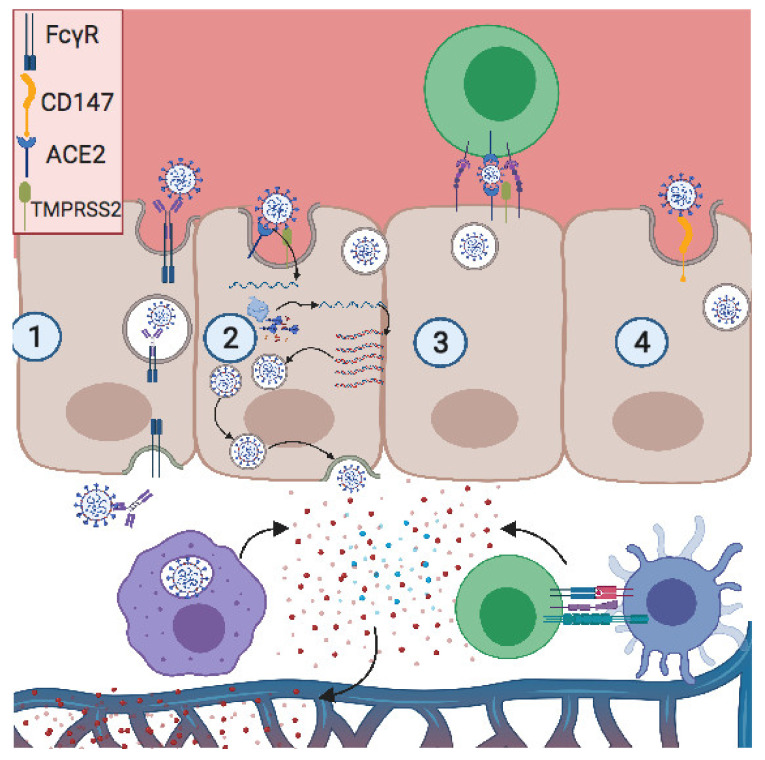
Figure 1
Figure 1
Potential modes of placental invasion by SARS-CoV-2. (1) Antibody-dependent enhancement (ADE): the antibody neutralizing SARS-CoV-2 binds its Fc region onto FCγR, expressed on the apical pole of the trophoblast. Then the neutralized virus is transcytosed into the basic pole, releasing the virus into the fetal extracellular matrix. (2) ACE2/TMPRSS2 pathway: the S2 subunit of the S protein interacts with ACE2 on the apical pole, promoting the fusion of the envelope with the membrane. This is followed by a proteolytic cleavage between S1 and S2 subunits by TMPRSS2, thus releasing the virus. The positive RNA translates the viral-RNA-dependent RNA polymerase and the viral proteins. Then this polymerase produces a high copy number of the viral genome, after which the virion is assembled and released on the basal pole. (3) Cell-to-cell contact: LFA1 expressed on infected T cells interacts with ICAM1 expressed on the trophoblast apical pole, forming a tight interaction and close proximity between two membranes. Thus, the viral release in the placental immune synapse can facilitate viral infection. (4) CD147 expressed on the apical pole of the trophoblast interacts with viral particles, promoting viral infection. Created with BioRender.com.
Figure 2
Figure 2
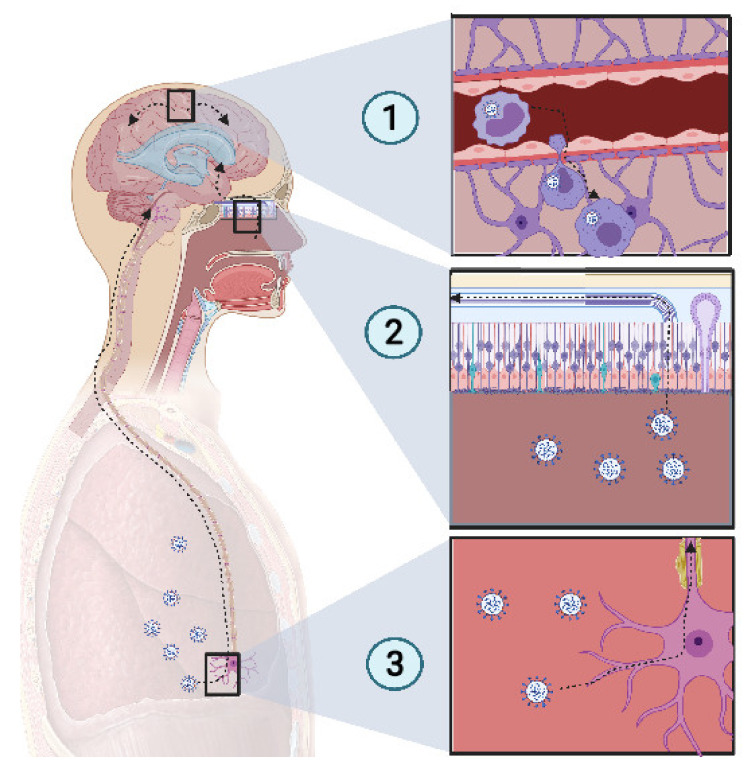
Potential mechanism of CNS invasion by SARS-CoV-2. (1) The blood−brain barrier (BBB) permits a limited exchange, due to the continuous capillary endothelium, with a tight junction supported by continuous basement membrane and surrounded by astrocyte feet. Monocytes infected with SARS-CoV-2 act as Trojan horses, due to their access to the CNS. Thus, an extravasation of infected monocytes can promote CNS infection. (2) The high-spectrum olfactory receptors expressed on the cilia of olfactory neurons may act as receptors for SARS-CoV-2, thus infecting the bipolar neuron in the nasal epithelium. Retrograde movement leads SARS-CoV-2 to the olfactory bulb, which is connected to the limbic system, thus promoting the invasion of the limbic system, including the hippocampus. (3) Chemoreceptive neuron infection in the lower respiratory tract may lead to a retrograde migration of the virus through the nervous network toward the respiratory center in the brain stem, resulting in acute respiratory failure. Created with BioRender.com
Figure 3
Figure 3
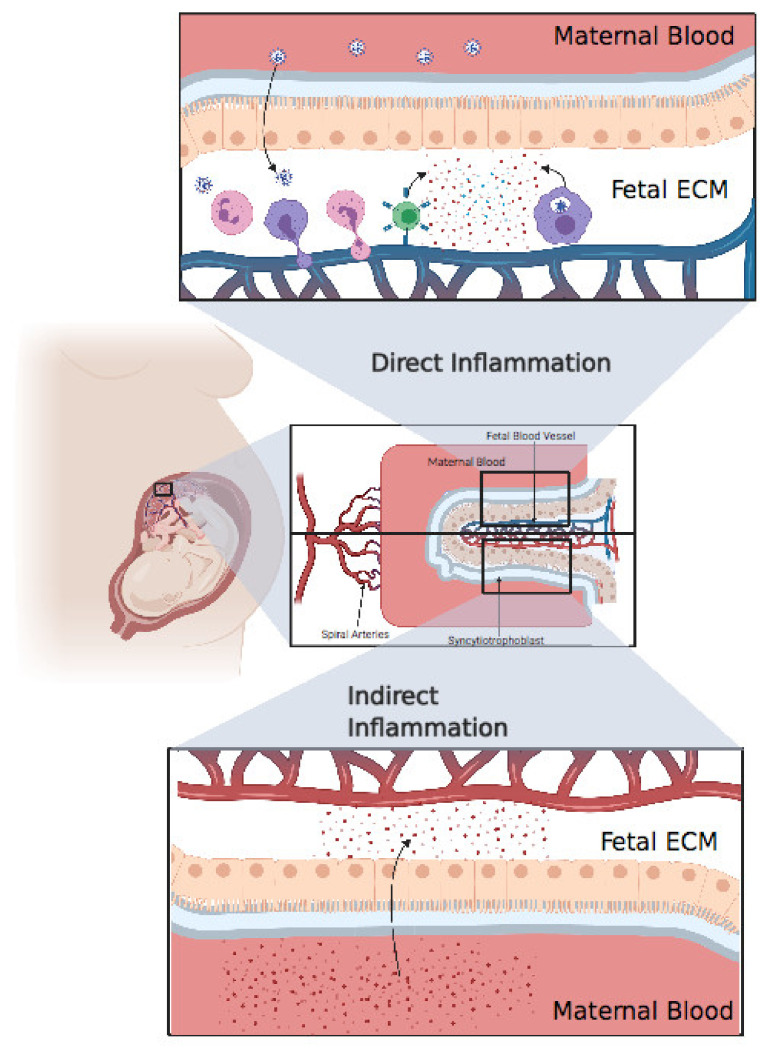
Direct inflammation or indirect inflammation. Direct inflammation: after viral invasion of the placenta, fetal immune cells, including neutrophils, monocytes, and T cells, extravasate from fetal blood to the placental extracellular matter, resulting in an extensive inflammatory response in the fetal extracellular matrix (ECM). Finally, these inflammatory cytokines pass through the blood, resulting in systemic inflammation in the fetus. Indirect inflammation: inflammatory cytokines circulating in maternal blood after a cytokine storm might pass through the placenta, resulting in indirect inflammation. Created with BioRender.com.

References

    1. Li Q., Guan X., Wu P., Wang X., Zhou L., Tong Y., Ren R., Leung K.S., Lau E.H., Wong J.Y. Early transmission dynamics in Wuhan, China, of novel coronavirus–infected pneumonia. N. Engl. J. Med. 2020;382:1199–1207. doi: 10.1056/NEJMoa2001316. - DOI - PMC - PubMed
    1. Zhu N., Zhang D., Wang W., Li X., Yang B., Song J., Zhao X., Huang B., Shi W., Lu R. A novel coronavirus from patients with pneumonia in China, 2019. N. Engl. J. Med. 2020;382:727–733. doi: 10.1056/NEJMoa2001017. - DOI - PMC - PubMed
    1. WHO. [(accessed on 31 July 2020)]; Available online: https://www.who.int/emergencies/diseases/novel-coronavirus-2019/events-a....
    1. Johns Hopkins University Medicine. [(accessed on 30 March 2021)];2020 Available online: https://coronavirus.jhu.edu/map.html.
    1. Richardson S., Hirsch J.S., Narasimhan M., Crawford J.M., McGinn T., Davidson K.W., Barnaby D.P., Becker L.B., Chelico J.D., Cohen S.L. Presenting characteristics, comorbidities, and outcomes among 5700 patients hospitalized with COVID-19 in the New York City area. JAMA. 2020;323:2052–2059. doi: 10.1001/jama.2020.6775. - DOI - PMC - PubMed

LinkOut - more resources