Review
. 2021 Apr 22;22(9):4369.
doi: 10.3390/ijms22094369.

Tezepelumab: A Potential New Biological Therapy for Severe Refractory Asthma

Affiliations
Review

Tezepelumab: A Potential New Biological Therapy for Severe Refractory Asthma

Corrado Pelaia et al. Int J Mol Sci. .

Abstract

Thymic stromal lymphopoietin (TSLP) is an innate cytokine, belonging to the group of alarmins, which plays a key pathogenic role in asthma by acting as an upstream activator of cellular and molecular pathways leading to type 2 (T2-high) airway inflammation. Released from airway epithelial cells upon tissue damage induced by several noxious agents including allergens, viruses, bacteria, and airborne pollutants, TSLP activates dendritic cells and group 2 innate lymphoid cells involved in the pathobiology of T2-high asthma. Tezepelumab is a fully human monoclonal antibody that binds to TSLP, thereby preventing its interaction with the TSLP receptor complex. Preliminary results of randomized clinical trials suggest that tezepelumab is characterized by a good safety and efficacy profile in patients with severe, uncontrolled asthma.

Keywords: TSLP; alarmins; asthma; tezepelumab.


Conflict of interest statement

The authors declare that there is no conflict of interest.

Figures
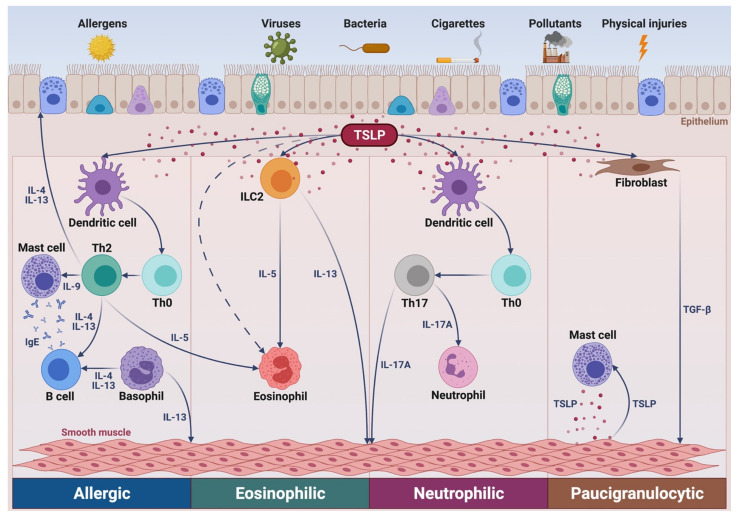
Figure 1
Figure 1
Putative role of TSLP in several asthma pathways. In allergic asthma, via activation of dendritic cells, TSLP promotes the differentiation of Th2 lymphocytes secreting IL-4, IL-5, IL-9, and IL-13, which target B cells, eosinophils, mast cells, and airway smooth muscle cells, respectively. IL-4 and IL-13 are also produced by basophils. In non-allergic eosinophilic asthma, TSLP stimulates ILC2 to release IL-5 and IL-13. In neutrophilic asthma, TSLP induces dendritic cells to drive the development of neutrophil-activating Th17 lymphocytes. In paucigranulocytic asthma, TSLP mediates the complex crosstalks involving inflammatory cellular elements, such as mast cells, and airway structural cells including epithelial cells, fibroblasts, and smooth muscle cells. TSLP: thymic stromal lymphopoetin; Th: T helper; ILC2: group 2 innate lymphoid cells; IL: interleukin; TGF-β: transforming growth factor-β. This original figure was created by the authors using BioRender.com.
Figure 2
Figure 2
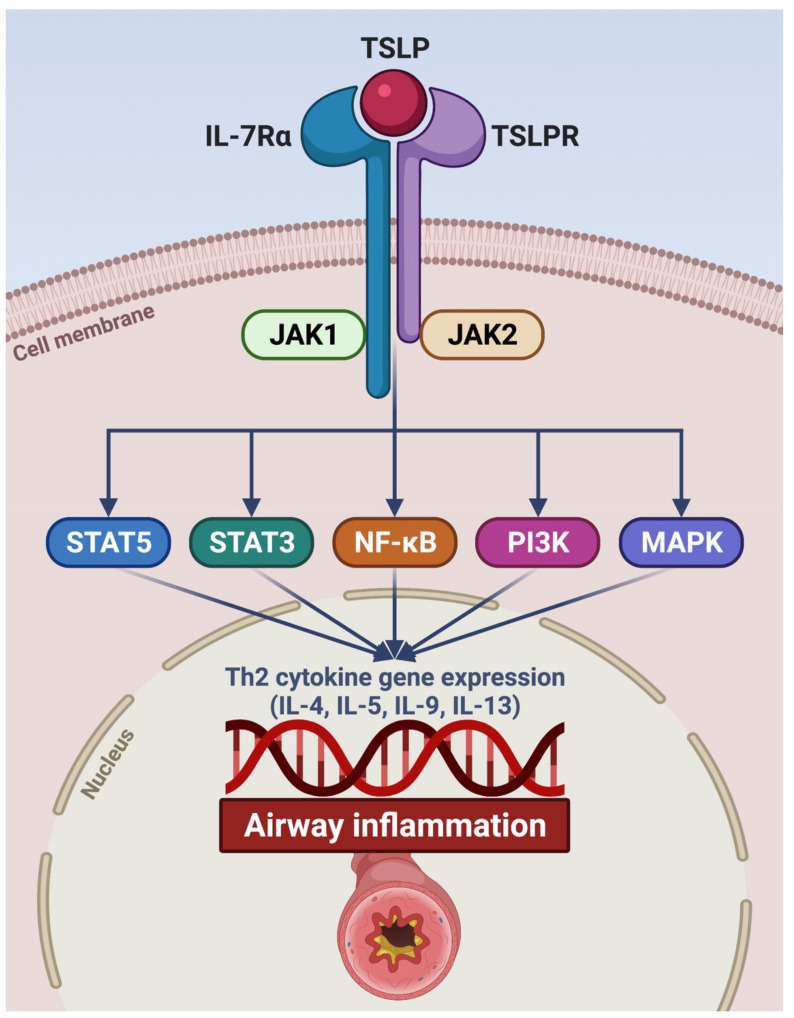
Signaling pathways activated by TSLP. TSLP specifically binds to TSLPR expressed by target cells. The TSLP/TSLPR binary aggregate thus recruits IL-7Rα, thereby promoting the assembly of the ternary molecular complex TSLP/TSLPR/IL-7Rα. The latter triggers the activation of intracellular signaling cascades initiated by JAK1/JAK2, which phosphorylates STAT3/5 and also involves NF-κB, PI3K, and MAPK. As a consequence, this transduction network activates target genes encoding pro-inflammatory cytokines (IL-4, IL-5, IL-9, and IL-13) implicated in airway inflammation. TSLP: thymic stromal lymphopoietin; TSLPR: thymic stromal lymphopoietin receptor; IL-7Rα: α subunit of the interleukin-7 receptor; JAK: Janus kinases; STAT: signal transducers and activators of transcription; NF-κB: nuclear factor-κB; PI3K: phosphoinositide 3 kinase; MAPK: mitogen-activated protein kinases. This original figure was created by the authors using BioRender.com.

References

    1. Papi A., Brightling C., Pedersen S.E., Reddel H.K. Asthma. Lancet. 2018;391:783–800. doi: 10.1016/S0140-6736(17)33311-1. - DOI - PubMed
    1. Khalaf K., Paoletti G., Puggioni F., Racca F., De Luca F., Giorgis V., Canonica G.W., Heffler E. Asthma from immune pathogenesis to precision medicine. Semin. Immunol. 2019;46:101294. doi: 10.1016/j.smim.2019.101294. - DOI - PubMed
    1. McDowell P.J., Heaney L.G. Different endotypes and phenotypes drive the heterogeneity in severe asthma. Allergy. 2020;75:302–310. doi: 10.1111/all.13966. - DOI - PubMed
    1. Suraya R., Nagano T., Katsurada M., Sekiya R., Kobayashi K., Nishimura Y. Molecular mechanism of asthma and its novel molecular target therapeutic agent. Respir. Investig. 2021;59:291–301. doi: 10.1016/j.resinv.2020.12.007. - DOI - PubMed
    1. Pelaia C., Crimi C., Vatrella A., Tinello C., Terracciano R., Pelaia G. Molecular Targets for Biological Therapies of Severe Asthma. Front. Immunol. 2020;11:603312. doi: 10.3389/fimmu.2020.603312. - DOI - PMC - PubMed

Substances