


Ectopic FOXP3 Expression in Combination with TGF-β1 and IL-2 Stimulation Generates Limited Suppressive Function in Human Primary Activated Thymocytes Ex Vivo
- PMID: 33922629
- PMCID: PMC8146103
- DOI: 10.3390/biomedicines9050461
Ectopic FOXP3 Expression in Combination with TGF-β1 and IL-2 Stimulation Generates Limited Suppressive Function in Human Primary Activated Thymocytes Ex Vivo
Abstract
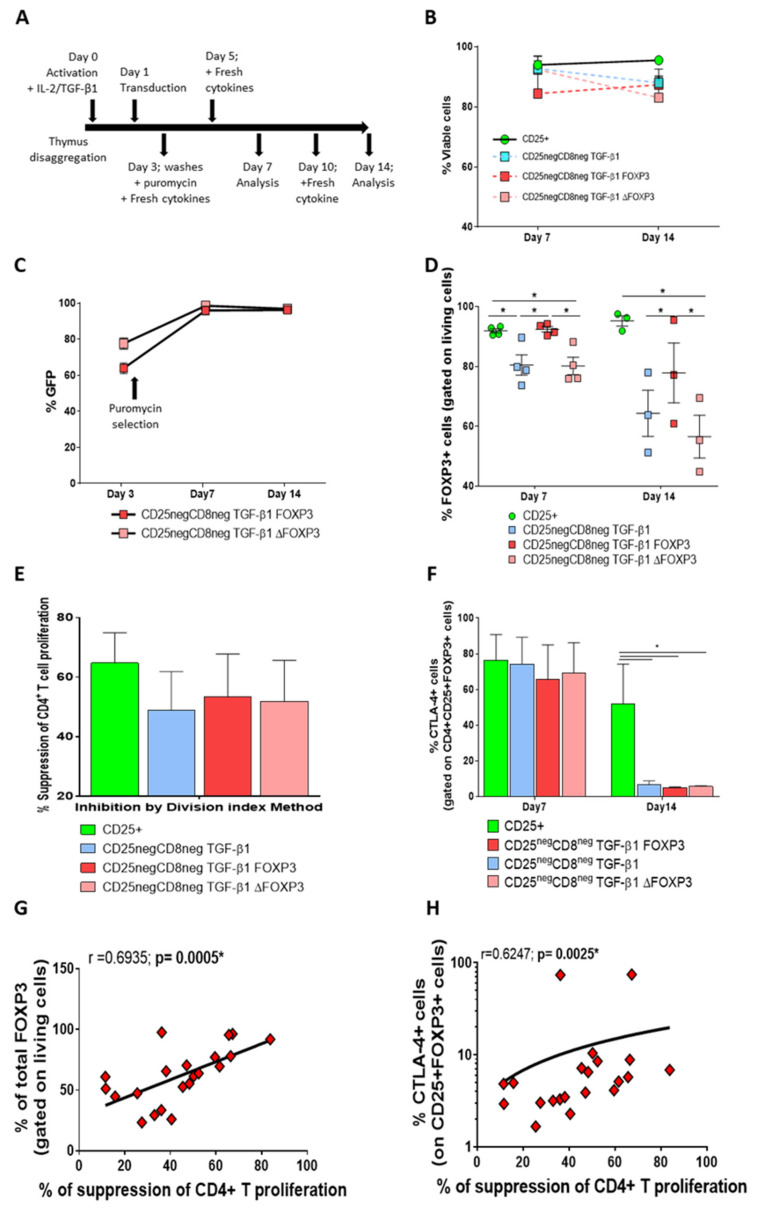
Regulatory T cells (Tregs), which are characterized by the expression of the transcription factor forkhead box P3 (FOXP3), are the main immune cells that induce tolerance and are regulators of immune homeostasis. Natural Treg cells (nTregs), described as CD4+CD25+FOXP3+, are generated in the thymus via activation and cytokine signaling. Transforming growth factor beta type 1 (TGF-β1) is pivotal to the generation of the nTreg lineage, its maintenance in the thymus, and to generating induced Treg cells (iTregs) in the periphery or in vitro arising from conventional T cells (Tconvs). Here, we tested whether TGF-β1 treatment, associated with interleukin-2 (IL-2) and CD3/CD28 stimulation, could generate functional Treg-like cells from human thymocytes in vitro, as it does from Tconvs. Additionally, we genetically manipulated the cells for ectopic FOXP3 expression, along with the TGF-β1 treatment. We demonstrated that TGF-β1 and ectopic FOXP3, combined with IL-2 and through CD3/CD28 activation, transformed human thymocytes into cells that expressed high levels of Treg-associated markers. However, these cells also presented a lack of homogeneous suppressive function and an unstable proinflammatory cytokine profile. Therefore, thymocyte-derived cells, activated with the same stimuli as Tconvs, were not an appropriate alternative for inducing cells with a Treg-like phenotype and function.
Keywords: FOXP3; engineering cells; human thymocytes; regulatory T cells.
Conflict of interest statement
The authors declare that they have no competing interest.
Figures



References
-
- Canavan J.B., Scottà C., Vossenkämper A., Goldberg R., Elder M.J., Shoval I., Marks E., Stolarczyk E., Lo J.W., Powell N., et al. Developing in vitro expanded CD45RA+ regulatory T cells as an adoptive cell therapy for Crohn’s disease. Gut. 2016;65:584–594. doi: 10.1136/gutjnl-2014-306919. - DOI - PMC - PubMed
-
- Marek-Trzonkowska N., Mysliwiec M., Dobyszuk A., Grabowska M., Techmanska I., Juscinska J., Wujtewicz M.A., Witkowski P., Mlynarski W., Balcerska A., et al. Administration of CD4+CD25highCD127- regulatory T cells preserves β-cell function in type 1 diabetes in children. Diabetes Care. 2012;35:1817–1820. doi: 10.2337/dc12-0038. - DOI - PMC - PubMed
Grants and funding
- B2017/BMD3727/Madrid community grants, ERDF Funds from the European commission "A way of making Europe"
- PI-MP-2018/IiSGM Intramural Grants
- FFA-FIBHGM-2019/Fundacion Familia Alonso
- PEJD-2018-PRE/BMD-809/Youth Employment Program of Madrid community grants, ERDF Funds from the European commission "A way of making Europe"
- Pre-JGV-2018/IiSGM Intramural Grants
LinkOut - more resources
Full Text Sources
Research Materials
