


The Role of Exercise, Diet, and Cytokines in Preventing Obesity and Improving Adipose Tissue
- PMID: 33922998
- PMCID: PMC8145589
- DOI: 10.3390/nu13051459
The Role of Exercise, Diet, and Cytokines in Preventing Obesity and Improving Adipose Tissue
Abstract
The prevalence of obesity continues to rise worldwide despite evidence-based public health recommendations. The promise to adopt a healthy lifestyle is increasingly important for tackling this global epidemic. Calorie restriction or regular exercise or a combination of the two is accepted as an effective strategy in preventing or treating obesity. Furthermore, the benefits conferred by regular exercise to overcome obesity are attributed not only to reduced adiposity or reduced levels of circulating lipids but also to the proteins, peptides, enzymes, and metabolites that are released from contracting skeletal muscle or other organs. The secretion of these molecules called cytokines in response to exercise induces browning of white adipose tissue by increasing the expression of brown adipocyte-specific genes within the white adipose tissue, suggesting that exercise-induced cytokines may play a significant role in preventing obesity. In this review, we present research-based evidence supporting the effects of exercise and various diet interventions on preventing obesity and adipose tissue health. We also discuss the interplay between adipose tissue and the cytokines secreted from skeletal muscle and other organs that are known to affect adipose tissue and metabolism.
Keywords: adipose tissue; cytokines; diet; exercise; obesity.
Conflict of interest statement
The authors declare no conflict of interest.
Figures
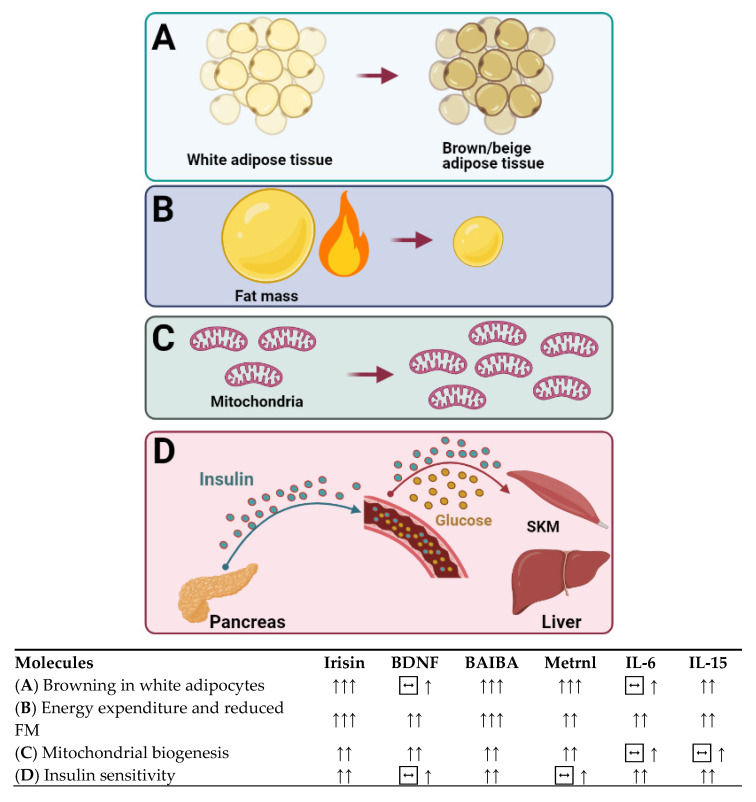
 ↑ small change or no change. ↑↑ modest change. ↑↑↑ large change. FM fat mass. SKM skeletal muscle.
References
-
- World Health Organization Obesity and Overweight. Fact Sheet. [(accessed on 25 February 2021)]; Available online: https://www.who.int/news-room/fact-sheets/detail/obesity-and-overweight.
-
- Stamatakis E., Chau J.Y., Pedisic Z., Bauman A., Macniven R., Coombs N., Hamer M. Are Sitting Occupations Associated with Increased All-Cause, Cancer, and Cardiovascular Disease Mortality Risk? A Pooled Analysis of Seven British Population Cohorts. PLoS ONE. 2013;8:e73753. doi: 10.1371/journal.pone.0073753. - DOI - PMC - PubMed
Publication types
MeSH terms
Substances
Grants and funding
LinkOut - more resources
Full Text Sources
Medical
