. 2021 Apr 25;13(5):755.
doi: 10.3390/v13050755.

Evaluation of Aedes aegypti, Aedes albopictus, and Culex quinquefasciatus Mosquitoes Competence to Oropouche virus Infection

Affiliations

Evaluation of Aedes aegypti, Aedes albopictus, and Culex quinquefasciatus Mosquitoes Competence to Oropouche virus Infection

Silvana F de Mendonça et al. Viruses. .

Abstract

The emergence of new human viral pathogens and re-emergence of several diseases are of particular concern in the last decades. Oropouche orthobunyavirus (OROV) is an arbovirus endemic to South and Central America tropical regions, responsible to several epidemic events in the last decades. There is little information regarding the ability of OROV to be transmitted by urban/peri-urban mosquitoes, which has limited the predictability of the emergence of permanent urban transmission cycles. Here, we evaluated the ability of OROV to infect, replicate, and be transmitted by three anthropophilic and urban species of mosquitoes, Aedes aegypti, Aedes albopictus, and Culex quinquefasciatus. We show that OROV is able to infect and efficiently replicate when systemically injected in all three species tested, but not when orally ingested. Moreover, we find that, once OROV replication has occurred in the mosquito body, all three species were able to transmit the virus to immunocompromised mice during blood feeding. These data provide evidence that OROV is restricted by the midgut barrier of three major urban mosquito species, but, if this restriction is overcome, could be efficiently transmitted to vertebrate hosts. This poses a great risk for the emergence of permanent urban cycles and geographic expansion of OROV to other continents.

Keywords: Aedes aegypti; Aedes albopictus; Culex quinquefasciatus; Oropouche; urban epidemics; vector competence.


Conflict of interest statement

The authors declare no conflict of interest.

Figures
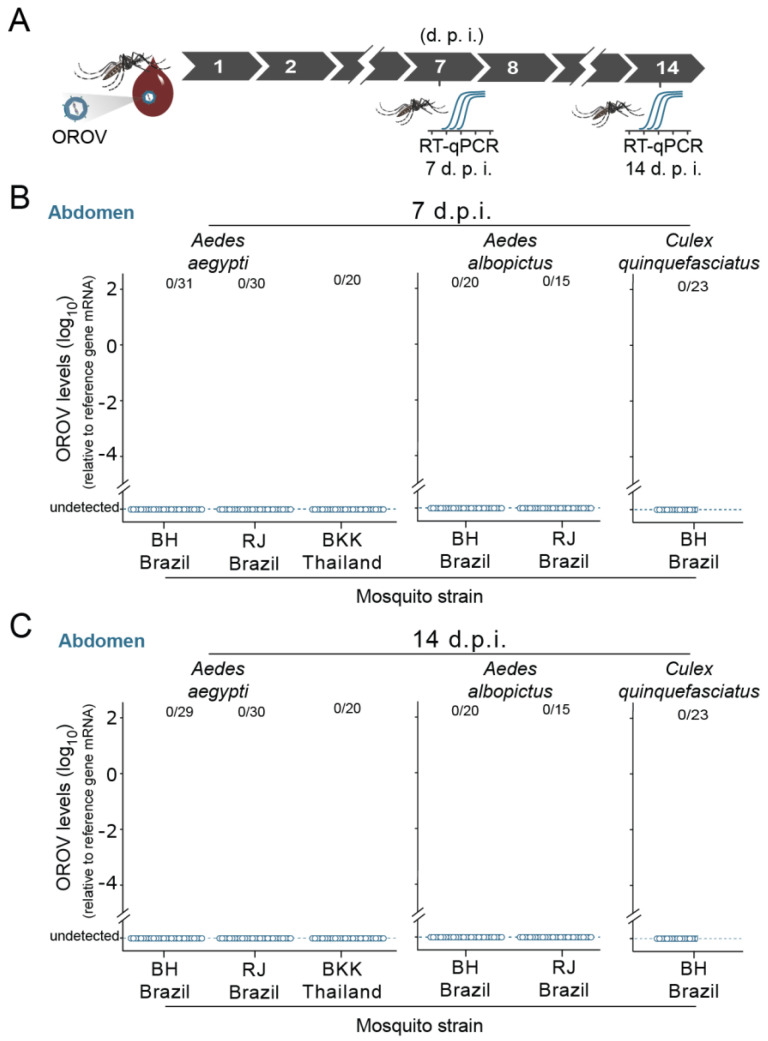
Figure 1
Figure 1
Mosquitoes Ae. aegypti, Ae. albopictus, and Cx. quinquefasciatus are resistant to Oropouche orthobunyavirus (OROV) oral infection after an artificial blood meal. (A) Scheme of the experimental design using membrane blood-feeding system to orally infect mosquitoes. Mosquitoes were allowed to take blood meals in the membrane blood-feeding apparatus containing OROV-infected blood. Seven and 14 days after the blood meal, mosquitoes were collected and tested individually for the presence of OROV. (B) Seven days post feeding (d.p.f.) OROV RNA levels of mosquito abdomen on blood meal containing 6.7 × 10⁷ p.f.u. mL−1 of OROV. RNA levels were quantified by quantitative real-time PCR (RT-qPCR). Three strains of Aedes aegypti were tested; that is, the BH strain; the RJ strain wild-caught population from Rio de Janeiro, Brazil); and the BKK strain. Two strains of Aedes albopictus were tested, the BH strain and the RJ strain (wild-caught population from Rio de Janeiro, Brazil). One strain of Culex quinquefasciatus was tested, the BH strain. (C) Fourteen d.p.f. OROV RNA levels of mosquito abdomen on blood meal containing 6.7 × 10⁷ p.f.u. mL−1 of OROV. Each dot represents a sample (abdomen) from an individual mosquito.
Figure 2
Figure 2
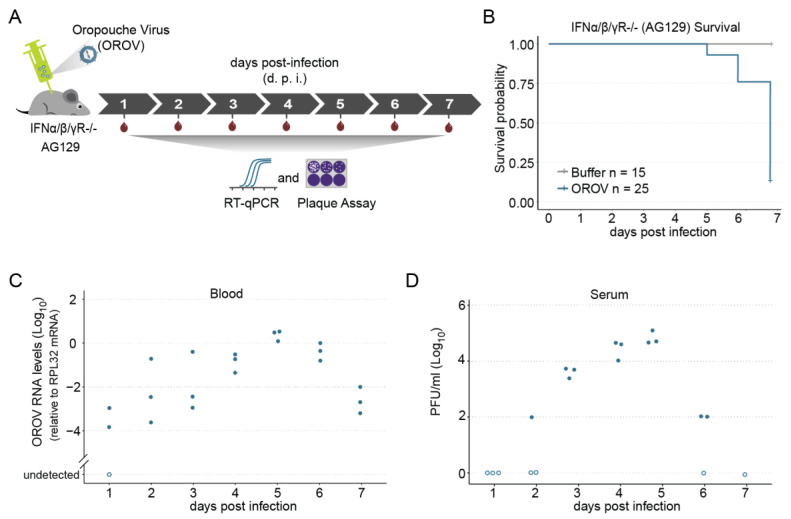
Immunodeficient AG129 (IFNα/β/γR−/−) mouse model of OROV virus infection. (A) Scheme of the experimental design. Four- to five-week-old AG129 mice were inoculated with 105 p.f.u. of OROV by intraperitoneal (IP) injection performed in the lower right quadrant. Blood was collected every 24 h during seven days for viral RNA quantification and plasma viremia titration. (B) Survival probability (Kaplan–Meier plot) of AG129 mice inoculated with mock or with 105 p.f.u. of OROV. (C) RNA levels of blood samples from AG129 mice inoculated with 105 p.f.u. of OROV. Samples were tested individually by RT-qPCR. Each dot represents a blood sample from an individual mouse. For each time point, three different mice were sampled. Mice were euthanized after a single blood collection. (D) Serum OROV titers. Serum samples were obtained from blood collected from OROV infected AG129 mice (105 p.f.u. per mouse) and virus titers were measured by plaque assay.
Figure 3
Figure 3
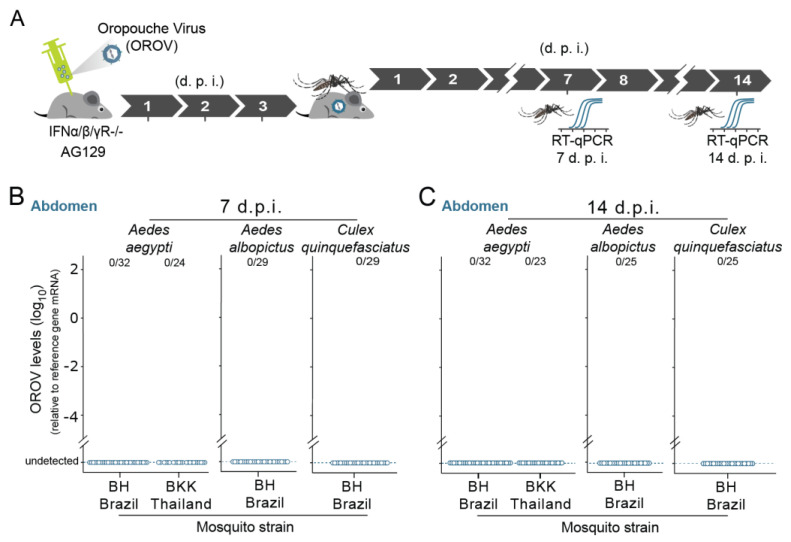
Ae. aegypti, Ae. Albopictus, and Cx. quinquefasciatus mosquitoes are resistant to OROV infection after feeding on infected mice. (A) Scheme of the experimental design using OROV viremic mice to orally infect mosquitoes. Four- to five-week-old AG129 mice were inoculated with 105 p.f.u. of OROV by intraperitoneal (IP) injection. After three days, mice were anaesthetized and then mosquitoes (5- to 7-day-old females) were allowed to take blood meals in the OROV-infected mice. Seven and 14 days after the blood meal, mosquitoes were collected and tested individually for the presence of OROV. (B) Seven d.p.f OROV RNA levels of mosquito abdomen that fed on OROV-infected mice. RNA levels were quantified by RT-qPCR. Two strains of Aedes aegypti were tested, the BH strain (wild-caught population from Belo Horizonte, Brazil) and the BKK strain (laboratory Bangkok strain). One strain of Aedes albopictus was tested, the BH strain (wild-caught population from Belo Horizonte, Brazil). One strain of Culex quinquefasciatus was tested, the BH strain (wild-caught population from Belo Horizonte, Brazil). (C) Fourteen d.p.f OROV RNA levels of mosquito abdomen that were fed on OROV-infected mice.
Figure 4
Figure 4
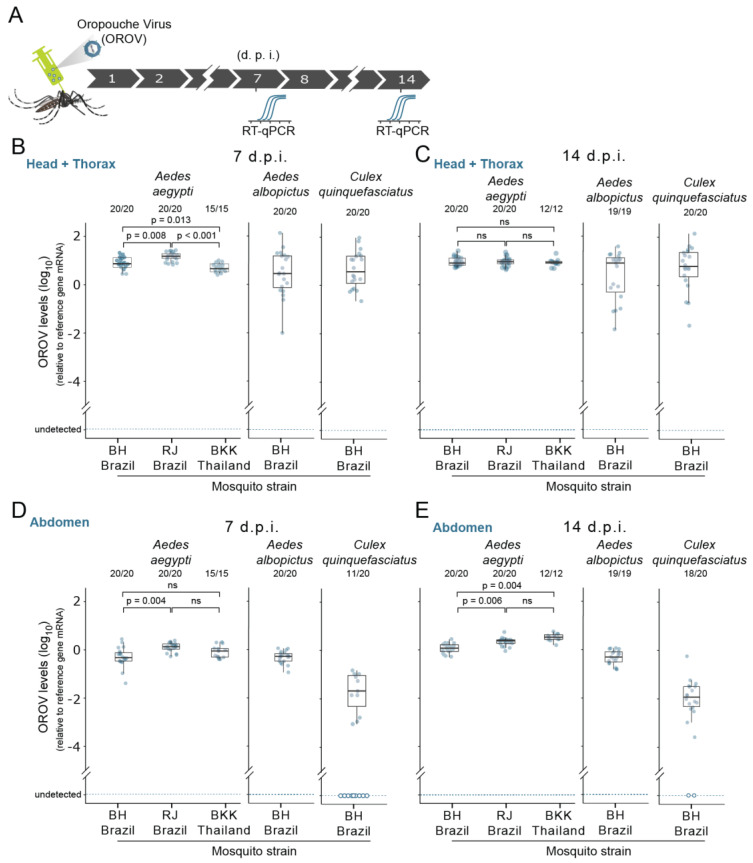
Susceptibility of Aedes aegypti, Aedes albopictus, and Culex quinquefasciatus mosquitoes to OROV systemic infection. (A) Scheme of the experimental design using intrathoracic injection to systemically infect mosquitoes. 1358 p.f.u. of OROV was injected in each mosquito; 7 and 14 days later, the head + thorax and abdomen were tested for the presence of viral RNA. (B) Seven d.p.i. OROV RNA levels of head + thorax from female mosquitoes injected with OROV. RNA levels were quantified by RT-qPCR. Three strains of Aedes aegypti were tested, BH, RJ, and BKK. One strain of Aedes albopictus was tested, the BH strain. One strain of Culex quinquefasciatus was tested, the BH strain. Each dot represents a sample (head plus thorax) from an individual mosquito. (C) Fourteen d.p.i. OROV RNA levels of head + thorax from female mosquitoes injected with OROV. (D) Seven d.p.i OROV RNA levels female mosquitoes abdomen injected with OROV. RNA levels were quantified by RT-qPCR. Three strains of Aedes aegypti were tested, BH, RJ, and BKK. One strain of Aedes albopictus was tested, the BH strain. One strain of Culex quinquefasciatus was tested, the BH strain. (E) Fourteen d.p.f OROV RNA levels female mosquitoes abdomen injected with OROV. Each dot represents a sample (abdomen) from an individual mosquito.
Figure 5
Figure 5
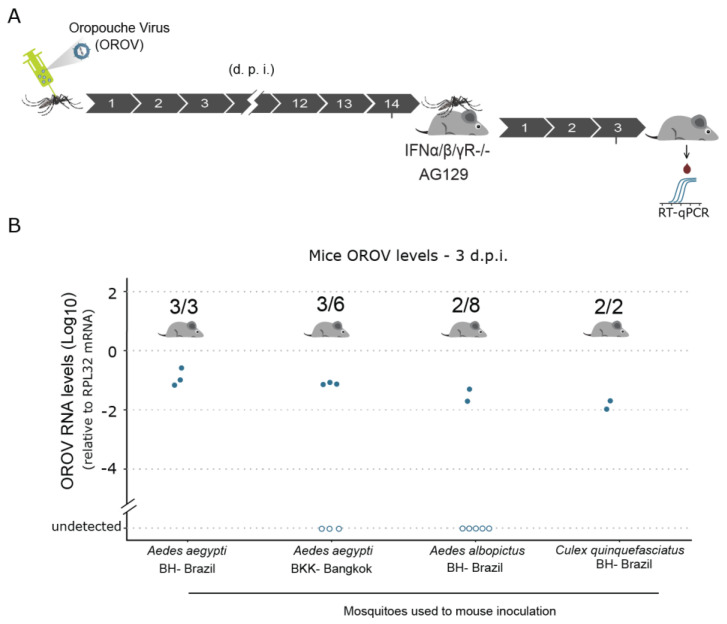
Upon systemic infection, Ae. aegypti, Ae. albopictus, and Cx. quinquefasciatus are able to transmit OROV to AG129 mice. (A) Scheme of the experimental design to test OROV transmission from mosquitoes to vertebrate host. 1358 p.f.u. of OROV was injected in each mosquito. Fourteen days later, the mosquitoes were exposed to anesthetized naïve AG129 mice for blood feeding. Three days later, the presence of OROV in the mice serum was tested by RT-qPCR. (B) OROV RNA levels in the mice serum three days after exposure to OROV infected mosquitoes. Mice serum samples were tested individually by RT-qPCR for the presence of OROV. Each AG129 mice was exposed to five infected mosquitoes for one hour. Between two and five mosquitoes were able to accomplish a blood meal. Full-engorged mosquitoes were counted and collected to confirm the presence of OROV by RT-qPCR. Samples were tested individually by RT-qPCR. Each dot represents a blood sample from an individual mouse.

References

    1. Weaver S.C., Reisen W.K. Present and future arboviral threats. Antiviral Res. 2010;85:328–345. doi: 10.1016/j.antiviral.2009.10.008. - DOI - PMC - PubMed
    1. Weaver S.C., Chen R., Diallo M. Chikungunya Virus: Role of Vectors in Emergence from Enzootic Cycles. Annu. Rev. Entomol. 2020;65:313–332. doi: 10.1146/annurev-ento-011019-025207. - DOI - PubMed
    1. Weaver S.C., Charlier C., Vasilakis N., Lecuit M. Zika, Chikungunya, and Other Emerging Vector-Borne Viral Diseases. Annu. Rev. Med. 2018;69:395–408. doi: 10.1146/annurev-med-050715-105122. - DOI - PMC - PubMed
    1. Weaver S.C. Prediction and prevention of urban arbovirus epidemics: A challenge for the global virology community. Antiviral Res. 2018;156:80–84. doi: 10.1016/j.antiviral.2018.06.009. - DOI - PMC - PubMed
    1. Messina J.P., Brady O.J., Golding N., Kraemer M.U.G., Wint G.R.W., Ray S.E., Pigott D.M., Shearer F.M., Johnson K., Earl L., et al. The current and future global distribution and population at risk of dengue. Nat. Microbiol. 2019;4:1508–1515. doi: 10.1038/s41564-019-0476-8. - DOI - PMC - PubMed

Publication types

Supplementary concepts

LinkOut - more resources