


Evaluation of the B.strong Queensland Indigenous Health Worker Brief Intervention Training Program for Multiple Health Risk Behaviours
- PMID: 33923462
- PMCID: PMC8073127
- DOI: 10.3390/ijerph18084220
Evaluation of the B.strong Queensland Indigenous Health Worker Brief Intervention Training Program for Multiple Health Risk Behaviours
Abstract
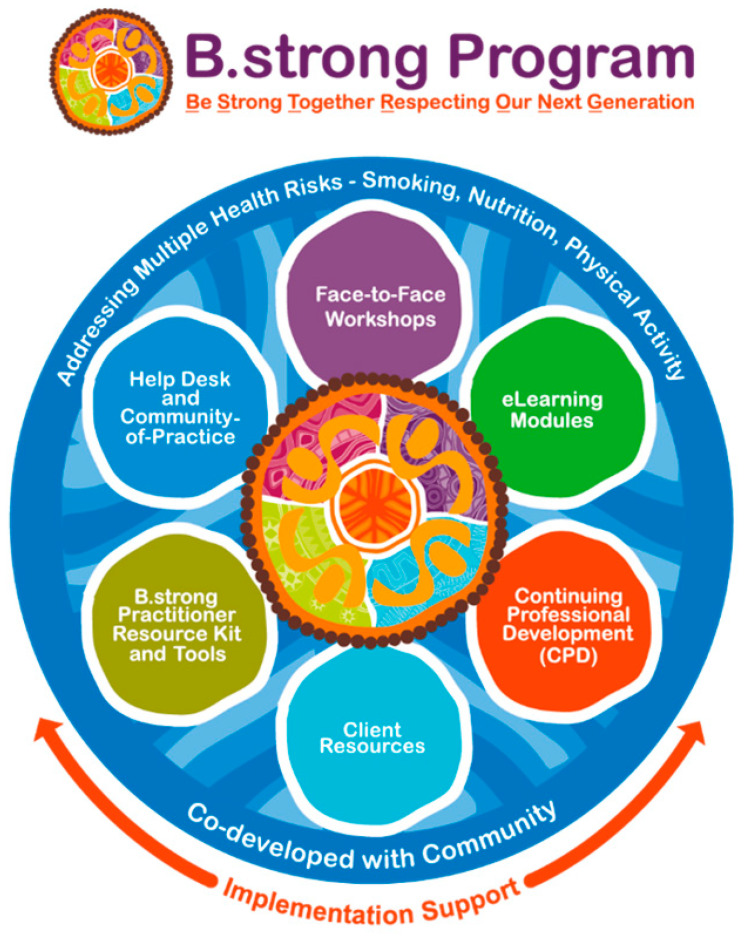
Queensland's B.strong brief intervention training program was a complex intervention developed for Aboriginal and Torres Strait Islander health workers to assist clients address multiple health risks of smoking, poor nutrition and physical inactivity. This study evaluates program effectiveness by applying the Kirkpatrick four-level evaluation model: (1) Reaction, participants' satisfaction; (2) Learning, changes in participants' knowledge, confidence, attitudes, skills and usual practice; (3) Behaviour, application of learning to practice; and (4) Results, outcomes resulting from training. A retrospective analysis was conducted on data for respondents completing pre-training, post-workshop and follow-up surveys. Changes in domains such as training participant knowledge, confidence, attitudes, and practices between survey times were assessed using paired-samples t-tests. From 2017-2019, B.strong trained 1150 health professionals, reaching targets for workshop and online training. Findings showed statistically significant improvements from baseline to follow-up in: participants' knowledge, confidence, and some attitudes to conducting brief interventions in each domain of smoking cessation, nutrition and physical activity; and in the frequency of participants providing client brief interventions in each of the three domains. There was a statistically significant improvement in frequency of participants providing brief interventions for multiple health behaviours at the same time from pre-workshop to follow-up. Indigenous Queenslander telephone counselling referrals for smoking cessation increased during the program period. B.strong improved practitioners' capacity to deliver brief interventions addressing multiple health risks with Indigenous clients.
Keywords: Indigenous; brief intervention; multiple health behaviours; nutrition; physical activity; primary health care; program evaluation; smoking; workforce development.
Conflict of interest statement
The authors declare no conflict of interest. The funder of the B.strong program had no role in the design of the study; in the collection, analyses or interpretation of data, in the writing of the manuscript, or in the decision to publish the results.
Figures
Similar articles
-
Impact of an Aboriginal and Torres Strait Islander brief intervention training program on health staff participants' own health behaviours: Smoking, nutrition and physical activity.Health Promot J Austr. 2022 Oct;33 Suppl 1:235-245. doi: 10.1002/hpja.628. Epub 2022 Jun 20. Health Promot J Austr. 2022. PMID: 35661321
-
Notes From the Field: Applying the Consolidated Framework for Implementation Research in a Qualitative Evaluation of Implementation of the Queensland Aboriginal and Torres Strait Islander Brief Intervention Training Program.Eval Health Prof. 2021 Dec;44(4):395-399. doi: 10.1177/0163278721992815. Epub 2021 Feb 8. Eval Health Prof. 2021. PMID: 33550836
-
Role of organisational factors on uptake and implementation of the B.strong brief intervention training program in Queensland Indigenous primary health care services.Health Promot J Austr. 2022 Jul;33(3):711-723. doi: 10.1002/hpja.542. Epub 2021 Sep 26. Health Promot J Austr. 2022. PMID: 34543494
-
Perceived impact of the characteristics of the Indigenous Queensland B.strong brief intervention training program on uptake and implementation.Health Promot J Austr. 2022 Jan;33(1):245-256. doi: 10.1002/hpja.477. Epub 2021 Mar 29. Health Promot J Austr. 2022. PMID: 33713377 Review.
-
Achieving cultural safety for Australia's First Peoples: a review of the Australian Health Practitioner Regulation Agency-registered health practitioners' Codes of Conduct and Codes of Ethics.Aust Health Rev. 2021 Aug;45(4):398-406. doi: 10.1071/AH20215. Aust Health Rev. 2021. PMID: 33844959 Review.
References
-
- Van der Sterren A., Greenhalgh E.M., Hanley-Jones S., Knoche D., Winstanley M.H. Chapter 8.3, Prevalence of Tobacco Use among Aboriginal and Torres Strait Islander Peoples. In: Greenhalgh E.M., Scollo M.M., Winstanley M.H., editors. Tobacco in Australia: Facts and Issues. Cancer Council Victoria; Melbourne, Australia: 2020. [(accessed on 18 December 2020)]. Available online: http://www.tobaccoinaustralia.org.au/chapter-8-aptsi/8-3-prevalence-of-t....
-
- Australian Bureau of Statistics . Estimates of Aboriginal and Torres Strait Islander Australians. ABS; Canberra, Australia: 2018.
-
- Australian Bureau of Statistics . Life Tables for Aboriginal and Torres Strait Islander Australians, 2015–2017. Australian Bureau of Statistics; Canberra, Australia: 2018. Catalog No: 3302.0.55.003.
-
- Australian Indigenous HealthInfoNet Overview of Aboriginal and Torres Strait Islander Health Status. [(accessed on 3 March 2021)];2019 Available online: https://healthinfonet.ecu.edu.au/learn/health-facts/overview-aboriginal-....
-
- Queensland Health . Report of the Chief Health Officer Queensland. Queensland Government; Brisbane, Australia: 2018. The Health of Queenslanders 2018.
Publication types
MeSH terms
LinkOut - more resources
Full Text Sources
Other Literature Sources
